InkContemporary Chinese Art
 Contemporary
 194.0 x 193.0 cm
 Today Art Museum
Hand-painted oil on canvas in your size and frame, made to order by our artists. ( Switch to Print Switch to Digital Image)





























Pick from our preset sizes that match the artwork's original proportions.

You may enter your own dimensions to fit a specific frame or space. If your selected size does not match the original image's proportions, we will either crop the artwork or extend the painting with additional hand-painted elements. A digital mockup will be sent for your approval before production begins.
Please note that the on-screen preview does not reflect the actual cropping or extension. Only the mockup will accurately show the final composition.
While custom sizes are available, we recommend selecting a dimension from the predefined list to preserve the original proportions.
Worldwide Delivery () in 3/4 weeks instead of standard 5 weeks. (12 September). No compromise on quality.


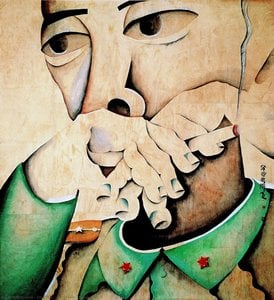
China Diary, No.54
Reproduction Size
Zhu Wei’s “China Diary, No.54” is more than just a depiction of a bull; it's an immersion into the heart of Chinese artistic tradition, rendered with a contemporary sensibility that speaks volumes about its time. Measuring 194 x 193 cm, this large-scale artwork immediately commands attention with its bold color palette – vibrant greens juxtaposed against meticulously crafted details of a powerfully rendered bull. The composition, largely symmetrical and anchored by traditional red seals at each corner, evokes a sense of ancient ritual and deliberate balance, hallmarks of Chinese painting’s enduring legacy.
Born in Beijing in 1966, Zhu Wei is a pivotal figure in contemporary Chinese art. His artistic journey began within the People's Liberation Army Art Academy following military service, an experience that shaped his understanding of state-sponsored art – a crucial context for interpreting his work. Emerging from the period following Tiananmen Square, Zhu Wei’s art subtly engages with political and social themes, demonstrating a remarkable continuity with traditional Chinese painting while offering a critical perspective on its historical evolution. The inclusion of seals, integral to Chinese artistic practice, further amplifies this symbolic engagement.
The meticulous detail in “China Diary, No.54” is immediately striking. Sharp lines define the bull’s musculature and horns, while rounded forms – its body, legs, and horns – are rendered with a confident hand. The texture achieved through layering and brushwork adds a tactile quality, inviting close observation. The use of color isn't merely decorative; it serves to enhance the symbolic power of the image, drawing attention to key elements and reinforcing the overall impression of strength and tradition. The placement of the red seals, often carrying auspicious meanings, further deepens the artwork’s narrative.
"China Diary, No.54" transcends a simple representation; it's an evocative piece that speaks to themes of cultural heritage, resilience, and the enduring power of symbolism. This hand-painted reproduction offers a unique opportunity to own a significant work by a leading contemporary Chinese artist, perfect for collectors seeking pieces with historical depth and artistic merit. Its scale makes it ideal for grand spaces, while the vibrant colors and powerful imagery will undoubtedly become a focal point within any interior design scheme.
Born in Beijing, China, in 1966, Zhu Wei is a prominent contemporary Chinese artist recognized for his subtly critical engagement with politics and society within the rapidly evolving landscape of modern China. He stands as one of the most visible practitioners of post-Tiananmen era art, demonstrating a remarkable fidelity to traditional Chinese painting while simultaneously offering a nuanced commentary on its historical context.
Zhu Wei occupies a crucial position within contemporary Chinese art. As an artist emerging in the aftermath of Tiananmen Square, his work reflects a complex negotiation between tradition and modernity, state control and individual expression. His subtle critique of political and social structures, delivered through the lens of classical Chinese painting, offers a unique perspective on China's rapid transformation. He demonstrates that traditional artistic forms can be powerfully adapted to address contemporary concerns, solidifying his legacy as a vital voice in global art discourse.

1966 - , China

Master the nuances of Giclée printing with our expert guide. Discover how pigment-based inks and museum-grade substrates create fade-resistant, high-fidelity art reproductions designed for discerning collectors seeking unparalleled quality and longevity.
Embark on a sophisticated exploration of ink wash painting and Sumi-e. Uncover the profound historical lineages, Zen philosophies, and technical mastery behind this timeless medium in our authoritative guide for fine art enthusiasts.
Embark on a profound journey through the soul of Chinese calligraphy. Explore the historical mastery of ink, brush, and script, from ancient Zhuanshu to elegant running script, and discover how this timeless art form reflects the enduring spirit of classical East Asian aesthetics.

Embark on a scholarly journey through the alchemy of lithography. This definitive guide offers collectors profound insights into the chemical mastery of stone and ink, the medium's historical legacy, and essential expertise for acquiring rare, museum-quality prints with absolute confidence.
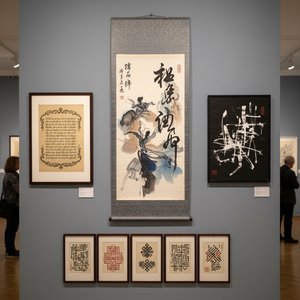
Explore the profound beauty of calligraphy art. From the fluid running script of Chinese masters to historical ink masterpieces, discover how the elegance of line transforms spaces with timeless grace and scholarly sophistication.

 Preview
 Send
Send Share
Share
 Details

 Download
 Similars
 X-Ray
X-Ray Diaporama
 Stats
Stats Read More







 Glass option is only available in size under 110 CM