
x


 Traditional Chinese Art
 95.0 x 23.0 cm
Hand-painted oil on canvas in your size and frame, made to order by our artists. ( Buy Print Buy Image)





























Pick from our preset sizes that match the artwork's original proportions.

You may enter your own dimensions to fit a specific frame or space. If your selected size does not match the original image's proportions, we will either crop the artwork or extend the painting with additional hand-painted elements. A digital mockup will be sent for your approval before production begins.
Please note that the on-screen preview does not reflect the actual cropping or extension. Only the mockup will accurately show the final composition.
While custom sizes are available, we recommend selecting a dimension from the predefined list to preserve the original proportions.
Worldwide Delivery () in 3/4 weeks instead of standard 5 weeks. (28 August). No compromise on quality.


CALLIGRAPHY IN REGULAR SCRIPT
Reproduction Size

In the grand tapestry of the Qing Dynasty, few figures embodied the harmonious union of scholarly elegance and political fortitude as profoundly as Zhang Zhiwan. Born in 1811 into a distinguished gentry family in Nanpi, Jiangsu Province, his early years were steeped in the rich traditions of Confucian scholarship. As the son of Zhang Yuce, an official in Zhili, Zhiwan was raised within the upper echelons of Chinese intellectual life, a background that provided him with the classical foundation necessary to ascend the imperial ranks. His journey through the rigorous imperial examination system culminated in his achievement of the Jinshi degree, one of the highest academic honors in the empire, which subsequently secured his prestigious position within the Hanlin Academy.
The life of Zhang Zhiwan was not merely defined by the quiet contemplation of scrolls, but by the turbulent winds of a changing China. His career unfolded against the backdrop of immense social upheaval, most notably during the Taiping Rebellion. Serving as an advisor to the Qing court and working under the military command of Sengge Rinchen, he demonstrated a rare capacity for strategic leadership. Whether suppressing the Nian rebellion in Nanyang or managing the complex defenses of northern Jiangsu, Zhiwan navigated the chaos of war with the same precision he applied to his brushwork. His ascent through the administrative ranks—serving as Governor of Shanxi and later as Viceroy of several vital provinces—marked him as a statesman of immense influence, a man capable of maintaining imperial stability during one of China's most precarious eras.
While history remembers him as a formidable minister and a member of the Grand Council, the art world celebrates Zhang Zhiwan as a master of the shan shui tradition. His artistic practice was an extension of his philosophical life, deeply rooted in Daoist principles of harmony and the interconnectedness of all living things. In his landscape paintings, one finds a breathtaking synthesis of meticulous observation and poetic imagination. He did not merely seek to replicate the physical world but to capture its spiritual essence through subtle tonal gradations and evocative compositions that invite the viewer into a meditative state.
His mastery extended equally to the art of calligraphy, where his command of the regular script showcased a disciplined yet fluid energy. The rhythmic flow of his ink work reflected the structured elegance of his administrative life, yet it remained imbued with a profound emotional depth. In his hands, the brush became a tool for expressing the cosmic balance between strength and softness, much like the balance he sought to maintain in the governance of provinces. His works are characterized by:
The passing of Zhang Zhiwan in 1897 marked the end of an era for both the Qing administration and the classical literati tradition. As a cousin to the prominent politician Zhang Zhidong, he was part of a powerful intellectual lineage that shaped the late imperial period. His ability to hold high-ranking positions, such as the Secretary of the Grand Secretariat and the Grand Secretary of the Eastern Library, speaks to a lifetime of service that bridged the gap between the scholarly pursuit of beauty and the heavy responsibilities of statecraft.
Today, the works of Zhang Zhiwan serve as vital windows into the aesthetic and political soul of 19th-century China. His landscapes are more than mere depictions of nature; they are reflections of a scholar-official's attempt to find permanence and peace amidst the shifting tides of history. Through his enduring legacy in ink and stone, he remains a pivotal figure whose artistic sensitivity continues to resonate with those who seek the profound beauty found in the balance of nature and the discipline of the human spirit.

1810 - 1897

Embark on a profound journey through the soul of Chinese calligraphy. Explore the historical mastery of ink, brush, and script, from ancient Zhuanshu to elegant running script, and discover how this timeless art form reflects the enduring spirit of classical East Asian aesthetics.
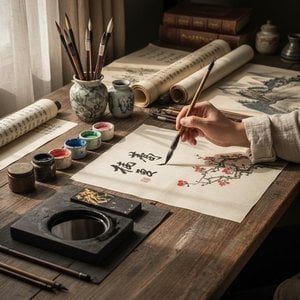
Embark on a sophisticated exploration of ink wash painting and Sumi-e. Uncover the profound historical lineages, Zen philosophies, and technical mastery behind this timeless medium in our authoritative guide for fine art enthusiasts.
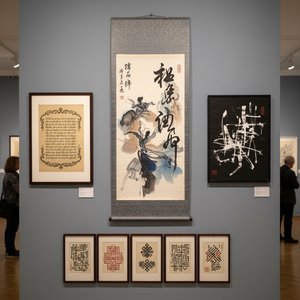
Explore the profound beauty of calligraphy art. From the fluid running script of Chinese masters to historical ink masterpieces, discover how the elegance of line transforms spaces with timeless grace and scholarly sophistication.

Transform your modern portraits into timeless Asian heritage masterpieces. Using AI-driven style transformation and master-level hand-painted oil techniques, WahooArt turns your memories into exquisite, museum-quality legacies of cultural artistry.


Stay updated with the latest art news, exclusive offers, and decoration ideas.
Tell us about your project and our art experts will provide you with 3 personalized art suggestions.
Let Us Curate 3 Options Just for You - Free!

 Preview
 Send
Send Share
Share
 Details

 Download
 Similars
 X-Ray
X-Ray Diaporama
 Read More







 Glass option is only available in size under 110 CM


