x


Museum-quality giclée or canvas print with fast production and flexible finish options. ( Buy Hand Made Painting Buy Image)
Pick from our preset sizes that match the artwork's original proportions.

You may enter your own dimensions to fit a specific frame or space. If your selected size does not match the original image's proportions, we will either crop the artwork or extend the image with a mirrored or solid-fill edge. A digital mockup will be sent for your approval before production begins.
Please note that the on-screen preview does not reflect the actual cropping or extension. Only the mockup will accurately show the final composition.
While custom sizes are available, we recommend selecting a dimension from the predefined list to preserve the original proportions.
Worldwide Delivery () in 2 weeks instead of standard 4/5 weeks. (5 September)


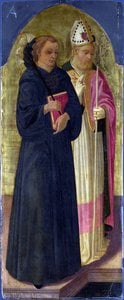
Saint Mark and Saint Augustine
Reproduction Size

In the vibrant, sun-drenched landscape of the Italian Renaissance, few artists captured the quiet intensity of spiritual devotion as delicately as Zanobi Machiavelli. Born around 1418 in the storied city of Pisa, Machiavelli emerged as a painter whose brushwork served as a bridge between the meticulous traditions of the late Middle Ages and the burgeoning humanism of the Florentine Quattrocento. While his historical footprint remains somewhat enigmatic, his presence is felt through the profound stillness and luminous clarity of his religious panels. He was an artist of focused purpose, dedicating much of his career to the creation of sacred imagery that invited the faithful into a deeper communion with the divine.
The foundations of Machiavelli’s aesthetic were laid in the workshops of Florence, where he is believed to have been a pupil of the celebrated Benozzo Gozzoli. This apprenticeship was transformative; from Gozzoli, Machiavelli inherited a profound appreciation for ornamental detail and a sophisticated command of color harmony. His style also bears the subtle, enduring echoes of masters like Filippo Lippi and Pesellino, as well as the monumental realism of Masaccio. By blending these influences, he developed a technique characterized by bright, clear palettes and a masterful use of defined shadows to sculpt figures within a believable, three-dimensional space. This ability to render anatomical accuracy alongside the soft, flowing drapery of saints allowed him to breathe life into the icons of his era.
The zenith of Machiavelli’s career is inextricably linked to the prestigious patronage of the Medici family. His most significant contribution to the visual landscape of Florence was his involvement in the ambitious decoration of the Badia Fiesolana chapel. Tasked with creating a monumental altarpiece for this sacred site, Machiavelli produced works that showcased his ability to weave complex theological narratives into single, breathtaking compositions. These paintings, featuring figures such as Saint Nicholas of Tolentino and Saint John the Baptist, were not merely decorations but spiritual instruments designed to inspire awe and contemplation.
Beyond the walls of the Badia, Machiavelli’s artistry reached across borders, leaving a trail of masterpieces that continue to captivate modern audiences. His works are celebrated for several defining characteristics:
As the 15th century progressed, Machiavelli’s activity moved toward Pisa, where he eventually passed away in 1479. Though his life ended far from the initial heights of Florentine fame, his artistic legacy remains preserved in some of the world's most esteemed institutions, including the National Gallery in London. Through his devotion to detail and his reverence for the sacred, Zanobi Machiavelli ensured that the spiritual fervor of the Renaissance would be etched permanently into the history of Western art.

1418 - 1479


Stay updated with the latest art news, exclusive offers, and decoration ideas.
Tell us about your project and our art experts will provide you with 3 personalized art suggestions.
Let Us Curate 3 Options Just for You - Free!

 Preview
 Send
Send Share
Share
 Details

 Download
 Similars
 X-Ray
X-Ray Diaporama
 Read More




































 Glass option is only available in size under 110 CM