
x


 2000
2000 32.0 x 23.0 cm
 Power Station of Art
Hand-painted oil on canvas in your size and frame, made to order by our artists. ( Buy Print Buy Image)
Pick from our preset sizes that match the artwork's original proportions.

You may enter your own dimensions to fit a specific frame or space. If your selected size does not match the original image's proportions, we will either crop the artwork or extend the painting with additional hand-painted elements. A digital mockup will be sent for your approval before production begins.
Please note that the on-screen preview does not reflect the actual cropping or extension. Only the mockup will accurately show the final composition.
While custom sizes are available, we recommend selecting a dimension from the predefined list to preserve the original proportions.
Worldwide Delivery () in 3/4 weeks instead of standard 5 weeks. (28 August). No compromise on quality.


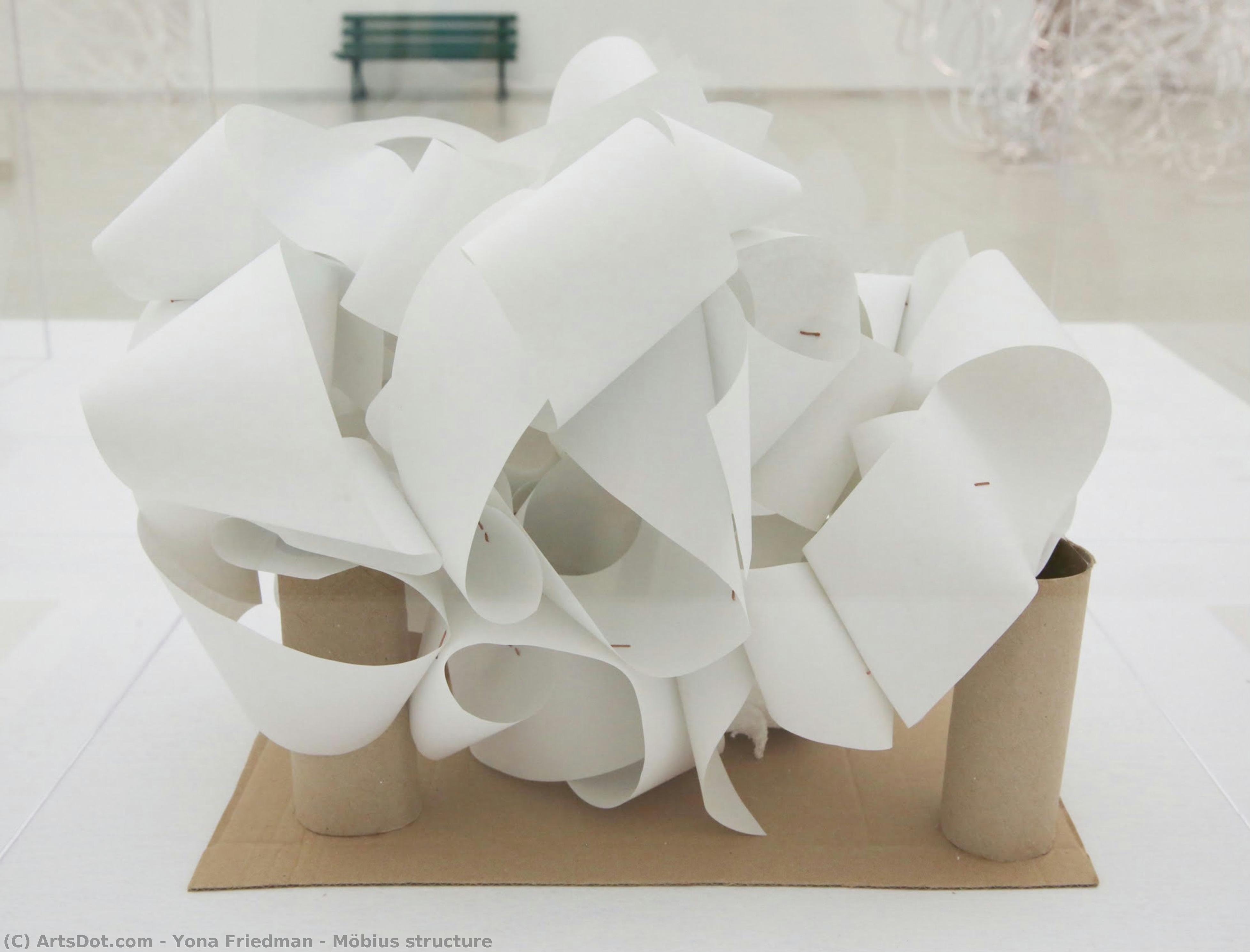
Möbius structure
Reproduction Size

Yona Friedman (1923–2020) was far more than a mere designer of structures; he was a visionary who sought to rewrite the very DNA of urban existence. Born in Budapest, Hungary, into a Jewish family navigating the rising tides of antisemitism and Nazi occupation, Friedman’s early life was defined by a profound sense of displacement and survival. This lived experience of instability—of witnessing the fragility of borders and the suddenness of upheaval—became the silent engine behind his most radical architectural theories. After escaping the horrors of the Second World and studying at the Technische Universität Wien, he embarked on a nomadic intellectual journey that would eventually lead him to Israel and, ultimately, to Paris. It was this very movement between cultures and geographies that allowed him to view the city not as a collection of static monuments, but as a living, breathing organism.
The true genesis of Friedman’s legacy arrived in 1956 with his provocative manifesto, Mobile Architecture. At a time when modernism was often synonymous with rigid, monumental permanence, Friedman proposed something startlingly different: an architecture of flux. He envisioned cities as dynamic systems capable of expanding, contracting, and evolving alongside the needs of their inhabitants. Drawing inspiration from the principles of Gestural psychology and complex mathematical geometries, he imagined "spatial networks" that could grow outward like a living web. His concept of the Ville Spatiale (Spatial City) challenged the traditional authority of the urban planner, suggesting instead that the infrastructure should be a permanent, adaptable framework upon which individuals could freely layer their own lives, homes, and desires.
Friedman’s work occupied a unique, shimmering space between architectural practice, social theory, and fine art. He was an uncompromising realist who used the language of utopia to address the very real problems of housing shortages and social mobility. His projects, such as the Möbius structure and various Container structures, were not merely blueprints for buildings but explorations of freedom. He believed that the inhabitants themselves should be the primary architects of their domestic reality. In his most daring thought experiments, he envisioned a world where construction workers might model exteriors based on personal preference, while the interior spaces remained an open canvas for the occupants to design and inhabit according to their own whims.
This philosophy of "mobility of living" resonated deeply with the cultural zeitgeist of the 1960s, particularly within the radical circles of Team 10. His ideas contributed significantly to the "Age of Megastructures," a period characterized by an obsession with large-scale, interconnected urban systems. Through his intricate drawings and diagrams, Friedman translated complex mathematical concepts into visceral spatial experiences. He saw no distinction between the technical precision of engineering and the poetic potential of art; for him, a bridge or a grid was a tool for liberation, a way to provide stability to the displaced while maintaining the liberty of the individual.
Throughout his long and storied career, Friedman remained a provocateur, never settling into the comfortable stagnation of established dogma. His ability to bridge the gap between the theoretical and the tangible earned him prestigious recognition, including the Austrian Frederick Kiesler Prize for Architecture and the Arts in 2018. Even as his projects often remained unrealized—existing as beautiful, haunting parabolas of what might be—their impact on the trajectory of modern urbanism was indelible.
The historical significance of Yona Friedman lies in his refusal to accept the city as a finished product. He taught us to view the urban landscape as an ongoing conversation between infrastructure and humanity. His life’s work serves as a profound reminder that architecture is not merely about sheltering bodies, but about fostering the autonomy of the human spirit. In an era of increasing urbanization and environmental uncertainty, his dreams of a flexible, adaptable, and deeply human-centric world continue to haunt and inspire the architects of our future.

1923 - 2020 , Hungary


Stay updated with the latest art news, exclusive offers, and decoration ideas.
Tell us about your project and our art experts will provide you with 3 personalized art suggestions.
Let Us Curate 3 Options Just for You - Free!

 Preview
 Send
Send Share
Share
 Details

 Download
 Similars
 X-Ray
X-Ray Diaporama
 Read More




































 Glass option is only available in size under 110 CM


