Museum-quality giclée or canvas print with fast production and flexible finish options. ( Buy Hand Made Painting Switch to Digital Image)





























Pick from our preset sizes that match the artwork's original proportions.

You may enter your own dimensions to fit a specific frame or space. If your selected size does not match the original image's proportions, we will either crop the artwork or extend the image with a mirrored or solid-fill edge. A digital mockup will be sent for your approval before production begins.
Please note that the on-screen preview does not reflect the actual cropping or extension. Only the mockup will accurately show the final composition.
While custom sizes are available, we recommend selecting a dimension from the predefined list to preserve the original proportions.
Worldwide Delivery () in 2 weeks instead of standard 4/5 weeks. (13 September)


Paddling at Dusk
Reproduction Size
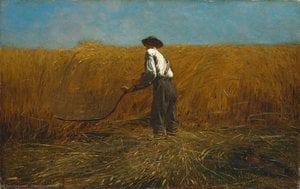
Winslow Homer's "Paddling at Dusk," painted in 1892, isn’t merely a depiction of a man and his canoe; it’s an immersion into a profound sense of tranquility. Housed within the Memorial Art Gallery of the University of Rochester, this watercolor captures a fleeting moment of perfect harmony between humanity and nature. Homer, a pivotal figure in American art, masterfully utilizes light and shadow to evoke not just a visual scene, but a palpable feeling – one of quiet contemplation and peaceful surrender to the beauty of the natural world.

Homer's signature style is immediately apparent in "Paddling at Dusk." He employs a loose, expressive watercolor technique, allowing the colors to bleed and blend naturally. The sky isn’t rendered with rigid lines but rather as a swirling mass of blues, purples, and greys – a dramatic backdrop that mirrors the subtle shifts in tone reflected on the water's surface. Notice how he builds up layers of color, creating depth and luminosity. The canoe itself is suggested through carefully placed washes of dark pigment, emphasizing its form without overwhelming the scene. The composition is remarkably simple yet powerfully effective; the central figure of the paddler draws the eye immediately, while the expansive sky and water create a sense of limitless space.
To understand "Paddling at Dusk," it’s crucial to consider Winslow Homer's broader artistic vision. Born in Boston in 1836, Homer rejected the formal training prevalent in Europe and instead developed his unique style through direct observation of America – its landscapes, its people, and its everyday life. His early work as a commercial illustrator honed his ability to capture detail with remarkable precision, skills he later applied to his paintings. "Paddling at Dusk" embodies this American realism, portraying a scene rooted in the familiar rhythms of rural New England. The solitary figure on the water speaks to themes of self-reliance and connection with nature – values deeply ingrained in the American ethos.
Beyond its technical brilliance, "Paddling at Dusk" resonates with a profound emotional depth. The act of paddling itself suggests a deliberate slowing down, a conscious choice to disconnect from the demands of daily life and immerse oneself in the present moment. The sunset symbolizes transition – the end of one day and the promise of another. The quiet solitude of the scene invites contemplation and introspection. Homer doesn’t offer a narrative; he simply presents a feeling—a sense of peace, serenity, and perhaps even a touch of melancholy. It's a reminder to appreciate the simple beauty that surrounds us, often overlooked in the hustle and bustle of modern life.
Interested in exploring more of Winslow Homer’s captivating works? His other celebrated paintings include "Sunrise," “Fishing in the Adirondacks,” and “On the Trail.” You can delve deeper into his life and artistic journey through resources like the Winslow Homer Foundation website (https://www.winslowhomerdotorg.com/) and online collections such as those at the Fine Arts Museums of San Francisco and the National Gallery of Art. For a fascinating look into his early career, consider researching Henry William Brewer and Arthur Boyd Houghton, influential artists who shaped the landscape of 19th-century illustration.


1836 - 1910 , United States of America

Discover the ethereal beauty of watercolor through an art-historical lens. Master the delicate balance of light, fluidity, and pigment to capture the luminous essence of nature, inspired by the legendary techniques of the Old Masters and Impressionist greats.

Embark on a visual journey through the golden hour. Discover how master painters capture the ethereal glow of sunsets, from Monet's Impressionism to the Hudson River School. Explore timeless techniques and bring the magic of twilight into your home with exquisite fine art reproductions.

Discover the ethereal beauty of premium watercolor reproductions and bespoke commissions at WahooArt. From museum-quality landscapes to custom AI-enhanced portraits, our master artists deliver unparalleled craftsmanship and white-glove service for discerning collectors worldwide.

An expert guide for art collectors exploring the chemistry and artistry of oil, acrylic, tempera, and watercolor. Discover how medium specificity and material integrity define the longevity and value of fine art masterpieces.

 Preview
 Send
Send Share
Share
 Details

 Download
 Similars
 X-Ray
X-Ray Diaporama
 Stats
Stats

 Read More







 Glass option is only available in size under 110 CM