Museum-quality giclée or canvas print with fast production and flexible finish options. ( Buy Hand Made Painting Switch to Digital Image)





























Pick from our preset sizes that match the artwork's original proportions.

You may enter your own dimensions to fit a specific frame or space. If your selected size does not match the original image's proportions, we will either crop the artwork or extend the image with a mirrored or solid-fill edge. A digital mockup will be sent for your approval before production begins.
Please note that the on-screen preview does not reflect the actual cropping or extension. Only the mockup will accurately show the final composition.
While custom sizes are available, we recommend selecting a dimension from the predefined list to preserve the original proportions.
Worldwide Delivery () in 2 weeks instead of standard 4/5 weeks. (14 September)


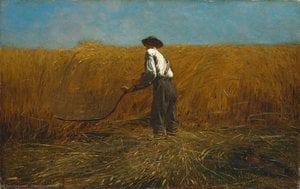
Farmer with a Pitchfork
Reproduction Size
Winslow Homer (1836 – 1910), an artist who defied convention and forged his own path to artistic greatness, remains one of America's most beloved painters. Unlike many of his peers who pursued formal training in Europe, Homer cultivated a singular vision—a deeply rooted connection to the American landscape and its inhabitants—resulting in works that resonate with enduring power.
"The Pitchfork," completed in 1865, exemplifies this distinctive approach. Painted shortly after the Civil War’s conclusion, it depicts a solitary man standing amidst tall grass, clutching a pitchfork – an instrument of labor and sustenance – against a backdrop of muted blues and greens.
Homer favored watercolor as his primary medium. This technique allowed for remarkable subtlety and luminosity, capturing the ephemeral qualities of light and atmosphere with unparalleled grace. Unlike oil paints which build up layers of pigment, watercolor relies on transparent washes that blend seamlessly together, creating an image that feels both immediate and deeply contemplative.
The artist’s meticulous observation is evident in every detail—the texture of the grass, the posture of the man, even the slight curve of his hat. Homer employed a loose brushstroke style, prioritizing tonal harmony over precise delineation. This deliberate choice contributes to the painting's overall sense of tranquility and understated emotion.
“The Pitchfork” emerged from a period marked by profound social upheaval. The Civil War had irrevocably altered the fabric of American life, leaving scars of loss and division. Homer’s depiction of rural America—a scene of quiet resilience amidst devastation—can be interpreted as a symbolic affirmation of enduring values: perseverance, connection to the land, and the promise of renewal.
The painting wasn't merely documenting a moment in time; it was responding to it. Homer sought to convey not just what he *saw*, but also what he *felt*—a quiet dignity born from confronting hardship with unwavering resolve.
The pitchfork itself is laden with symbolic significance. Representing agricultural labor, it symbolizes the fundamental human need for sustenance and productivity. Yet, in Homer’s hands, it transcends its literal function to become a symbol of hope—a tool poised to cultivate new beginnings from the ashes of old.
"The Pitchfork" invites viewers to contemplate themes of vulnerability, fortitude, and the beauty inherent in simplicity. Its muted palette reinforces this emotional resonance, fostering a feeling of contemplative stillness. It’s a painting that speaks not to the intellect alone, but directly to the soul—a testament to Homer's ability to transform observation into profound artistic expression.
Winslow Homer’s “The Pitchfork” stands as an enduring emblem of American art. Its masterful technique, evocative symbolism, and poignant historical context continue to captivate audiences today. More than just a depiction of a rural scene, it's a meditation on the human spirit—a reminder that even in times of darkness, beauty and resilience can flourish.


1836 - 1910 , United States of America

Explore the profound beauty of American Realism. From Winslow Homer’s rural landscapes to the dignity of everyday life, discover how master artists captured the soul of a nation through evocative oil paintings and timeless fine art techniques.

Explore the profound beauty of American Regionalism. Delve into the art history of Grant Wood and John Steuart Curry, uncovering how these masters captured the soul of the American Heartland through iconic landscapes and rural identity.

 Preview
 Send
Send Share
Share
 Details

 Download
 Similars
 X-Ray
X-Ray Diaporama
 Stats
Stats

 Read More







 Glass option is only available in size under 110 CM


![Indian Tobacco Shop Sign [reverse, Indian Facing Right] — Winslow Homer, Contemporary Realism](/media/artworks/images-thumb/74/22/7422432cafc295265ef3b7f7fa62d35d.jpg)