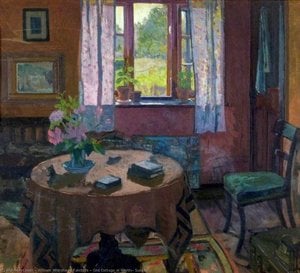
A Life Defined by Quiet Devotion
In the vibrant, often turbulent tapestry of early twentieth-century British art, certain names resonate with thunderous fame, while others whisper with a more profound, enduring grace. William Whitehead Ratcliffe belongs to that latter, more intimate category. A pioneer of the Camden Town Group, Ratcliffe was an artist whose life was characterized by a steadfast commitment to his craft, far removed from the pursuit of fleeting celebrity. Born on October 6th, 1870, in the tranquil village of Clenchwarton near Kings Lynn, Norfolk, his journey began in the modest surroundings of a draper’s assistant's family. Though his early years took him to the industrial landscape of Gorton, Manchester, the seeds of his artistic soul were sown through a disciplined pursuit of beauty and design.
Ratcliffe’s path was never one of sudden inspiration, but rather a gradual, deliberate unfolding of talent. While working as a clerk for a cotton merchant, he sought out evening classes at the Manchester School of Art. It was here that he encountered the influential Walter Crane, a master of the decorative arts who instilled in Ratcliffe a lifelong appreciation for the harmony between pattern and landscape. This early training in wallpaper design, gained while working for the Wallpaper Manufacturers’ Combine, would later manifest in his paintings as a unique sensitivity to texture, rhythm, and the quiet elegance of domestic objects.
The Crucible of Creativity: London and Letchworth
The turn of the century brought Ratcliffe to London, a move that would irrevocably alter the trajectory of his life. Drawn to the utopian ideals of the Garden City Movement, he settled in Letchworth Garden City in 1906. This experimental community became more than just a residence; it became a sanctuary for artistic experimentation and fellowship. It was within this setting that Ratcliffe formed a vital artistic circle alongside Harold Gilman and Richard Barry Parker. Under the mentorship and spirited encouragement of Gilman, Ratcliffe underwent a profound metamorphosis, turning his back on the commercial world of illustration to embrace the rigorous and rewarding pursuit of fine art.
Seeking to deepen his technical mastery, Ratcliffe enrolled at the Slade School of Fine Art in London. Studying under figures such as Frank Dobson, he refined his understanding of form and composition, blending the decorative sensibilities of his youth with a burgeoning interest in the immediacy of modern life. This period of formal education provided the structural foundation upon which he would build his most evocative works, allowing him to bridge the gap between the structured world of design and the fluid, emotive realm of painting.
A Legacy of Stillness and Light
The work of William Whitehead Ratcliffe is often characterized by a remarkable ability to find the extraordinary within the ordinary. As a member of the Camden Town Group, he shared their dedication to capturing the vibrancy of everyday existence, yet his approach often leaned toward a more contemplative, almost spiritual, stillness. His landscapes and interiors are not merely depictions of places, but explorations of atmosphere and emotion.
Consider the following hallmarks of his enduring artistic contribution:
- The Poetics of the Interior: In masterpieces such as Attic Room (1918), Ratcliffe transforms a simple domestic setting into a realm of profound solitude. Through the masterful use of soft, natural light filtering through eaves, he breathes life into humble objects—a bed, a chair, a solitary vase—creating a narrative of quiet companionship and peace.
- Landscape as Emotion: His depictions of the English countryside, such as Reflections, Ickleford, utilize Impressionistic brushwork to capture the tranquil beauty of rural life, emphasizing the tactile quality of the landscape.
- Architectural Essence: In works like Totnes, Devon (1931), he demonstrates a keen eye for the structural character of towns, capturing the idyllic harmony between architecture and the natural world.
Though he may not have shared the widespread fame of his contemporary Harold Gilman, Ratcliffe’s significance lies in his unwavering authenticity. He remained a full-time artist throughout his life, supported by the very community and family ties that nurtured his early growth. When he passed away in January 1955, he left behind a body of work that serves as a poignant reminder of the beauty found in the quiet corners of the world—a testament to an artist who found greatness not in the spotlight, but in the gentle rhythm of a life lived through art.



 Preview
 Switch to Print
 Send
Send Share
Share
 Details
 Guide
Guide

 Download
 Similars
 X-Ray
X-Ray Diaporama
 Q&A
Q&A Stats
Stats

 Read More






































 Glass option is only available in size under 110 CM