
Preview AR preview Switch to Print Switch to Digital Image Send
Details Guide Add to favorites Download Similars X-Ray Diaporama Stats

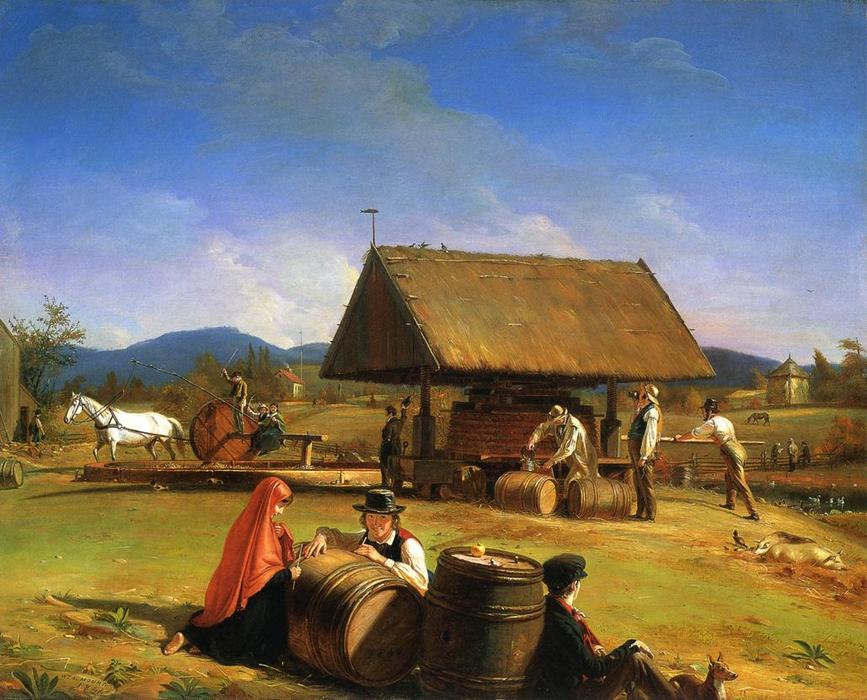
Cider Making

Experience Luminism's soft light in William Sidney Mount's 1841 Cider Making, a beautiful genre scene capturing rural American life; discover this pastoral masterpiece today.

Discover William Sidney Mount (1807-1868), a pioneering American genre painter celebrated for his realistic depictions of rural Long Island life, dance, and everyday moments.

Hand Made Oil Reproduction

Hand-painted oil on canvas in your size and frame, made to order by our artists. ( Switch to Print Switch to Digital Image)

Corner sample of the P118B picture frame: moulded polystyrene, 5 cm wide and 3 cm thick
P118B $10
Corner sample of the P118H picture frame: moulded polystyrene, 5 cm wide and 3 cm thick
P118H $10
Corner sample of the P118W picture frame: moulded polystyrene, 5 cm wide and 3 cm thick
P118W $10
Corner sample of the P438Z picture frame: moulded polystyrene, 5.5 cm wide and 3.5 cm thick
P438Z $10
Corner sample of the P508JH picture frame: moulded polystyrene, 7 cm wide and 3.5 cm thick
P508JH $12
Corner sample of the P508YH picture frame: moulded polystyrene, 7 cm wide and 3.5 cm thick
P508YH $12
Corner sample of the P805H picture frame: moulded polystyrene, 5 cm wide and 3.5 cm thick
P805H $10
Corner sample of the P805Z picture frame: moulded polystyrene, 5 cm wide and 3.5 cm thick
P805Z $10
Corner sample of the P919BZ picture frame: moulded polystyrene, 7 cm wide and 3.5 cm thick
P919BZ $10
Corner sample of the P919G picture frame: moulded polystyrene, 7 cm wide and 3.5 cm thick
P919G $10
Corner sample of the P919XJ picture frame: moulded polystyrene, 7 cm wide and 3.5 cm thick
P919XJ $10
Corner sample of the P959ZH picture frame: moulded polystyrene, 5 cm wide and 3 cm thick
P959ZH $10
Corner sample of the P968JZ picture frame: moulded polystyrene, 6 cm wide and 4 cm thick
P968JZ $12
Corner sample of the W106C picture frame: solid wood, 5 cm wide and 3 cm thick
W106C $8
Corner sample of the W218G picture frame: solid wood, 5 cm wide and 3 cm thick
W218G $10
Corner sample of the W218JH picture frame: solid wood, 5 cm wide and 3 cm thick
W218JH $8
Corner sample of the W218Y picture frame: solid wood, 5 cm wide and 3 cm thick
W218Y $10
Corner sample of the W307PJ picture frame: solid wood, 6 cm wide and 3 cm thick
W307PJ $10
Corner sample of the W316G picture frame: solid wood, 6 cm wide and 3 cm thick
W316G $10
Corner sample of the W316PJ picture frame: solid wood, 6 cm wide and 3 cm thick
W316PJ $8
Corner sample of the W316Y picture frame: solid wood, 6 cm wide and 3 cm thick
W316Y $10
Corner sample of the W398PJ picture frame: solid wood, 5 cm wide and 3 cm thick
W398PJ $8
Corner sample of the W4111J picture frame: solid wood, 6.5 cm wide and 3.5 cm thick
W4111J $10
Corner sample of the W500HY picture frame: solid wood, 7 cm wide and 5 cm thick
W500HY $15
Corner sample of the W500JH picture frame: solid wood, 7 cm wide and 5 cm thick
W500JH $15
Corner sample of the W692G picture frame: solid wood, 8 cm wide and 4 cm thick
W692G $12
Corner sample of the W849H picture frame: solid wood, 5 cm wide and 3 cm thick
W849H $8
Corner sample of the W940BG picture frame: solid wood, 7.5 cm wide and 4.5 cm thick
W940BG $15
Corner sample of the W953PJ picture frame: solid wood, 6 cm wide and 3.5 cm thick
W953PJ $8

Standard
custom
CM
INCH

Pick from our preset sizes that match the artwork's original proportions.

width
height

Type the width and the height you need, to fit your frame or your wall. This is hand-painted, so for a size with a different shape the artist can paint a bit more around the picture, or cut a bit — you choose. We send you a digital mockup to approve before the painting starts. The picture shown on this page does not show the real result — only the mockup does.

Examples of what can be changed: Replace face with customer photo; Add pet (e.g., replace cat with dog); Include hidden message in background; Change background landscape or elements.
After order, WahooArt.com team will email client for instructions and provide a mockup preview

Worldwide Delivery () in 3/4 weeks instead of standard 5 weeks. (22 October). No compromise on quality.

Free Worldwide Express Shipping
High-Quality Linen Canvas
Full Shipping Insurance
Customs Tax Refund Guarantee
True Color Matching Guarantee
100-Day Return Policy (Defects Only)
100% Money-Back Guarantee
Bulk Discount Offer

Total Price

$ 272

Cider Making

Reproduction Medium

Reproduction Size

-

Total Price

$ 272

Quick Facts

  • Location: Private Collection
  • Subject or theme: Rural Life
  • Artistic style: Realism
  • Title: Cider Making
  • Year: 1841

Art Quiz

There is only one correct answer for each question.

Question 1:
What genre of painting is William Sidney Mount considered a pioneer of?
Question 2:
The artwork 'Cider Making' primarily depicts scenes from which setting and time period?
Question 3:
Mount's artistic style, evident in 'Cider Making,' is closely associated with which art movement known for soft, diffused light?
Question 4:
Besides documenting daily labor, what deeper context did Mount subtly incorporate into 'Cider Making'?
Question 5:
What central object dominates the composition in 'Cider Making,' around which the figures are gathered?

A Pastoral Symphony: The Heart of American Genre Painting

In the quiet, sun-drenched landscapes of 19th-century Long Island, there existed a rhythm of life defined by the seasons and the steady pulse of manual labor. William Sidney Mount, a pioneer of American genre painting, possessed the rare ability to freeze these fleeting moments of communal harmony within the frame of a canvas. His masterpiece, Cider Making, is far more than a mere visual record of a seasonal chore; it is a vibrant, breathing tableau that invites the viewer into a world of shared purpose and rustic charm. As one gazes upon this work, the eye is immediately drawn to the central barrel, a focal point around which the community orbits. Men, women, and children are woven together in a tapestry of activity, their movements suggesting a seamless dance of cooperation. The scene captures the very essence of Luminism, where soft, diffused light bathes the field in a gentle glow, elevating a commonplace agricultural event into something approaching the divine.

The technical mastery displayed in this work lies in Mount’s meticulous attention to detail and his sophisticated use of light. Unlike the dramatic, often turbulent shadows found in European Romanticism, Mount employs a subtle, atmospheric approach that emphasizes clarity and tranquility. Each figure is rendered with a distinct personality, contributing to a sense of palpable atmosphere—a feeling of warmth, camaraderie, and the sweet, crisp scent of freshly pressed fruit. For the discerning collector or interior designer, this painting offers a profound sense of stability and peace. The composition, balanced and grounded by the presence of sturdy horses and the heavy wooden barrel, provides an anchor for any space, bringing with it an air of timelessness and a connection to the enduring spirit of the American landscape.

Hidden Narratives and Political Echoes

Beyond its surface beauty, Cider Making serves as a fascinating historical document, layered with subtle political symbolism that would have been keenly understood by contemporary viewers. While the painting celebrates the idyllic nature of rural life in Setauket, it also whispers of the intense political fervor surrounding the 1840 United States presidential election. Art historians have long speculated that Mount, a man deeply embedded in his local community, may have used the figures within this social gathering to represent various political candidates. This layer of subtext transforms the painting from a simple pastoral scene into a sophisticated commentary on the democratic process and the way national politics permeate even the most remote corners of the country. The cider mill becomes a stage where the pulse of a nation is felt through the interactions of its people.

This duality—the ability to be simultaneously a charming domestic scene and a complex political allegory—is what gives the work its lasting emotional impact. It resonates with anyone who appreciates art that rewards deep looking and intellectual engagement. To hang a reproduction of this masterpiece is to invite a conversation into one's home; it is to celebrate not just the beauty of the natural world, but the intricate, often unseen threads of history and human connection that bind us all together. Whether viewed as an homage to the dignity of labor or as a window into a bygone era of American identity, Cider Making remains an evocative and essential piece for any collection dedicated to the soul of American art.

Questions & Answers

How is the palette of "Cider Making" by William Sidney Mount described?

The colors of "Cider Making" form a dark palette. This classification describes the dominant color families.

What emotion does "Cider Making" by William Sidney Mount convey?

"Cider Making" by William Sidney Mount conveys a comforting emotional tone.

Can I see an X-ray view of "Cider Making" by William Sidney Mount?

The X-Ray view of "Cider Making" by William Sidney Mount is on the artwork's X-Ray page: an interactive examination of the image through eleven optical layers.


Artist Biography

A Pioneer of American Genre Painting

William Sidney Mount, born November 26, 1807, in the quiet hamlet of Setauket, Long Island, emerged as a pivotal figure in the development of distinctly American art. He wasn’t drawn to the grand historical narratives or formal portraiture favored by many of his contemporaries; instead, Mount turned his keen eye toward the everyday lives unfolding around him – the farmers, musicians, and ordinary folk who populated the rural landscapes of 19th-century Long Island. This dedication to depicting scenes of common life established him as a pioneer of genre painting in America, a style that celebrated the dignity and inherent beauty found within the mundane. His artistic journey was deeply rooted in his upbringing; his father operated a bustling farm, store, and tavern, while his uncle Micah Hawkins was a man of varied talents – a composer, playwright, mimic, and poet – fostering an environment rich with both artistic expression and observation of human character.

Early Training and Artistic Awakening

Mount’s initial foray into the art world began not in a formal academy but through an apprenticeship with his older brother, Henry Smith Mount, a sign painter in New York City. This practical training honed his skills in draftsmanship and painting technique, providing a solid foundation for future endeavors. However, it was a visit to the American Academy of the Fine Arts exhibition in 1825 that truly ignited his artistic passion. Immersed in the works of established artists, Mount experienced an awakening, shifting his focus from traditional subjects toward capturing authentic moments from everyday life. He established his own studio in New York City in 1829, a significant step towards independence and solidifying his commitment to pursuing art as a profession. Though initially influenced by historical painting—he created works like *Christ Raising the Daughter of Jairus* (1828)—Mount soon found his true calling lay in portraying the world he knew best: the rural life of Long Island. He was captivated by the rhythms and interactions of those around him, recognizing a compelling narrative within their simple existence.

Capturing Rural Life with Realism and Warmth

Mount’s artistic style is characterized by an unwavering realism coupled with a remarkable ability to infuse his scenes with warmth and humor. He didn't idealize rural life; rather, he presented it as it was – full of both labor and leisure, hardship and joy. His attention to detail is meticulous, from the textures of clothing to the expressions on faces, creating a sense of immediacy and authenticity. *Dancing on the Barn Floor* (1831), one of his early successes, exemplifies this approach; it’s a lively depiction of a rural dance, brimming with energy and capturing the spirit of communal celebration. Later works like *The Banjo Player* (1856) demonstrate not only his technical skill but also a profound sensitivity to his subjects. This poignant portrait of an African American musician is particularly noteworthy for its dignified portrayal, challenging prevailing stereotypes of the time. Other notable paintings include *The Long Story* (also known as *The Tough Story*) and *Right and Left*, each offering a glimpse into the lives and experiences of ordinary Americans.

Innovation Beyond the Canvas

Mount’s creativity extended beyond painting; he was also an accomplished musician and inventor. He played the fiddle with skill, composed music, and dedicated considerable time to designing his own version of the violin, which he affectionately named the “Cradle of Harmony.” This passion for music frequently found its way into his artwork, with many paintings featuring musicians or scenes of musical performance. In 1860, demonstrating a remarkable spirit of innovation, Mount constructed a portable studio within a horse-drawn wagon. This mobile workspace allowed him to travel freely throughout Long Island, painting directly from life and capturing spontaneous moments as they unfolded. It was a testament to his dedication to authenticity and his desire to connect with the people he depicted.

Legacy and Enduring Influence

William Sidney Mount passed away on November 19, 1868, in his beloved Setauket, leaving behind a rich artistic legacy that continues to resonate today. His pioneering work in genre painting helped establish it as a significant force within the American art landscape, paving the way for future generations of artists who sought to capture the essence of American identity and culture. He is remembered not only for his technical skill and realistic depictions but also for his compassionate portrayal of everyday people, celebrating their lives with dignity and respect. His home and studio are now designated as a National Historic Landmark, preserving his creative space as a testament to his enduring influence. Mount’s paintings offer a valuable window into 19th-century American life, reminding us of the beauty and significance found within the ordinary moments that shape our shared history. He was truly a chronicler of rural America, an artist who understood the power of art to connect us to our past and to each other.
William Sidney Mount

William Sidney Mount

1807 - 1868 , United States of America

Quick Facts

  • Full Name: William Sidney Mount
  • Nationality: American
  • Date Of Birth: 1807
  • Date Of Death: 1868
  • Place Of Birth: Setauket, United States of America
  • Notable Artworks:
    • The Banjo Player
    • The Long Story
    • Dancing on Barn Floor
    • Right and Left
    • Loss and Gain
    • School Boys Quarreling
  • Artistic Movement Or Style: Genre painting, Realism
  • Artists Who Influenced This Artist:
    • Benjamin West
    • William Hogarth
  • Artists Or Movements Influenced By This Artist: ['American Genre Painting']
Explore artworks organized by themes, styles, and characteristics.


































