Early Life and Apprenticeship
William Kay Blacklock, a name synonymous with the gentle beauty of early 20th-century British painting, began his life in the industrial heartland of Bishop Wearmouth, Sunderland, in 1872. Born William Kilbride Blacklock to John Blacklock, an engine fitter and painter, and Isabella, his upbringing was steeped in a practical world far removed from the artistic circles he would later inhabit. The family’s modest circumstances were altered by the untimely death of John Blacklock in 1886, leaving young William to contribute to the household income. By the age of eighteen, as documented in the 1891 census, he was apprenticed to a lithographer, a trade that undoubtedly honed his meticulous attention to detail and understanding of tonal values – skills that would prove invaluable in his later work as a watercolourist and oil painter. This early period, though seemingly distant from the idyllic scenes he’d eventually become known for, laid a crucial foundation for his artistic journey. The addition of “Kay” as a middle name appears to coincide with his emergence as an artist, perhaps signifying a new identity forged through creative expression. Probate records reveal a later life under the name William Kilbride Blacklock, adding layers to the understanding of this artist’s personal history and naming conventions.
From Lithography to Impressionism: Artistic Education and Influences
Blacklock's path took a decisive turn as he embraced his vocation as an artist. He married Ellen Richardson in Hackney, London, and together they established a home in Chelsea, a burgeoning hub for artistic activity. It was here that Blacklock enrolled at the prestigious Royal College of Art, formally beginning his training. However, it wasn’t until the couple relocated to Edinburgh in 1902, and subsequently to Walberswick in Suffolk around 1906, that Blacklock truly found his artistic voice. Walberswick was a thriving artists' colony founded by Philip Wilson Steer, attracting a group of painters deeply influenced by English Impressionism. This environment proved transformative for Blacklock. He absorbed the principles of *plein air* painting – capturing the fleeting effects of light and atmosphere directly from nature – and began to develop his signature style characterized by delicate brushwork, soft palettes, and a focus on rural life. The colony’s emphasis on realism tempered with an atmospheric sensibility resonated deeply with Blacklock's own artistic inclinations.
A Life Depicted: Themes and Techniques
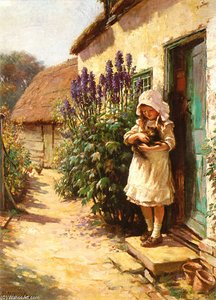
Blacklock’s oeuvre is remarkably consistent in its subject matter. He primarily focused on scenes of everyday life, particularly those found in the English countryside. His paintings depict landscapes bathed in gentle light, charming genre scenes featuring figures engaged in simple activities – women tending gardens, children playing by the sea, boats resting on tranquil waters.
His wife, Ellen (“Nellie”), and their daughter Eleanor frequently served as models, imbuing his work with a sense of intimacy and domesticity. He worked proficiently in both watercolours and oils, each medium lending itself to different aspects of his artistic vision. His watercolours are particularly notable for their luminosity and delicate washes, capturing the ephemeral beauty of the natural world. His oil paintings, while equally refined, often exhibit a greater depth of texture and a more robust sense of form.
Blacklock’s technique was rooted in observation but elevated by a subtle poetic sensibility. He wasn't interested in grand narratives or dramatic compositions; instead, he sought to capture the quiet moments of beauty that permeate everyday existence.
Legacy and Historical Significance
While not achieving widespread fame during his lifetime, William Kay Blacklock’s work has experienced a resurgence in appreciation in recent years. His paintings offer a poignant glimpse into a bygone era – a time when rural life was more prevalent and the rhythms of nature dictated the pace of existence. He stands as a representative of a generation of British artists who embraced Impressionistic principles while maintaining a distinctly English aesthetic.
- His work provides valuable insight into the social and cultural landscape of early 20th-century England.
- Blacklock’s paintings are admired for their technical skill, delicate beauty, and evocative atmosphere.
- He is considered a significant figure within the Walberswick artists' colony, contributing to the development of English Impressionism.
The rediscovery of his full name – William Kilbride Blacklock – adds another dimension to understanding his artistic identity. His paintings continue to captivate viewers with their timeless appeal and gentle charm, offering a serene escape from the complexities of modern life. He died in 1924 leaving behind a legacy of quiet beauty that continues to resonate today.