

Museum-quality giclée or canvas print with fast production and flexible finish options. ( Buy Hand Made Painting Switch to Digital Image)





























Pick from our preset sizes that match the artwork's original proportions.

Type the width and the height you need, to fit your frame or your wall. A print can only be cut, never made bigger than the picture, so a size with a different shape loses a part of the image. We send you a digital mockup to approve before we print anything. The picture shown on this page does not show the real cut — only the mockup does.
Worldwide Delivery () in 2 weeks instead of standard 4/5 weeks. (10 November)
Chairing the Member
Reproduction Size
William Hogarth’s “Chairing the Member,” completed in 1758, stands as a cornerstone of British art history—a masterful distillation of social critique and theatrical observation that continues to resonate with audiences today. More than just a depiction of an event, it's a meticulously crafted commentary on power dynamics, hypocrisy, and the performative nature of public life during the Enlightenment.
The painting captures a moment of brazen defiance within the confines of London’s prisons—specifically, Bedlam Royal Hospital. Two inmates orchestrated a mock election, electing themselves as Members of Parliament in a calculated act designed to expose the failings of the political establishment. Hogarth brilliantly portrays this spectacle with unflinching realism, capturing not only the physical scene but also the psychological tension palpable amongst those involved.
Hogarth’s style exemplifies the burgeoning neoclassical movement—characterized by clarity of form, precise draughtsmanship, and an emphasis on conveying emotion through gesture. Unlike the ornate Rococo styles prevalent before him, Hogarth eschewed excessive ornamentation in favor of a restrained palette and meticulous attention to detail. The artist skillfully employs chiaroscuro – dramatic contrasts between light and dark – to sculpt the figures and heighten the theatrical impact of the composition.
The canvas itself is dominated by a monumental figure—the “Member,” seated awkwardly in a chair, subjected to the indignity of being forcibly ejected by a group of guards. Hogarth’s masterful use of perspective draws the viewer into the scene, creating an immersive experience that underscores the vulnerability of the individual against institutional authority.
While the mock election serves as the immediate subject matter, “Chairing the Member” operates on a deeper symbolic level. The clocks prominently displayed—one at the top left corner and another centrally positioned—represent time’s relentless march toward judgment and underscore the futility of resisting societal pressures. Furthermore, Hogarth's inclusion of the horse symbolizes nobility and power – juxtaposed against the humiliation of the imprisoned men.
Painted during a period marked by anxieties surrounding social reform and political corruption, “Chairing the Member” reflects Hogarth’s broader commitment to exposing hypocrisy and challenging conventional morality. It is a testament to his ability to transform observation into profound artistic expression—a legacy that continues to inspire artists and scholars alike.
The painting's enduring power lies in its unflinching portrayal of human behavior and its unsettling depiction of institutional injustice. Hogarth compels us to confront the illusion of grandeur and privilege that masks underlying vulnerabilities. “Chairing the Member” remains a poignant reminder of the importance of questioning authority and resisting conformity—a timeless masterpiece that speaks volumes about the complexities of human experience.
A digital image of "Chairing the Member" by William Hogarth can be purchased on its Digital Image page: a high-resolution digital image download.
Use (accent) and space (living room) are the two recommendations recorded for "Chairing the Member" by William Hogarth.
"Chairing the Member" shares with William Hogarth's other works its Baroque Satire style and the recorded themes: satirical observation, social commentary style, royal society patronage, moral critique focus, hogarth’s legacy vision.

London, 1697. The air in Bartholomew Close is thick with the sounds of a growing metropolis. Here, William Hogarth enters a world of precarious stability. His father, Richard Hogarth, struggles to make a living as a Latin schoolmaster and textbook writer. The family's finances fluctuate; at one point, Richard faces the harsh reality of imprisonment for debt in the Fleet Prison. This early exposure to the instability of urban life leaves a mark. William Hogarth grows up watching the gap between the social classes, a perspective that will eventually define his career as a painter, engraver, satirist, cartoonist, and writer.
The boy's path is not one of inherited wealth or easy patronage. Instead, it is a life shaped by the grit of the city. He moves through the streets of London, observing the characters that populate the coffee houses and the fairs. His mother, Anne Gibbons, provides the domestic anchor to a life often marked by the economic shifts of the era. By the time he begins to make his mark, he is already a man of many disciplines, using ink and paint to dissect the very society that raised him.
London, 1697. The son of Richard Hogarth, a Latin schoolmaster and occasional writer, William grows up amidst the shifting fortunes of a man struggling to maintain a footing in the city. The instability of the household takes a sharp turn when Richard is imprisoned in the Fleet Prison for five years due to unpaid debts. This period of hardship, marked by the precariousness of the family's finances, leaves a lasting impression on the young observer of the metropolis.
By 1714, the focus shifts to the technicalities of craft. Hogarth enters an apprenticeship with Ellis Gamble, a gold and silver engraver operating in Leicester Fields. He learns the precision required for trade cards and similar products, developing a fundamental command of the copper plate. This technical grounding provides the tools for a career that will eventually move beyond mere commercial reproduction.
The trajectory changes as he moves toward formal artistic study. In 1720, he enrolls at the St Martin's Lane Academy. His training expands further under Sir James Thornhill, the serjeant painter to George I. Under Thornhill, the focus shifts from the small-scale precision of engraving to the broader complexities of painting and composition. He moves from the meticulous work of a craftsman toward the grander scale of fine art.
Hogarth moves between the precision of realistic portraiture and the rapid, sequential energy of comic strip-like series. He does not merely paint; he constructs narratives. This approach finds its peak in his development of "modern moral subjects," a method where he uses visual storytelling to critique the social fabric. He treats the canvas and the copper plate as stages for unfolding drama, often utilizing a blend of humor and biting satire to drive his points home.
The technical foundation of his work lies in his mastery of engraving. He understands the weight of a line and the power of a print to reach a mass audience. In 1753, he shifts from the visual to the theoretical with the publication of his Analysis of Beauty. Here, he moves beyond mere observation to codify his aesthetic theories, specifically stressing the importance of the "serpentine line" as a fundamental principle of beauty and movement.
The narrative power of his work finds its peak in the "modern moral subjects," a series of paintings designed to function like visual novels. In 1731/1732, A Harlot's Progress traces the tragic downfall of a young woman arriving in London, only to succumb to the city's temptations. This pattern of social descent continues in 1735 with A Rake's Progress, which follows Tom Rakewell as he squanders an inheritance on gambling and debauchery. These works do not merely depict scenes; they chart the consequences of moral decay through meticulous detail and symbolic elements.
The focus shifts from individual ruin to the collision of social classes in the series Marriage A-la-Mode, produced between 1743 and 1745. Here, the artist skewers the disastrous results of arranged marriages and the pursuit of status. The tension between the opulent interiors of the wealthy and the squalid realities of the poor becomes a recurring theme. Even in his later years, the commentary remains sharp. In 1748, O the Roast Beef of Old England addresses national identity, while 1750's The March of the Guards to Finchley presents a chaotic, boisterous view of military life, contrasting disciplined ranks in the distance with the raucous behavior of soldiers in the foreground.
The 18th century sees the emergence of a distinctly British school of art, a movement helped into being by Hogarth's refusal to rely on Continental models. He moves beyond the mere imitation of foreign styles to establish a visual language rooted in the streets of London. This shift is significant; he becomes the most important English artist of his generation. His influence is so pervasive that the term "Hogarthian" enters the lexicon to describe his specific brand of satirical observation.
The commercial reality of his success brings a new kind of conflict. As his prints gain massive popularity, they also attract a wave of unauthorized reproductions. Plagiarism becomes a constant threat to his livelihood. This tension forces a legal confrontation that changes the landscape of intellectual property. He lobbies for the Copyright Act of 1735, a move that secures the rights of creators against those who would profit from their labor without permission.
His method of storytelling through sequential imagery creates a blueprint for future media. He functions as a direct precursor to the modern political cartoon and the comic strip. By using a series of images to dissect social behavior, he provides a template for visual narratives that rely on reading rather than just looking. His influence stretches from the satirical prints of the 1700s into the very foundations of popular culture.
The physical traces of Hogarth's social critiques remain scattered across major institutions. In London, the National Gallery houses pieces from the Marriage à la Mode series, where the visual narrative of social decay is preserved. Nearby, Tate Britain holds Satan, Sin and Death (A Scene from Milton), a work that highlights his ability to translate complex literary themes into visual form. The Foundling Museum also maintains a presence in the city, holding The March of the Guards to Finchley, a piece that captures the chaotic energy of 18th-century military life.
The reach of his work extends beyond the United Kingdom. In New York City, the Frick Collection preserves Miss Mary Edwards, a portrait that reflects his skill in capturing individual character. These collections offer a way to encounter the specific details of his engravings and paintings in their original contexts. Visitors can find his influence in the way these institutions manage the tension between fine art and popular satire.

1697 - 1764 , United Kingdom

Explore the world of 18th-century portraiture with WahooArt. Discover symbolism, artistic innovation & societal values reflected in masterpieces by Reynolds, Hogarth & more. Expert insights for collectors.

Journey through 18th century art! Explore 10 iconic paintings – from Rococo elegance to Neoclassical grandeur. Discover Fragonard, David & more. Find museum-quality reproductions and elevate your home decor on WahooArt.com.

Explore the satirical world of William Hogarth, pioneering British painter & engraver. Discover his iconic works like *A Rake's Progress* and insightful social commentary on 18th-century London life.
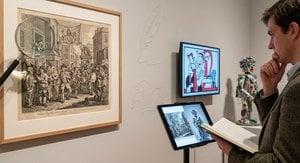
Explore the history of satire in art! From Hogarth's London to contemporary critique, discover how artists use wit & visual power to reflect and challenge society. Expert insights at WahooArt.

Explore the history of satire in art! From ancient masters like Aristophanes to Goya & Grosz, discover how artists use wit and critique to reflect—and challenge—society. Expert insights at WahooArt.
 Preview
 Send
Send Share
Share
 Details
 Guide
Guide

 Download
 Similars
 X-Ray
X-Ray Diaporama
 Q&A
Q&A
 Stats
Stats
 Read More









 Glass option is only available in size under 110 CM


