Artist Biography
A Topographical Visionary: The Life and Art of William Henry Bartlett
Born in the bustling heart of Kentish Town, London, in 1809, William Henry Bartlett embarked on a career that would indelibly mark the landscape of nineteenth-century topographical illustration. His journey began not with brushes and palettes, but as an apprentice to John Britton, a prominent antiquarian and artist whose influence proved foundational. This early immersion into the world of historical documentation and artistic rendering instilled in Bartlett a meticulous attention to detail and a deep appreciation for the stories embedded within architecture and scenery – qualities that would define his life’s work. It was a formative period, shaping not just his technical skills but also his understanding of how art could serve as a powerful vehicle for preserving and communicating history. The apprenticeship with Britton wasn't merely about learning to draw; it was an education in seeing the world through the lens of time, recognizing the layers of narrative etched into every stone and vista.
From British Shores to Distant Lands: A Career Forged Through Travel
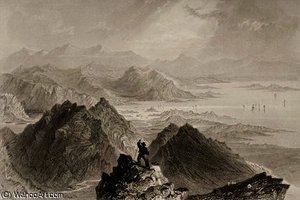
Bartlett quickly distinguished himself with his remarkable ability to capture landscapes and architectural scenes with precision and atmosphere, primarily working with detailed steel engravings. He wasn’t content to remain confined within the studio; instead, he embraced travel as an integral part of his artistic process. Extensive journeys throughout Britain laid the groundwork for his career, but it was his ventures further afield – to the Balkans, the Middle East, and crucially, North America – that truly cemented his reputation. Between 1836 and 1852, four visits to North America provided a wealth of material, establishing him as an important chronicler of transatlantic landscapes. These weren’t simply picturesque depictions; they were carefully observed records of a rapidly changing world, offering glimpses into the lives and environments of people across continents. His work became immensely popular, fueled by a growing Victorian appetite for travel narratives and visual documentation of distant lands. The success of series like *American Scenery* (1837-1839), published with text by Nathaniel Parker Willis, demonstrated his ability to connect with a broad audience, offering them vicarious experiences through the power of image and word.
Capturing Impressions: Style and Technique
Bartlett’s artistic process was characterized by a unique blend of observation, draftsmanship, and technical skill. He favored creating sepia wash drawings – delicate renderings that captured subtle nuances of light and shadow – which were then meticulously engraved onto steel plates. This technique allowed for the production of highly detailed prints with remarkable clarity. His engravings weren’t merely copies of reality; they were interpretations infused with his artistic sensibility. Bartlett possessed a keen eye for composition, carefully selecting viewpoints to highlight key features of the landscape or architecture. He often incorporated ruins or historical elements into his scenes, adding layers of meaning and inviting viewers to contemplate the passage of time. His aim, as he himself stated, was to convey “lively impressions of actual sights,” prioritizing realism and accuracy while simultaneously imbuing his work with a sense of atmosphere and emotional resonance. This dedication to capturing not just *what* things looked like but *how they felt* is what sets his work apart.
A Lasting Legacy: Historical Significance and Enduring Appeal
William Henry Bartlett’s untimely death aboard a French ship off the coast of Malta in 1854 cut short a promising career, yet his legacy endures. His detailed engravings played a vital role in popularizing travel and landscape imagery during the nineteenth century, providing valuable visual records of places undergoing significant transformation due to industrialization and urbanization. He didn’t produce signed oil paintings, but his engravings were widely copied by other artists, demonstrating the profound impact of his style on contemporary art. His work served as a bridge between artistic representation and historical documentation, offering insights into the landscapes and cultures of Britain, North America, and the Middle East during a pivotal period in history. Even today, Bartlett’s images continue to captivate viewers with their meticulous detail, atmospheric depth, and evocative power. They offer not just a glimpse into the past but also a testament to the enduring allure of travel, exploration, and the art of seeing the world anew. His influence can be seen in subsequent generations of topographical artists and continues to inspire those who seek to capture the beauty and complexity of our planet through visual means.



 Preview
 Buy Print
 Send
Send Share
Share
 Details

 Download
 Similars
 X-Ray
X-Ray Diaporama
 Read More






































 Glass option is only available in size under 110 CM