x


 1846
1846 27.0 x 21.0 cm
Hand-painted oil on canvas in your size and frame, made to order by our artists. ( Buy Print Buy Image)
Pick from our preset sizes that match the artwork's original proportions.

You may enter your own dimensions to fit a specific frame or space. If your selected size does not match the original image's proportions, we will either crop the artwork or extend the painting with additional hand-painted elements. A digital mockup will be sent for your approval before production begins.
Please note that the on-screen preview does not reflect the actual cropping or extension. Only the mockup will accurately show the final composition.
While custom sizes are available, we recommend selecting a dimension from the predefined list to preserve the original proportions.
Worldwide Delivery () in 3/4 weeks instead of standard 5 weeks. (27 August). No compromise on quality.


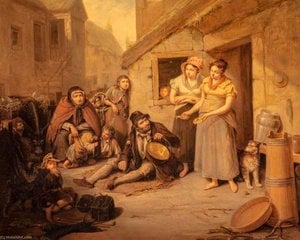
Scotch Toper
Reproduction Size

William Bonnar (1800 – 1853) stands as a pivotal figure in the history of Scottish portraiture, a painter whose career navigated the evolving landscape of art during the early Victorian era. Born into a family steeped in artistic tradition—his father a house-painter and interior designer—Bonnar’s early exposure to visual craftsmanship laid the foundation for his own distinguished career. He wasn't merely inheriting a trade; he was absorbing a philosophy of meticulous observation, skillful execution, and an appreciation for detail that would profoundly shape his artistic vision. His life coincided with a period of significant social and political change in Scotland, marked by industrialization, urbanization, and the rise of the middle class—themes that subtly permeate many of his most celebrated works.
Bonnar’s formative years were spent assisting David Roberts, a prominent artist associated with the Royal Scottish Academy. This apprenticeship provided invaluable experience in depicting historical subjects and grand scenes, skills he later adapted to his primary focus: portraiture. The commission to decorate the Assembly Rooms in Edinburgh for George IV's visit in 1822 marked a crucial early step, demonstrating his burgeoning talent and establishing him as a rising star within the artistic community. This event wasn’t just about decoration; it was a demonstration of Bonnar’s ability to capture the nuances of aristocratic society – an interest that would define much of his subsequent work.
Bonnar’s artistic output is overwhelmingly defined by portraiture, yet he didn’t simply replicate established conventions. He possessed a remarkable ability to imbue his subjects with personality and character, moving beyond mere likenesses to create compelling representations of individuals. His early works often featured rural scenes—images of children playing in idyllic landscapes—reflecting the Romantic sensibility prevalent at the time. However, it was his portraits that truly cemented his reputation. He painted a diverse range of sitters: prominent figures from Scottish society – including Reverend Dr Patrick Clason, Reverend William Cunningham, George Meikle Kemp, and Thomas Chalmers – alongside members of the landed gentry and local notables.
Bonnar’s style evolved over time, demonstrating a growing sophistication. Initially influenced by the Neoclassical tradition, he gradually incorporated elements of Romanticism, particularly in his use of light and shadow to create mood and atmosphere. His portraits are characterized by their meticulous detail, subtle color palettes, and an acute awareness of anatomy and expression. He wasn’t afraid to capture the weariness or quiet dignity of his subjects, revealing a sensitivity that went beyond superficial appearances. His work with George Meikle Kemp is particularly notable for its emotional depth and technical mastery.
A fascinating aspect of Bonnar’s career lies in his involvement with the construction of the Robert Burns Monument in Edinburgh—a project that ultimately became a defining moment in his artistic life. Following the untimely death of George Meikle Kemp, the architect responsible for designing the monument, Bonnar was entrusted with its completion. This commission presented a significant challenge, requiring him to integrate existing designs and oversee the intricate process of assembling the massive structure. While the precise details of his role remain somewhat debated, it’s widely believed that Bonnar played a crucial part in ensuring the monument's successful realization—a testament to his technical skills and artistic judgment.
William Bonnar operated within a dynamic period of Scottish art history. The Royal Scottish Academy, where he was elected in 1829, served as a central hub for artistic development, fostering dialogue between established artists and emerging talents. His work reflects the broader trends of the era—the rise of Romanticism, the growing interest in portraiture, and the increasing importance of visual culture in shaping social perceptions. Furthermore, Bonnar’s family background – his father's expertise as a house-painter and interior designer – provided him with a unique perspective on craftsmanship and design, which informed his approach to portraiture. His legacy is not simply that of a skilled painter; he was an artist deeply embedded in the social and cultural fabric of 19th-century Scotland.

1800 - 1863


Stay updated with the latest art news, exclusive offers, and decoration ideas.
Tell us about your project and our art experts will provide you with 3 personalized art suggestions.
Let Us Curate 3 Options Just for You - Free!

 Preview
 Send
Send Share
Share
 Details

 Download
 Similars
 X-Ray
X-Ray Diaporama
 Read More




































 Glass option is only available in size under 110 CM