
x


Hand-painted oil on canvas in your size and frame, made to order by our artists. ( Buy Print Buy Image)
Pick from our preset sizes that match the artwork's original proportions.

You may enter your own dimensions to fit a specific frame or space. If your selected size does not match the original image's proportions, we will either crop the artwork or extend the painting with additional hand-painted elements. A digital mockup will be sent for your approval before production begins.
Please note that the on-screen preview does not reflect the actual cropping or extension. Only the mockup will accurately show the final composition.
While custom sizes are available, we recommend selecting a dimension from the predefined list to preserve the original proportions.
Worldwide Delivery () in 3/4 weeks instead of standard 5 weeks. (28 August). No compromise on quality.


Job´s despair 1
Reproduction Size
William Blake’s “Job’s Despair” stands as a cornerstone of Romantic art, encapsulating the era's preoccupation with profound emotion and spiritual questioning. Executed in black and white etching on paper around 1825, this artwork transcends mere visual representation; it embodies a visceral response to biblical narrative—specifically Job’s agonizing suffering following divine retribution.
Blake’s masterful technique—characterized by meticulous hatching and cross-hatching—captures the bleakness of Job's predicament with breathtaking precision. Fine lines delineate forms, building up tonal values that convey not just visual appearance but also palpable sorrow. The border itself is ornate, reflecting Blake’s stylistic penchant for decorative embellishment and reinforcing the artwork’s formal grandeur.
The composition immediately commands attention with Job dominating the central plane, arms outstretched in supplication—a gesture laden with grief and desperation. Surrounding him are figures of comforters, arranged in poses mirroring his anguish, creating a dynamic interplay of emotion. Behind Job looms a monumental rectangular block, interpreted as representing divine judgment or perhaps an impenetrable barrier to solace.
Blake’s deliberate asymmetry contributes to the artwork's dramatic impact, while the border serves as a visual constraint, emphasizing the emotional core of the scene. Recurring motifs—such as swirling clouds and stylized drapery—further amplify the sense of turmoil and spiritual struggle.
"Job's Despair" firmly establishes Blake as a champion of Romantic ideals: an unwavering belief in emotion, imagination, and the sublime. His distinctive style—marked by intricate line work and symbolic imagery—is evident throughout, mirroring his broader artistic mission to explore the depths of human experience and wrestle with existential questions.
Research into similar artworks like “Job’s Comforters” and “Job’s Evil Dreams 1” reveals Blake's consistent engagement with themes of faith, loss, and divine retribution. These pieces demonstrate his ability to transform biblical stories into emotionally resonant visual narratives—a testament to his enduring legacy as a visionary artist.
Created during the Romantic period (roughly 1798-1837), “Job’s Despair” reflects the broader cultural anxieties of its time – disillusionment with Enlightenment rationalism alongside an intensified interest in spirituality and emotion. Blake's etching stands as a precursor to later Expressionist explorations of psychological torment, cementing his position as a pivotal figure in art history.
Consider commissioning a high-quality reproduction of “Job’s Despair” to infuse your interior space with the artwork’s evocative atmosphere and profound symbolic depth. Its enduring power continues to inspire viewers today—a timeless masterpiece capturing the essence of human suffering and spiritual yearning.


1757 - 1827 , United Kingdom
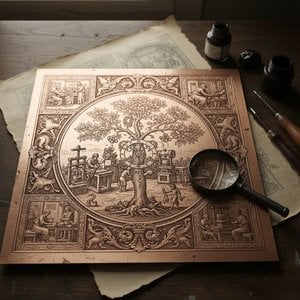
Explore the intricate world of etching and intaglio printmaking. Discover how masters use acid and metal to create profound textures and lines, from Romanticism to modern era, through an expert lens of art history and technical mastery.


Stay updated with the latest art news, exclusive offers, and decoration ideas.
Tell us about your project and our art experts will provide you with 3 personalized art suggestions.
Let Us Curate 3 Options Just for You - Free!

 Preview
 Send
Send Share
Share
 Details

 Download
 Similars
 X-Ray
X-Ray Diaporama
 Read More




































 Glass option is only available in size under 110 CM


