Oil On CanvasWallArtAbstract Expressionism
 1939Early Medieval
 97.0 x 87.0 cm
The artwork displayed on this page is protected by copyright law, which means we cannot legally create or sell an identical reproduction. This protection is enforced under international agreements such as the Berne Convention and by national laws, including those outlined by the U.S. Copyright Law - Title 17.
This method fully complies with copyright regulations because it does not involve copying or duplicating the protected artwork. Instead, it is a creative reinterpretation - a new painting that is influenced by the original but not identical to it.
Museum-quality giclée or canvas print with fast production and flexible finish options. ( Buy Hand Made Painting Switch to Digital Image)





























Pick from our preset sizes that match the artwork's original proportions.

You may enter your own dimensions to fit a specific frame or space. If your selected size does not match the original image's proportions, we will either crop the artwork or extend the image with a mirrored or solid-fill edge. A digital mockup will be sent for your approval before production begins.
Please note that the on-screen preview does not reflect the actual cropping or extension. Only the mockup will accurately show the final composition.
While custom sizes are available, we recommend selecting a dimension from the predefined list to preserve the original proportions.
Worldwide Delivery () in 2 weeks instead of standard 4/5 weeks. (12 October)
Seated Man
Reproduction Size
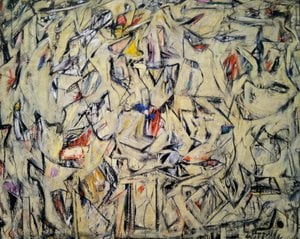
Willem de Kooning's “Seated Man,” painted in 1939, isn’t merely a depiction of a man at rest; it’s a potent distillation of the artist’s evolving approach to capturing human emotion and experience. This oil on canvas, measuring a modest yet significant 97 x 87 cm, currently resides within the Hirshhorn Museum and Sculpture Garden in Washington D.C., offering viewers an intimate glimpse into the mind of a pivotal figure in the New York School of art. De Kooning’s work during this period represents a fascinating crossroads – a deliberate exploration of realism interwoven with the burgeoning abstraction that would define his legacy, creating a dynamic tension within each piece.
The painting immediately draws the eye to its central subject: a man seated in a chair, his posture relaxed yet imbued with an underlying sense of contemplation. His arms are crossed, suggesting both vulnerability and self-possession. The deliberate use of color – primarily yellows and browns – contributes significantly to the work’s mood. The bright yellow shirt contrasts sharply with the darker tones of the figure's clothing and the chair, creating a visual rhythm that guides the viewer’s gaze across the canvas. Notably, de Kooning eschews a completely smooth finish; visible brushstrokes are prominent, adding texture and immediacy to the scene – a characteristic hallmark of his style.
The composition itself is carefully constructed to establish a clear dialogue between form and space. The man occupies the left side of the frame, anchoring the viewer’s attention while simultaneously allowing the right half of the canvas to be dominated by a dining table. This arrangement isn't arbitrary; it subtly suggests a domestic scene, a moment of quiet contemplation or perhaps even a shared meal. Two bowls are placed on the table, one closer to the center and the other slightly further away – a detail that invites speculation about their contents and the context of the gathering. A bottle is positioned in the upper left corner, adding another layer of visual interest and subtly directing the eye upwards.
The placement of these objects isn’t simply decorative; it contributes to the painting's overall sense of ambiguity. Is this a portrait of an individual lost in thought? Or does it represent a broader commentary on human interaction and the rituals of daily life? De Kooning deliberately avoids providing easy answers, leaving the interpretation open to the viewer’s own sensibility.
“Seated Man” is deeply rooted in de Kooning's early experimentation with abstract expressionism. While retaining elements of realism – particularly in the depiction of the man’s face and posture – the painting demonstrates a willingness to distort and fragment forms, anticipating the more radical gestures that would characterize his later work. This exploration of the human figure, often rendered with a sense of unease or even violence, reflects de Kooning's broader engagement with themes of identity, alienation, and the complexities of modern life. His work during this period was profoundly influenced by artists like Jackson Pollock and Franz Kline, whose techniques he absorbed and adapted to his own unique vision.
“Seated Man” stands as a significant testament to de Kooning’s contribution to the development of abstract expressionism. It exemplifies his ability to balance realism with abstraction, capturing not only the outward appearance of a subject but also its underlying emotional state. The painting's blend of observation and invention makes it a compelling study for art enthusiasts and scholars alike, offering insights into the artist’s creative process and his place within the broader context of 20th-century art. Reproductions of this powerful work offer a tangible connection to a pivotal moment in artistic history, allowing viewers to experience de Kooning's vision firsthand.
"Seated Man" by Willem de Kooning has a soft shadow luminance. Luminance describes how much light the colors appear to reflect.
Behind "Seated Man" stand Willem de Kooning and the Abstract Expressionism movement.
"Seated Man" by Willem de Kooning shows a serene contrast between its light and dark areas.
"Seated Man" was made in oil on canvas and measures 97 x 87 cm in its original form.
"Seated Man" is available as a high-resolution digital image download, purchased directly on this page.
"Seated Man" by Willem de Kooning depicts seated man, figure, chair, dining, baldness, yellow shirt, abstraction, casual, in an elegant mood. Subject and atmosphere together describe the work.
"Seated Man" is available as a hand-painted oil reproduction on linen canvas. The order can be placed on this page, with a choice of sizes.
"Seated Man" is defined by a dark palette led by driftwood (#cb935b).


1904 - 1997 , Netherlands

Explore the profound emotional depth of Abstract Expressionism. From Pollock's dynamic drips to de Kooning's gestural mastery, our expert guide offers art collectors a sophisticated analysis of this transformative movement and its enduring legacy in modern fine art.

 Preview
 Send
Send Share
Share
 Details
 Guide
Guide

 Download
 Similars
 X-Ray
X-Ray Diaporama
 Stats
Stats Read More









 Glass option is only available in size under 110 CM