The artwork displayed on this page is protected by copyright law, which means we cannot legally create or sell an identical reproduction. This protection is enforced under international agreements such as the Berne Convention and by national laws, including those outlined by the U.S. Copyright Law - Title 17.
This method fully complies with copyright regulations because it does not involve copying or duplicating the protected artwork. Instead, it is a creative reinterpretation - a new painting that is influenced by the original but not identical to it.
Museum-quality giclée or canvas print with fast production and flexible finish options. ( Buy Hand Made Painting Switch to Digital Image)





























Pick from our preset sizes that match the artwork's original proportions.

Type the width and the height you need, to fit your frame or your wall. A print can only be cut, never made bigger than the picture, so a size with a different shape loses a part of the image. We send you a digital mockup to approve before we print anything. The picture shown on this page does not show the real cut — only the mockup does.
Worldwide Delivery () in 2 weeks instead of standard 4/5 weeks. (16 October)
Composition
Reproduction Size
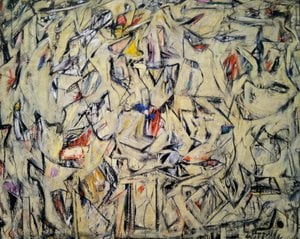
Willem de Kooning's "Composition," painted in the heart of the Abstract Expressionist movement, isn’t merely a painting; it’s an embodiment of restless energy and a profound exploration of form and feeling. Born in Rotterdam in 1904, De Kooning arrived in New York with a determined spirit – a stowaway on a ship, mirroring his artistic ambition to forge a new path entirely separate from the constraints of European tradition. This journey, fueled by a childhood marked by familial discord, profoundly shaped his approach to art: an insistence on raw emotion and a rejection of representational accuracy. “Composition” perfectly encapsulates this ethos, presenting a vibrant tableau where geometric shapes collide with gestural brushstrokes, creating a dynamic visual experience that feels both controlled and utterly spontaneous.
The painting’s immediate impact is dominated by a bold and arresting color scheme – a fiery interplay of reds and yellows punctuated by strategic accents of blue. These aren't colors used to depict reality; they are instruments of expression, deployed with an almost violent intensity. The dominant red, often interpreted as representing passion or even anger, clashes dramatically with the warm yellow, suggesting a volatile tension. Scattered throughout this chromatic drama are carefully placed geometric forms: squares and rectangles, rendered with varying degrees of precision. These shapes aren’t static; they seem to vibrate against each other, creating a sense of movement and instability within the composition. De Kooning masterfully uses these simple forms to disrupt any potential for harmony, forcing the eye to constantly navigate the painting's complex spatial relationships.
What truly distinguishes “Composition” is De Kooning’s distinctive technique – his expressive brushstrokes. These aren’t delicate, controlled marks; they are bold, assertive gestures that reveal the physicality of the painting's creation. Thick impasto layers build up on the canvas, creating a palpable sense of texture and depth. The application of paint feels almost violent at times, as if the artist were wrestling with the image itself. This technique is central to Abstract Expressionism’s core philosophy: prioritizing the process of painting over the finished product. De Kooning wasn't aiming to create a beautiful object; he was channeling his emotions and experiences directly onto the canvas through the act of applying paint.
"Composition" emerged during a pivotal moment in art history – the rise of Abstract Expressionism following World War II. This movement, characterized by its emphasis on individualism and emotional intensity, represented a radical departure from the established norms of Western art. De Kooning’s work stands as a cornerstone of this era, profoundly influencing subsequent movements like Pop Art and Minimalism. His willingness to embrace abstraction, coupled with his intensely personal style, paved the way for artists to explore new forms of expression and challenge traditional notions of representation. “Composition” isn't just a painting; it’s a document of its time – a vibrant testament to the anxieties, aspirations, and creative ferment of mid-20th century America.
WahooArt offers meticulously crafted hand-painted reproductions of “Composition,” allowing you to experience the raw power and emotional depth of this iconic artwork in your own home. Each reproduction is created by skilled artists who painstakingly replicate De Kooning’s technique, capturing the vibrancy of the colors and the dynamism of the brushstrokes. Whether adorning a gallery wall or adding a touch of artistic intensity to a contemporary interior, a WahooArt reproduction of “Composition” is more than just a print; it's an investment in art history and a celebration of De Kooning’s enduring legacy.
"Composition" by Willem de Kooning can be viewed as a slideshow on the artwork's Diaporama page.
The art-historical classification of "Composition" by Willem de Kooning is Abstract Expressionism, in the Early-Modern period.
"Composition" by Willem de Kooning belongs to the Abstract Expressionism movement. This movement provides the stylistic context of the work.


1904 - 1997 , Netherlands

Explore the profound elegance of De Stijl. Discover how Piet Mondrian and the masters of Neoplasticism utilized geometric harmony and primary colors to redefine modern abstraction. An authoritative guide for the discerning collector seeking timeless, structured beauty.

Explore the profound emotional depth of Abstract Expressionism. From Pollock's dynamic drips to de Kooning's gestural mastery, our expert guide offers art collectors a sophisticated analysis of this transformative movement and its enduring legacy in modern fine art.

 Preview
 Send
Send Share
Share
 Details
 Guide
Guide

 Download
 Similars
 X-Ray
X-Ray Diaporama
 Stats
Stats

 Read More









 Glass option is only available in size under 110 CM