

 Acrylic On CanvasWallArtTang Dynasty Calligraphy
 23.0 x 14.0 cm
 National Palace Museum
The artwork displayed on this page is protected by copyright law, which means we cannot legally create or sell an identical reproduction. This protection is enforced under international agreements such as the Berne Convention and by national laws, including those outlined by the U.S. Copyright Law - Title 17.
This method fully complies with copyright regulations because it does not involve copying or duplicating the protected artwork. Instead, it is a creative reinterpretation - a new painting that is influenced by the original but not identical to it.
Museum-quality giclée or canvas print with fast production and flexible finish options. ( Buy Hand Made Painting Switch to Digital Image)





























Pick from our preset sizes that match the artwork's original proportions.

Type the width and the height you need, to fit your frame or your wall. A print can only be cut, never made bigger than the picture, so a size with a different shape loses a part of the image. We send you a digital mockup to approve before we print anything. The picture shown on this page does not show the real cut — only the mockup does.
Worldwide Delivery () in 2 weeks instead of standard 4/5 weeks. (24 October)
Timely Clearing After Snowfall
Reproduction Size
The movement associated with "Timely Clearing After Snowfall" by Wang Hsi-Chih is Tang Dynasty Calligraphy. This classification situates the work among related artists and artworks.
"Timely Clearing After Snowfall" is recommended at a large print size. Other sizes are available with the same proportions.
The Preview page of "Timely Clearing After Snowfall" lets you preview the artwork before ordering.

Wang Xizhi, born around 303 CE in Linyi, Shandong province, China, stands as a monumental figure in East Asian art history—a calligrapher whose name resonates with reverence even today. Often hailed as the “Sage of Calligraphy” (Shu Sheng), Wang didn’t simply practice calligraphy; he embodied it, elevating the art form to unprecedented heights and establishing standards that would influence generations of artists across China, Korea, and Japan. His life, though documented through historical accounts and anecdotes, reveals a journey marked by both aristocratic privilege and profound dedication to aesthetic pursuit.
Born into a prominent family during the Jin dynasty, Wang’s early years offered little indication of his future mastery. Accounts suggest he initially struggled with writing, yet driven by an unwavering commitment, he devoted himself tirelessly to honing his skills. Legend has it that he practiced so diligently, even inscribing characters on his arm with his finger, and that the pond beside his studio was perpetually stained black from the constant flow of ink. This relentless pursuit laid the foundation for a revolutionary approach to calligraphy.
The Jin dynasty was a period of significant political upheaval, and Wang Xizhi’s life mirrored this instability. Following the collapse of the Western Jin dynasty, his family fled south, seeking refuge from the turmoil. Despite these challenges, he managed to secure various government positions between 324 and 354 CE, reaching the esteemed title of “General of the Right Army” in 347 and later becoming administrator of Kuaiji (present-day Shaoxing, Zhejiang). However, Wang’s true passion lay not in politics but in the refinement of his artistic expression. He eventually retired from public service in 355 to fully immerse himself in Taoist practices and calligraphy.
His engagement to Xi Xuan around 323 CE proved pivotal, resulting in eight children, including Wang Xianzhi, who would also achieve renown as a calligrapher—cementing the family’s legacy within the art world. The collaborative spirit and shared dedication to calligraphy within the Wang family further amplified their influence on subsequent generations.
Wang Xizhi's most celebrated work, composed in 353 CE, is the Lantingji Xu (蘭亭集序; “Preface to the Poems Composed at the Orchid Pavilion”). This remarkable piece emerged from a convivial gathering hosted by Wang for forty-one friends, relatives, and pupils at Mount Kuaiji. The occasion involved a "winding stream party," where participants composed poetry as they enjoyed wine flowing down a creek. It was during this spirited event that Wang penned the Lantingji Xu, a preface to the collection of poems created that day.
Written in the Running Style (xingshu), the Lantingji Xu is lauded for its effortless fluidity, dynamic brushwork, and harmonious balance between legibility and artistic expression. The work captures not only the joy of the gathering but also Wang’s profound connection to nature and his philosophical reflections on life's transience. While no original versions survive today—only rubbings and tracing copies remain—the Lantingji Xu continues to be revered as the pinnacle of Chinese calligraphy, studied and emulated by artists for centuries.
Wang Xizhi’s mastery extended beyond the Running Style; he excelled in Regular Script (kaishu) and Cursive Script (caoshu) as well. However, his true innovation lay in his ability to synthesize these styles, creating a unique aesthetic that prioritized naturalness, spontaneity, and emotional resonance. He didn’t merely copy existing texts; he infused them with his own personality and artistic vision.
His impact on the art world was profound. Emperor Taizong of Tang (626-649 CE) recognized Wang Xizhi as the defining standard for Chinese calligraphy, mandating that imperial court scholars study his techniques. He commissioned calligraphers to create handwritten tracing copies and ink rubbings of Wang’s works, ensuring their preservation and dissemination. This patronage solidified Wang's position as a cultural icon and established his style as the benchmark for excellence.
Today, Wang Xizhi remains an enduring symbol of artistic dedication and innovation. His influence permeates East Asian calligraphy, inspiring artists to strive for balance, harmony, and emotional depth in their work. The “Sage of Calligraphy” continues to captivate audiences with his timeless masterpieces, reminding us of the power of brush and ink to transcend time and culture.

China

Explore the profound beauty of village scene art. From Impressionist light to pastoral realism, discover how timeless landscapes capture nostalgia through expert artistry and historical depth. Perfect for collectors seeking evocative, museum-quality landscape inspirations.

Embark on a visual journey through history's most iconic landscapes. Discover the mastery of Impressionism and the sublime power of nature through our expert guide to classical landscape art, curated for the discerning collector and fine art enthusiast.
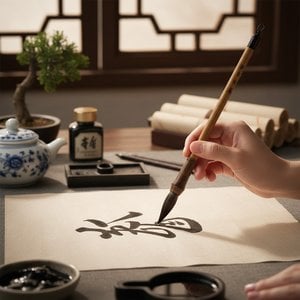
Embark on a profound journey through the soul of Chinese calligraphy. Explore the historical mastery of ink, brush, and script, from ancient Zhuanshu to elegant running script, and discover how this timeless art form reflects the enduring spirit of classical East Asian aesthetics.
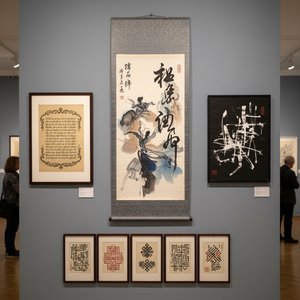
Explore the profound beauty of calligraphy art. From the fluid running script of Chinese masters to historical ink masterpieces, discover how the elegance of line transforms spaces with timeless grace and scholarly sophistication.

 Preview
 Send
Send Share
Share
 Details
 Guide
Guide

 Download
 Similars
 X-Ray
X-Ray Diaporama
 Stats
Stats Read More









 Glass option is only available in size under 110 CM


