Museum-quality giclée or canvas print with fast production and flexible finish options. ( Buy Hand Made Painting Switch to Digital Image)
Pick from our preset sizes that match the artwork's original proportions.

You may enter your own dimensions to fit a specific frame or space. If your selected size does not match the original image's proportions, we will either crop the artwork or extend the image with a mirrored or solid-fill edge. A digital mockup will be sent for your approval before production begins.
Please note that the on-screen preview does not reflect the actual cropping or extension. Only the mockup will accurately show the final composition.
While custom sizes are available, we recommend selecting a dimension from the predefined list to preserve the original proportions.
Worldwide Delivery () in 2 weeks instead of standard 4/5 weeks. (7 October)


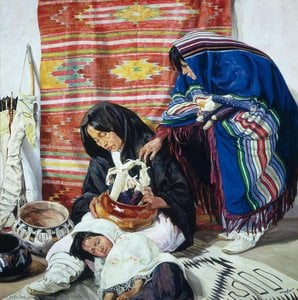
The Watcher
Reproduction Size

Walter Ufer stands as a pivotal figure in American Impressionism, a painter whose brushstrokes did more than merely capture light; they captured the very heartbeat of a culture. Born in 1876 in Hückeswagen, Germany, Ufer’s journey to the high deserts of New Mexico was paved with rigorous European training and a deep-seated curiosity about the human condition. His early years were shaped by the German-American diaspora in Louisville, Kentucky, where he first began to absorb the rich textures of his heritage. This foundational period, marked by studies in lithography and printmaking, gifted him with a technical precision that would later allow him to navigate the complexities of light and shadow with unparalleled mastery.
His pursuit of artistic excellence led him on a transformative odyssey across Europe. As a traveling journeyman, Ufer immersed himself in the diverse artistic traditions of the continent, refining his technique at the prestigious academies of Hamburg and Dresden. This period of intense intellectual and creative expansion culminated in his time in Munich, where he dedicated himself to an intensive studio practice. When he finally returned to the United and States in 1911, he carried with him a sophisticated European sensibility that was poised for a profound encounter with the rugged, sun-drenched landscapes of the American West.
The year 1914 marked a definitive turning point in Ufer’s life and the trajectory of American art. Upon venturing into Taos Pueblo, New Mexico, he found himself part of an extraordinary artistic revolution. Joining the influential group known as the "Taos Ten," Ufer became a central figure in a collective that sought to move beyond mere landscape painting toward a more authentic, visceral portrayal of Native American life. Unlike many of his contemporaries who viewed the Southwest through a romanticized or colonial lens, Ufer approached his subjects with a profound respect and an eye for the dignity of daily existence.
His work became a bridge between European Impressionist techniques and the raw, spiritual energy of the Pueblo people. He was not merely an observer but a chronicler of rituals, landscapes, and the quiet rhythms of community life. Central to this creative evolution was his relationship with Jim Mirabal, a Taos Indian who served as both Ufer’s muse and collaborator. Through this connection, Ufer gained an intimate understanding of the cultural nuances that define the region, allowing him to infuse his canvases with a sense of lived truth that resonated far beyond the borders of New Mexico.
Ufer’s oeuvre is characterized by a masterful command of color and a bold, expressive application of paint. His style, while rooted in the principles of American Impressionism, often leaned toward a more robust and textured approach that captured the heat of the desert sun and the weight of the earth. He utilized light not just to illuminate form, but to evoke emotion—creating scenes where the atmosphere feels heavy with history and tradition.
The historical significance of Walter Ufer lies in his ability to elevate genre painting into a profound social and cultural statement. His achievements include:
Today, Ufer’s paintings remain enduring testaments to a period of intense cultural intersection. His ability to weave together the technical rigor of his European education with the spiritual depth of the Pueblo culture ensures that his work continues to captivate, inviting modern viewers to witness the timeless spirit of the Taos Valley through his evocative and masterful eyes.

1876 - 1936 , Germany

 Preview
 Send
Send Share
Share
 Details
 Guide
Guide

 Download
 Similars
 X-Ray
X-Ray Diaporama
 Stats
Stats Read More




































 Glass option is only available in size under 110 CM