Acrylic On CanvasWallArtImpressionism
 192619th Century
 128.0 x 128.0 cm
 Smithsonian American Art Museum
Museum-quality giclée or canvas print with fast production and flexible finish options. ( Buy Hand Made Painting Switch to Digital Image)





























Pick from our preset sizes that match the artwork's original proportions.

Type the width and the height you need, to fit your frame or your wall. A print can only be cut, never made bigger than the picture, so a size with a different shape loses a part of the image. We send you a digital mockup to approve before we print anything. The picture shown on this page does not show the real cut — only the mockup does.
Worldwide Delivery () in 2 weeks instead of standard 4/5 weeks. (21 October)
Callers
Reproduction Size
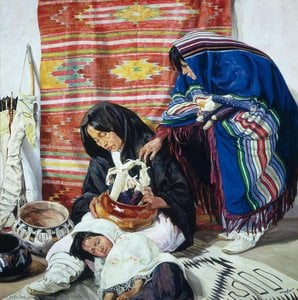
“Callers,” painted in 1926 by Walter Ufer, offers a captivating glimpse into the daily rhythms and social connections of the Native American communities residing within the artistic heartland of Taos Pueblo, New Mexico. This evocative scene, measuring 128 x 128 cm, depicts three individuals engaged in a leisurely horseback ride before a modest dwelling – a tableau brimming with quiet dignity and an understated appreciation for the natural world. Ufer, a German émigré deeply sympathetic to the lives of ordinary people, masterfully translates this experience into a work that resonates with both formal artistic skill and profound human understanding.
Ufer’s artistic journey began in Hückeswagen, Germany, where he honed his skills in lithography – a technique that would profoundly influence his later style, characterized by meticulous detail and a nuanced approach to light and shadow. Following formative training in printmaking, Ufer embarked on a period of extensive travel across Europe, immersing himself in diverse artistic traditions. This exposure shaped his perspective, allowing him to synthesize European formal techniques with the burgeoning spirit of American Impressionism. The painting’s brushwork is loose yet controlled, capturing not just the physical appearance of the subjects but also their palpable energy and connection to the landscape.
The scene itself is rich in symbolic resonance. The riders – likely members of a local Pueblo family – represent a harmonious blend of tradition and modernity. Their activity, a simple ride through the countryside, speaks volumes about their relationship with the land and each other. The inclusion of a dog adds another layer to the narrative, suggesting companionship and loyalty. Ufer’s deliberate choice of subject matter reflects his deep respect for Native American culture, portraying them not as exotic figures but as integral members of a vibrant community. This painting is a testament to Ufer's commitment to documenting the lives of those often overlooked by mainstream art history.
"Callers" exemplifies Ufer’s mastery of color and light, hallmarks of his Impressionistic style. The muted palette – dominated by earthy tones of brown, ochre, and green – evokes the arid beauty of the New Mexico landscape. Painted in 1926, the work reflects a period of significant artistic exchange between Europe and America, as well as Ufer’s own role as a bridge between these two worlds. The painting's creation coincided with a growing interest in Native American art and culture within the American art scene, fueled by artists like Georgia O'Keeffe who were also drawn to the landscapes of New Mexico. This reproduction offers an exceptional opportunity to experience Ufer’s vision firsthand, capturing the essence of Taos Pueblo life through his skilled hand.
You can order a hand-painted reproduction of "Callers" by Walter Ufer directly on its Hand-Painted Reproduction page: a hand-painted oil reproduction on linen canvas, made to order.
"Callers" is executed in acrylic on canvas.
"Callers" was created by Walter Ufer, born in Germany, within the Impressionism movement. The artist's origin links the work to Impressionism as practiced by artists from Germany.

Walter Ufer stands as a pivotal figure in American Impressionism, a painter whose brushstrokes did more than merely capture light; they captured the very heartbeat of a culture. Born in 1876 in Hückeswagen, Germany, Ufer’s journey to the high deserts of New Mexico was paved with rigorous European training and a deep-seated curiosity about the human condition. His early years were shaped by the German-American diaspora in Louisville, Kentucky, where he first began to absorb the rich textures of his heritage. This foundational period, marked by studies in lithography and printmaking, gifted him with a technical precision that would later allow him to navigate the complexities of light and shadow with unparalleled mastery.
His pursuit of artistic excellence led him on a transformative odyssey across Europe. As a traveling journeyman, Ufer immersed himself in the diverse artistic traditions of the continent, refining his technique at the prestigious academies of Hamburg and Dresden. This period of intense intellectual and creative expansion culminated in his time in Munich, where he dedicated himself to an intensive studio practice. When he finally returned to the United and States in 1911, he carried with him a sophisticated European sensibility that was poised for a profound encounter with the rugged, sun-drenched landscapes of the American West.
The year 1914 marked a definitive turning point in Ufer’s life and the trajectory of American art. Upon venturing into Taos Pueblo, New Mexico, he found himself part of an extraordinary artistic revolution. Joining the influential group known as the "Taos Ten," Ufer became a central figure in a collective that sought to move beyond mere landscape painting toward a more authentic, visceral portrayal of Native American life. Unlike many of his contemporaries who viewed the Southwest through a romanticized or colonial lens, Ufer approached his subjects with a profound respect and an eye for the dignity of daily existence.
His work became a bridge between European Impressionist techniques and the raw, spiritual energy of the Pueblo people. He was not merely an observer but a chronicler of rituals, landscapes, and the quiet rhythms of community life. Central to this creative evolution was his relationship with Jim Mirabal, a Taos Indian who served as both Ufer’s muse and collaborator. Through this connection, Ufer gained an intimate understanding of the cultural nuances that define the region, allowing him to infuse his canvases with a sense of lived truth that resonated far beyond the borders of New Mexico.
Ufer’s oeuvre is characterized by a masterful command of color and a bold, expressive application of paint. His style, while rooted in the principles of American Impressionism, often leaned toward a more robust and textured approach that captured the heat of the desert sun and the weight of the earth. He utilized light not just to illuminate form, but to evoke emotion—creating scenes where the atmosphere feels heavy with history and tradition.
The historical significance of Walter Ufer lies in his ability to elevate genre painting into a profound social and cultural statement. His achievements include:
Today, Ufer’s paintings remain enduring testaments to a period of intense cultural intersection. His ability to weave together the technical rigor of his European education with the spiritual depth of the Pueblo culture ensures that his work continues to captivate, inviting modern viewers to witness the timeless spirit of the Taos Valley through his evocative and masterful eyes.

1876 - 1936 , Germany

Explore the life & art of Eanger Irving Couse, a pivotal figure in Southwestern Impressionism and founder of the Taos Society of Artists. Discover his captivating paintings & legacy.

Explore the captivating world of American Impressionism! Discover key artists, techniques & its lasting impact on art history. Find museum-quality reproductions and expert guidance at WahooArt.
Explore the life & art of Joseph Henry Sharp, a founding member of the Taos Society of Artists renowned for his realistic depictions of Native American culture and Western landscapes. Discover his legacy with WahooArt.

Explore the captivating world of Frederick Childe Hassam, a pioneer of American Impressionism. Discover his iconic paintings capturing light, urban life & coastal beauty. Learn about his legacy and influence on American art history.

Explore the world of Grant Wood & American Regionalism with WahooArt. Discover the symbolism behind 'American Gothic', recurring themes, and the movement's lasting impact on art history. High-quality reproductions available.

 Preview
 Send
Send Share
Share
 Details
 Guide
Guide

 Download
 Similars
 X-Ray
X-Ray Diaporama
 Stats
Stats Read More









 Glass option is only available in size under 110 CM