The Thames Painter's Quiet Brilliance
To understand the soul of Walter Greaves, one must first understand the rhythmic pulse of the River Thames during the nineteenth century. Born in 1846 into the industrious heart of London, Greaves was not merely an observer of the water; he was a product of it. As the son of Charles William Greaves, a Chelsea boat builder and Waterman, his childhood was steeped in the sights, sounds, and textures of the bustling docks. This early immersion provided him with a unique, visceral connection to the river’s character—a perspective that would later transform his canvases into living chronicles of London's maritime life. His formative years were spent amidst the timber and tar of his father's craft, an upbringing that instilled in him a profound respect for meticulous craftsmanship and a keen eye for the subtle shifts in light and atmosphere that define the riverfront.
The trajectory of Greaves’s artistry was profoundly shaped by chance encounters with the giants of British art. In his youth, he gained practical experience as a shipwright and boatman, a role that brought him into the orbit of the legendary J.M.W. Turner. While not a formal apprentice, the experience of ferrying passengers—and witnessing Turner’s own rapid, atmospheric sketches from the water—left an indelible mark on his visual language. From Turner, Greaves inherited a fascination with the ephemeral qualities of light and weather, learning how to capture the fleeting essence of a mist-covered morning or a sun-drenched afternoon on the Thames. This foundation of atmospheric observation would become the bedrock of his later, more structured realism.
A Partnership of Light and Line
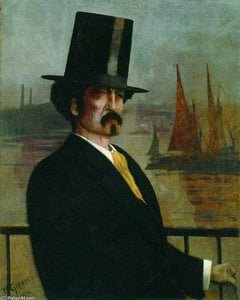
As Greaves matured, his artistic circle expanded to include one of the most influential figures of the era: James McNeill Whistler. Their encounter in 1863 ignited a lifelong friendship and a transformative artistic partnership. Where Turner provided the atmospheric inspiration, Whistler offered a new way of seeing through the lens of Aestheticism. Under Whistler’s mentorship, Greaves began to experiment with more daring color palettes and innovative compositional structures. This period saw Greaves moving beyond mere topographical documentation toward a more nuanced exploration of urban mood and tonal harmony. Together, they wandered the Thames landscape, capturing the changing tides of both the river and the city itself.
The brilliance of Greaves’s talent was perhaps most startlingly evident in his early achievements. At the tender age of sixteen, he produced “Hammersmith Bridge on Boat-Race Day,” a work that remains a cornerstone of British art history. This piece, often celebrated for its naïve charm, reveals a prodigious ability to render human energy and architectural scale with remarkable accuracy. It serves as a testament to a young artist capable of capturing the sheer excitement of London’s social spectacles through a lens of profound observation. Through his work, the river was never just a setting; it was a protagonist, subject to the same dramatic shifts in emotion and light as the people who lived along its banks.
Legacy of the Victorian Realist
Throughout a career spanning over five decades, Greaves maintained a steadfast dedication to the social landscape of his beloved London. His oeuvre is characterized by a beautiful tension between meticulous detail and impressionistic atmosphere. Whether he was depicting the gritty reality of “Unloading The Barge, Lindsey Wharf” or the hazy, dreamlike qualities of “Lindsay Wharf, Chelsea,” his work consistently sought to honor the dignity of labor and the quiet beauty of the industrial Thames. His ability to blend the realism of a topographical draftsman with the evocative textures of an etcher allowed him to document a vanishing era of London life.
The historical significance of Walter Greaves lies in his role as a vital chronicler of the Victorian social landscape. While names like Whistler and Turner often dominate the historical narrative, Greaves provided the essential connective tissue between the grand romanticism of the past and the burgeoning realism of the modern age. His paintings remain evocative windows into a world of coal offices, bustling wharves, and the enduring spirit of the river. Today, his work stands as a tribute to the power of observation and the enduring allure of the Thames, reminding us that true artistic brilliance often resides in the quiet, faithful recording of the world around us.



 Preview
 Buy Hand Made Painting
 Send
Send Share
Share
 Details

 Download
 Similars
 X-Ray
X-Ray Diaporama
 Read More






































 Glass option is only available in size under 110 CM