

The artwork displayed on this page is protected by copyright law, which means we cannot legally create or sell an identical reproduction. This protection is enforced under international agreements such as the Berne Convention and by national laws, including those outlined by the U.S. Copyright Law - Title 17.
This method fully complies with copyright regulations because it does not involve copying or duplicating the protected artwork. Instead, it is a creative reinterpretation - a new painting that is influenced by the original but not identical to it.
Museum-quality giclée or canvas print with fast production and flexible finish options. ( Buy Hand Made Painting Switch to Digital Image)





























Pick from our preset sizes that match the artwork's original proportions.

Type the width and the height you need, to fit your frame or your wall. A print can only be cut, never made bigger than the picture, so a size with a different shape loses a part of the image. We send you a digital mockup to approve before we print anything. The picture shown on this page does not show the real cut — only the mockup does.
Worldwide Delivery () in 2 weeks instead of standard 4/5 weeks. (22 October)
Ocean
Reproduction Size
Vija Celmins’s “Ocean” isn’t merely a painting; it’s an immersion. It’s a deliberate stripping away of all extraneous context, leaving only the raw, insistent presence of water itself. The work, created in 1975, presents a relentlessly horizontal expanse of gray and white – a seemingly simple depiction of waves that, upon closer inspection, reveals itself to be a profound meditation on observation, memory, and the very nature of perception. There’s no horizon line to anchor the eye, no suggestion of sky or distant shore; instead, we are confronted with an infinite field of undulating lines, each meticulously rendered to capture the subtle shifts in texture and tone that define the surface of the sea.
Celmins' approach is deeply rooted in a process of painstaking replication. She began by studying photographs of oceans, not as representations of reality, but as records of light and movement. This foundational act of observation informs every line, every shade, creating an illusion of depth and volume that defies the two-dimensionality of the medium. The work’s hyperrealistic quality isn't about photographic accuracy; it’s about distilling the essence of the ocean – its ceaseless motion, its subtle variations in color, and its inherent quietude – into a visual language that transcends literal depiction.
While often associated with painting, Celmins' technique leans heavily towards printmaking. The incredibly fine lines, achieved through the application of graphite on paper, evoke the delicate tracery of etching or lithography. This choice of medium is crucial to understanding the work’s impact. Graphite allows for an unparalleled level of detail and tonal control, enabling Celmins to capture the subtle nuances of light reflection and wave movement with astonishing precision. The process itself—the countless hours spent meticulously rendering each individual crest – speaks volumes about her dedication to observation and her commitment to translating a sensory experience into a tangible form.
It’s important to note that Celmins' work is not simply a technical exercise; it’s an intensely personal one. She has described the act of drawing as a way of “remembering” – of holding onto fleeting moments and impressions. The repetitive nature of her process, combined with the subject matter—the ocean, a symbol of vastness and timelessness—creates a meditative effect, inviting the viewer to lose themselves in the work’s quiet intensity.
Celmins' early artistic development was profoundly shaped by her encounter with the Italian monochrome still life painter Giorgio Morandi. Like Morandi, she was drawn to the subtle variations in tone and texture—the way light plays across surfaces, the delicate interplay of shadow and highlight. This influence is evident in “Ocean,” where Celmins masterfully manipulates graphite to create a sense of depth and volume through carefully controlled gradations of gray. The work shares Morandi’s quiet contemplation, its focus on the beauty of simple forms and the power of observation.
At first glance, “Ocean” might seem like a purely descriptive image—a straightforward representation of water. However, beneath this surface simplicity lies a wealth of symbolic meaning. The ocean has long been associated with vastness, mystery, and the unknown – representing both the potential for adventure and the inevitability of change. Celmins’s meticulous rendering of its surface suggests an attempt to capture this elusive quality—to hold onto the fleeting moment before it dissolves into nothingness. The work's stillness, despite the implied movement of the waves, speaks to a deeper sense of contemplation, inviting us to consider our place within the larger context of existence.
"Ocean", created in 1975, belongs to the Contemporary of Vija Celmins's career.
"Ocean" connects the Contemporary Realism movement with Latvia through its creator's birthplace.
Vija Celmins made "Ocean" in 1975.


1938 - , Latvia

Embark on a cultural journey through Lyrical Abstraction. Explore how masters like Kandinsky used color and motion to translate emotion into visual poetry. Discover the profound beauty of abstract expressionism and learn to curate emotional resonance in your own art collection.

Explore 10 defining Abstract Expressionism masterpieces by Pollock, Rothko & de Kooning. Discover the stories behind these iconic paintings and find museum-quality art reproductions to elevate your home decor on .
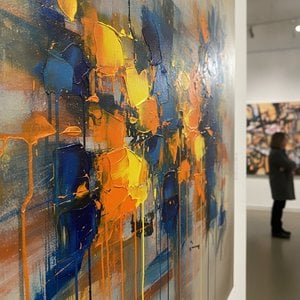
Master the high-impact world of contemporary abstraction. Discover how bold colors, textures, and modern movements like Abstract Expressionism can transform your space with premium, high-energy art curated for the design-conscious professional.

Journey through Wassily Kandinsky's 25 most iconic abstract paintings. Explore his revolutionary use of color, form & spiritual expressionism. Find museum-quality Kandinsky reproductions and elevate your home decor with WahooArt.com. Discover all masterpieces on WahooArt.com!

Explore 10 defining masterpieces of Geometric Abstraction! Discover Kandinsky, Mondrian & Malevich’s iconic works. Find museum-quality art reproductions and curated decor ideas to elevate your home at WahooArt.com.

 Preview
 Send
Send Share
Share
 Details
 Guide
Guide

 Download
 Similars
 X-Ray
X-Ray Diaporama
 Stats
Stats


 Read More









 Glass option is only available in size under 110 CM


