

The artwork displayed on this page is protected by copyright law, which means we cannot legally create or sell an identical reproduction. This protection is enforced under international agreements such as the Berne Convention and by national laws, including those outlined by the U.S. Copyright Law - Title 17.
This method fully complies with copyright regulations because it does not involve copying or duplicating the protected artwork. Instead, it is a creative reinterpretation - a new painting that is influenced by the original but not identical to it.
Museum-quality giclée or canvas print with fast production and flexible finish options. ( Buy Hand Made Painting Switch to Digital Image)





























Pick from our preset sizes that match the artwork's original proportions.

Type the width and the height you need, to fit your frame or your wall. A print can only be cut, never made bigger than the picture, so a size with a different shape loses a part of the image. We send you a digital mockup to approve before we print anything. The picture shown on this page does not show the real cut — only the mockup does.
Worldwide Delivery () in 2 weeks instead of standard 4/5 weeks. (9 November)
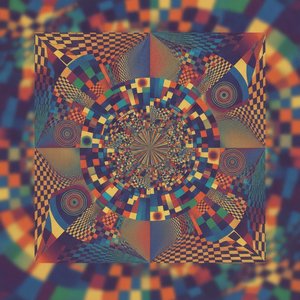
Ouivar II
Reproduction Size
Victor Vasarely’s “Ouivar II” stands as a testament to the transformative power of abstraction and the mesmerizing allure of optical illusion. Painted sometime in the late 1960s, this striking artwork embodies the zenith of Op Art – Optical Art – a movement that sought to challenge conventional perceptions of reality by exploiting visual phenomena like parallax and simultaneous contrast.
Historical Context: Op Art emerged in the mid-1960s, fueled by advancements in printing technology and a growing fascination with neuroscience. Artists like Vasarely were driven by a desire to investigate how the human eye perceives color and form. They aimed to provoke a visceral reaction from the audience – disorientation, surprise, and ultimately, an awareness of the brain’s active role in constructing visual experience.
Symbolism & Emotional Impact: While devoid of explicit narrative content, “Ouivar II” speaks volumes about order amidst apparent chaos. The repetitive geometric pattern symbolizes stability and precision, juxtaposed against the illusion of movement. Vasarely himself described his work as a "visual music," suggesting that it seeks to evoke feelings of dynamism and contemplation.
Victor Vasarely's recurring themes include bauhaus geometric abstraction, visual perception art, modern design aesthetic, formal experimentation style, kinetic illusion artwork; "Ouivar II" focuses on geometric patterns, optical illusion, tessellation, color contrast, bauhaus influence, kinetic art, visual perception.
"Ouivar II" has an augmented reality preview: the artwork's AR Preview page shows it in your own space on a compatible device.
A slideshow is available: the Diaporama page of "Ouivar II" by Victor Vasarely.
Born Károly Vaszary on 9 April 1906 in Pécs, Hungary, the man who would become known as Victor Vasarely began his path in a different field entirely. In 1925, he moved into the halls of Eötvös Loránd University in Budapest to study medicine. The logic of the human body and science occupied his time for two years, but the pull of visual expression eventually took precedence. By 1927, he left his medical studies behind to pursue the study of traditional academic painting at the Podolini-Volkmann Academy.
His training continued as he moved into Sándor Bortnyik’s műhely. This workshop was a place where the principles of the Bauhaus movement took root, focusing on the intersection of functional design and geometric abstraction. Here, the focus shifted toward the structural and the systematic. The lessons learned in these studios provided the foundation for his later investigations into how shapes and colors interact with the eye.
Between 1929 and 1944, Vasarely focused on graphic work. He spent these years experimenting with how light and shadow interact with simple forms. His early graphic period produced pieces like Chess Board (1935) and Girl-power (1934). He also worked on Zebras in 1937. These works show a growing interest in how a viewer perceives a flat surface. He moved away from traditional painting toward a more structured, graphic approach.
From 1944 to 1947, his direction shifted. He moved through several styles, including cubistic, futuristic, expressionistic, symbolistic, and surrealistic approaches. He eventually moved past these experiments, looking for a more precise way to organize space. This search for a new logic led him to publish his Yellow Manifest. His work became less about individual expression and more about the mechanics of sight. This systematic method eventually established him as a leader of the Op art movement.
Vasarely’s approach relies on a systematic use of geometry to trigger a physical response in the viewer. He did not rely on traditional light sources or classical chiaroscuro to create form. Instead, he used a sophisticated interplay of high-contrast pigments to simulate depth and movement. By manipulating color density, he could trick the eye into perceiving recession and protrusion on a flat plane. This method turns a static surface into a space that seems to swell or recede.
His method, which he referred to as visual kinetics or plastique cinétique, involves a precise arrangement of shapes. He utilized textural effects, perspective, shadow, and light to build these illusions. The work often relies on the way the eye interprets rhythmic, internal radiance rather than external illumination. Through the use of grids and mathematical principles, he created sensations of visual vibration and swirling effects. The result is a sense of movement that exists entirely within the viewer's perception.
The precision of his technique is evident in how he handles color and line to create architectural depth. In works like Torony-Nagy, the intersection of crisp white lines with deep blues and emerald greens creates a rhythmic optical vibration. These elements work together to produce a sensation of pulsing light. He used these tools to move beyond simple representation, focusing instead on the mechanics of how we see.
In 1937, the creation of Zebra marked a shift toward what many consider the earliest examples of Op Art. This work moved away from traditional representation, focusing instead on the way the eye interprets simple forms. By the 1960s, his experiments with rhythm and light reached a peak in the 1969 work Torony-Nagy. This piece uses four stylized towers and a high-contrast palette of blues, greens, and oranges to create a sense of internal radiance. The composition relies on intersecting white lines and color density to make the flat surface appear to pulse and recede.
His interest in movement extended into three-dimensional space and everyday objects. He designed Georges Pompidou, a large kinematic object, which integrated his visual theories into a physical, moving form. This interest in the practical application of his geometry also led to a collaboration with Rosenthal Studio Linie. This partnership resulted in the Suomi tableware series, a 500-piece run that brought his geometric patterns into the domestic sphere.
In 1966, Victor Vasarely began the process of establishing the Fondation Vasarely. This project was built upon his specific ideas regarding the concept of "art for all" and his vision for a "city of tomorrow." He wanted to create a space that moved beyond the traditional gallery experience to reflect these principles. The physical construction of the building began in 1973.
The foundation was officially inaugurated on 14 February 1976 in Aix-en-Provence, France. The site was designed to house his works and promote his theories on how art and urban design might interact. The architecture of the space itself was part of this vision, with the building's layout intended to support the way his geometric forms were meant to be experienced by the public.
The reach of his visual language extended far beyond the walls of a gallery. His patterns and geometric structures found their way into the textures of everyday life, influencing the lines of fashion, the layouts of interior design, and the logic of graphic design. Even the early development of computer graphics carries the imprint of his systematic approach to form and perception. His ideas were not confined to the canvas; they moved into the functional world of objects and the digital structures that followed.
In 1982, his work traveled into space when serigraphs were included aboard the French-Soviet spacecraft Salyut 7. This moment highlighted a connection between his mathematical precision and the broader human endeavor of exploration. He remained a central figure in modern art history until his death in Paris, France, on 15 March 1997.
Tracing the physical presence of his work requires traveling across several locations in France and Hungary. In Aix-en-Provence, France, the Fondation Vasarely holds a significant portion of his output. This museum was established by the artist himself to promote his ideas regarding art for all. The space is organized into seven hexagonal cells, each measuring 14 metres across and 11 metres high, designed to house forty-two large-scale works that are 6 by 8 metres in size.
His presence in Hungary is also felt through dedicated spaces. The Vasarely Museum is located in Pécs, the city of his birth. There is also a Vasarely Museum situated in the Zichy Palace in Óbuda, Budapest. These locations allow for a direct encounter with the geometric forms and optical effects that defined his practice. In France, another site for his work is the Vasarely Museum at the Saint-Firmin Palace in Gordes.
Beyond these specific museums, his influence is found in various institutional collections. Some of his pieces are held by the Bilbao Fine Arts Museum, while others are part of the collections at the Inter-American Development Bank in Washington, D.C., and the Bechtler Museum of Modern Art in Charlotte. These scattered locations ensure his visual experiments remain accessible to different audiences.

1906 - 1997 , Croatia

Explore the profound spiritual depth of geometric abstraction. From Malevich's Suprematism to modern masters, our expert guide reveals how pure form and color command presence in fine art collections.

Embark on a visual journey through the mesmerizing world of Op Art. Discover the masters of optical illusion, explore geometric abstraction, and learn how to curate high-impact kinetic works for your private collection with expert guidance from art professionals.

Explore the profound world of optical art and masterpieces that redefine perception. From Vasarely’s geometric illusions to Farndon’s sensory reality, discover how legendary works challenge the eye and transform the viewer's experience through sophisticated abstraction.
Explore the mesmerizing world of Victor Vasarely. Discover how his Bauhaus-inspired Op Art masters the science of perception through geometric abstraction and vibrant color. A sophisticated guide for discerning art collectors seeking to understand the legacy of optical illusion.

Discover the profound beauty of abstract art. Our expert guide explores geometric abstraction, Op Art, and Expressionism, offering connoisseurs deep insights into collecting and curating powerful, non-representational masterpieces for sophisticated interiors.
 Preview
 Send
Send Share
Share
 Details
 Guide
Guide

 Download
 Similars
 X-Ray
X-Ray Diaporama
 Q&A
Q&A
 Stats
Stats
 Read More









 Glass option is only available in size under 110 CM


