Early Life and the Seeds of Surrealism
Victor Brauner, born in Piatra Neamt, Romania, in 1903, embarked on an artistic journey deeply intertwined with spiritual currents and a restless exploration of form. His father’s interest in spiritualism cast a long shadow over young Victor's formative years, fostering a fascination with the unseen realms that would later permeate his canvases. The family’s relocation to Vienna introduced him to new cultural landscapes, followed by a return to Romania where he attended school in Brăila and developed an early passion for zoology – a curiosity about living forms that would subtly inform his artistic vision. Formal training at the National School of Fine Arts in Bucharest provided a foundation, but Brauner quickly proved himself a nonconformist, eager to break free from traditional constraints. Early landscapes, reminiscent of Paul Cézanne’s structured compositions during visits to Fălticeni and Balcic, were merely stepping stones; he was destined for more radical territories. He swiftly declared allegiance to Dadaism, Abstraction, and Expressionism before finding his true home within the burgeoning Surrealist movement. His first solo exhibition in Bucharest in 1924 at the Mozart Galleries signaled the arrival of a unique voice, one poised to challenge conventional perceptions of reality.
Parisian Encounters and the Development of a Personal Mythology
The pull of Paris proved irresistible, and Brauner made his first journey there in 1925, returning again in 1927. This period marked a crucial phase in his artistic development, fueled by intellectual exchange and collaboration. Co-founding the avant-garde magazine *75HP* with poet Ilarie Voronca allowed him to articulate his theories on “pictopoetry” and "surrationalism," concepts that sought to bridge the gap between visual art and poetic expression. Works like *Christ at the Cabaret*, a biting commentary on societal structures influenced by George Grosz, and *The Girl in the Factory*, echoing Ferdinand Hodler’s solemnity, demonstrated his early critical engagement with the world around him. A pivotal encounter occurred with Constantin Brâncuși, who mentored Brauner in art photography, refining his eye for composition and form. Friendships with Benjamin Fondane and Yves Tanguy further cemented his connection to the Parisian Surrealist circle. This was a time of intense experimentation, culminating in works like *Self-Portrait with Enucleated Eye*, a haunting premonition of loss and a recurring motif that would define much of his later work. André Breton’s enthusiastic introduction to Brauner's 1934 Paris exhibition at the Pierre Gallery highlighted pieces such as *Mr. K's Power of Concentration* and *The Strange Case of Mr. K*, drawing parallels to Alfred Jarry’s absurdist masterpiece, *Ubu Roi*.
Tragedy, War, and a Deepening of Symbolic Language
Brauner’s return to Bucharest in 1935 was marked by brief involvement with the Romanian Communist Party, but his artistic focus remained firmly rooted in Surrealism. An exhibition at the Mozart Galleries sparked debate about the role of avant-garde art within Romanian society. However, it was a personal tragedy that profoundly altered the course of his life and work: in 1938, during an altercation between Oscar Domínguez and Esteban Francés, Brauner intervened to protect Francés and lost his left eye. This devastating event seemed to confirm the prophetic nature of his earlier paintings featuring eyes—symbols of vision, perception, and vulnerability. He married Jaqueline Abraham that same year and began creating a series of paintings known as *Lycanthropic* or *Chimeras*, exploring themes of transformation, hybridity, and the primal forces within the human psyche. The outbreak of World War II forced Brauner to flee Paris in 1940 with Pierre Mabille, seeking refuge first in Perpignan and then in the remote Eastern Pyrenees, where he endured a period of enforced seclusion at Saint Feliu d'Amont. Despite these hardships, he maintained contact with fellow Surrealists in Marseille, sustaining his artistic practice amidst chaos and uncertainty.
Post-War Resilience and Lasting Legacy
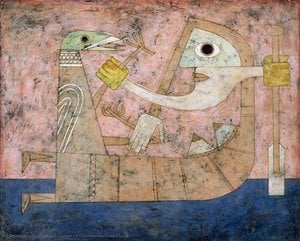
After gaining permission to settle in Marseille in 1941, Brauner continued painting despite serious illness, demonstrating remarkable resilience. *Prelude to a Civilization*, completed in 1954 and now housed at the Metropolitan Museum of Art, exemplifies his mature style—an intricate encaustic on masonite that showcases his mastery of texture and symbolic layering. He participated in the Venice Biennale and traveled to Italy after the war, further expanding his artistic horizons. Victor Brauner’s work is characterized by its unique blend of Surrealist imagery, mythological references, and a deeply personal exploration of prophecy and spirituality. His distinctive visual language, incorporating symbols from diverse sources like Tarot cards, ancient codices, and tribal art, established him as a significant figure in 20th-century art. He died in Paris on March 12, 1966, leaving behind a body of work that continues to fascinate and inspire viewers with its enigmatic power—a testament to an artist who dared to delve into the hidden depths of the human subconscious and translate his visions onto canvas.
Key Characteristics of Brauner’s Art
- Surrealist Imagery: Brauner's paintings are populated with dreamlike figures, hybrid creatures, and symbolic objects that defy rational interpretation.
- Mythological References: He drew inspiration from a wide range of mythologies, including Egyptian, Greek, and pre-Columbian cultures, imbuing his work with layers of meaning.
- Symbolism: Eyes, chimeras, geometric shapes, and esoteric symbols recur throughout his oeuvre, each carrying multiple layers of significance.
- Encaustic Technique: In his later years, Brauner experimented extensively with encaustic painting—a technique using heated beeswax—creating richly textured surfaces that enhance the otherworldly quality of his work.
- Autobiographical Elements: While often veiled in symbolism, Brauner’s paintings are deeply personal, reflecting his own experiences, anxieties, and spiritual beliefs. The loss of his eye became a central motif, representing both physical trauma and a heightened state of perception.


 Send
Send Share
Share
 Details
 Guide
Guide

 Download
 Similars
 Diaporama
 Q&A
Q&A
 Stats
Stats


 Read More
 Switch to Print





































 Glass option is only available in size under 110 CM