
 Acrylic On CanvasWallArtCubism
 1912Modern
 80.0 x 80.0 cm
Purchase a high-resolution, enhanced digital image, far superior to the online preview.
Each file is meticulously prepared by our in-house specialists using advanced tools and expert manual retouching. We ensure every image has exceptional clarity, precise color accuracy, and fine detail.
The final file is delivered via email within 72 hours, optimized for immediate use in professional, editorial, and print environments. This is the same quality trusted by top-tier design studios, publishers, and galleries.
Download a high-resolution file for personal display, printing, and creative projects. ( Switch to Print Buy Hand Made Painting)
When you choose WahooArt.com, you're not just getting an image - you're receiving a professionally enhanced digital artwork, crafted with precision and backed by a satisfaction guarantee. Here's everything that comes with your order, automatically:

Your high-resolution digital image file will be emailed to you within 72 hours of ordering - ready for immediate use.

Your artwork is professionally optimized using advanced AI tools and manual editing, ensuring maximum detail, clarity, and color accuracy.

Accidentally deleted or lost your file? No worries - we'll resend it to you anytime, free of charge.

Enjoy your artwork instantly with zero customs, duties, or delivery fees - digital downloads are always tax-free.

We ensure your digital image reflects the original colors as closely as possible using professional tools and color management.

If you're not satisfied with your digital image, we'll revise it or refund 100% within 100 days - no questions asked.

Not satisfied? Get a full refund within 100 days of receiving your digital file - no questions asked.

Buy 3 images, save 10% - Buy 5, save 15% - Buy 10+, save 20%. Great for creative projects, galleries, and agencies.
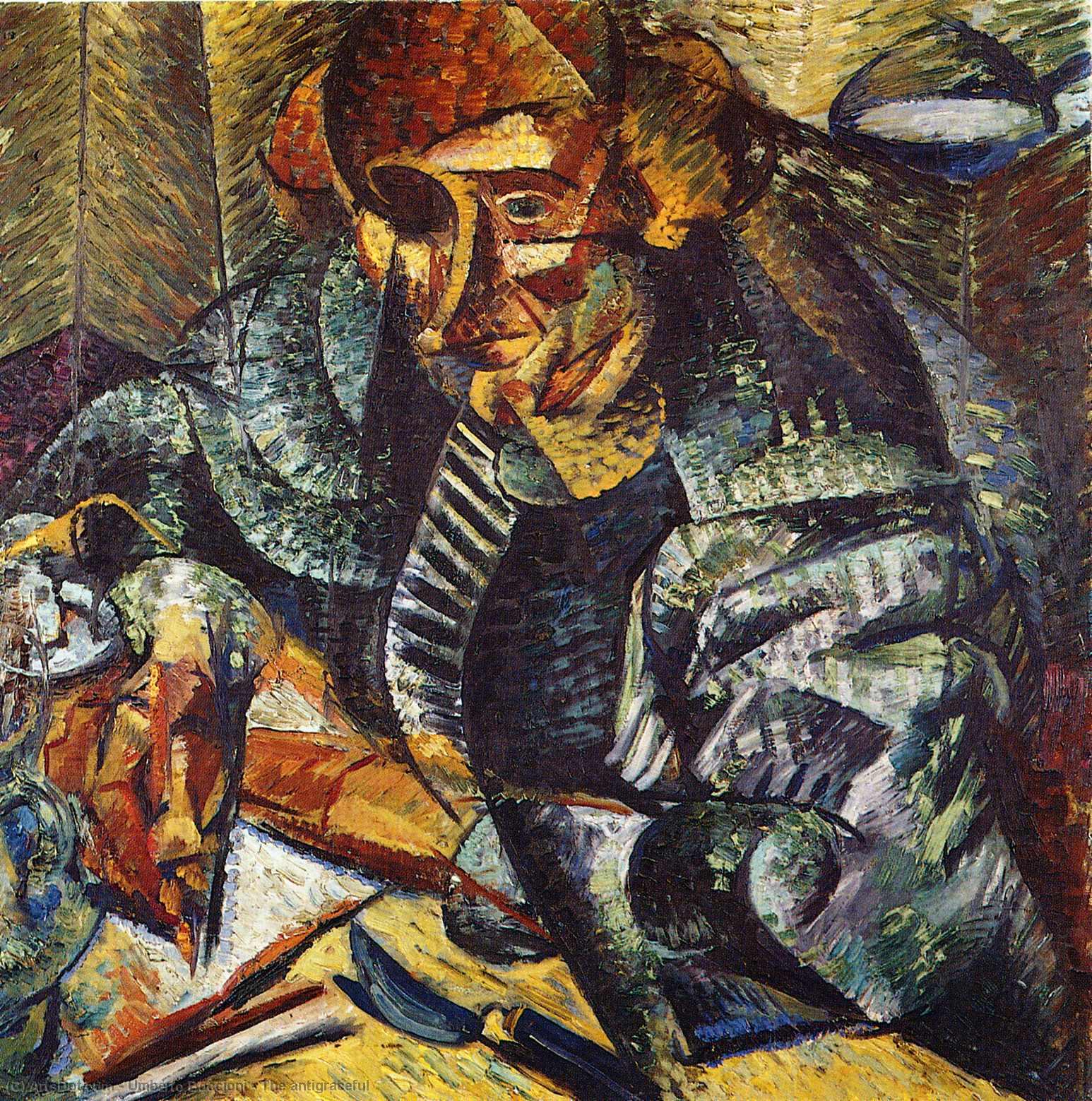
Umberto Boccioni's 1912 work, *The antigraceful*, is not merely a portrait; it’s a manifesto rendered in paint. A defiant gesture against the established artistic conventions of its time, this piece embodies the core tenets of Futurism – a movement obsessed with dynamism, technology, and the rejection of the past. Rather than seeking to capture conventional beauty, Boccioni aimed to dissect and reconstruct form, presenting a vision that was deliberately unsettling yet profoundly modern. The painting depicts his mother, Cecilia Forlani, but it’s not a sentimental tribute; instead, it's an intellectual exploration of how perception itself can be fragmented and reassembled.
To understand *The antigraceful*, one must consider the artistic climate of early 20th-century Italy. Boccioni, alongside artists like Giacomo Balla and Carlo Carrà, felt stifled by the academic traditions that dominated the art world. They sought to break free from these constraints, embracing a new aesthetic inspired by the speed and energy of modern life – the automobile, the factory, the bustling city streets. This fascination with motion is subtly present even in this seemingly static portrait; the fractured planes and angular forms suggest an underlying sense of restlessness, as if Cecilia Forlani herself is caught within a whirlwind of change. The influence of Paul Cézanne and, notably, Pablo Picasso’s early Cubist experiments are visible here, but Boccioni wasn't simply imitating these artists. He was adapting their techniques to express the unique spirit of Italian Futurism – a desire not just to depict reality, but to *dynamize* it.
The technique employed in *The antigraceful* is crucial to its impact. Boccioni abandons traditional modeling and shading, opting instead for a fractured composition built from intersecting planes of color. This deliberate distortion isn’t arbitrary; it's intended to convey the subject’s inner life – her thoughts, emotions, and experiences – as a complex interplay of forces. The painting doesn’t offer a single, fixed perspective; rather, it presents multiple viewpoints simultaneously, challenging the viewer to actively participate in constructing meaning. The muted palette, dominated by earthy tones with subtle accents of blue and yellow, further enhances the sense of introspection and psychological depth. It's a far cry from the idealized portraits of previous generations, offering instead a raw and honest portrayal of human experience. The title itself – *Antigraceful* – is a deliberate provocation, signaling Boccioni’s rejection of conventional notions of beauty and harmony.
Though his life was tragically cut short by war in 1916, Umberto Boccioni left an indelible mark on the history of art. *The antigraceful* remains a powerful testament to his artistic vision – a bold declaration of independence from tradition and a pioneering exploration of new ways of seeing and representing the world. Today, this work continues to resonate with audiences, inspiring artists and captivating collectors alike. A reproduction of *The antigraceful* isn’t just an acquisition; it's an invitation to engage with a pivotal moment in art history – a moment when the very foundations of artistic expression were being challenged and redefined.


1882 - 1916 , Italy

 Preview
 Send
Send Share
Share
 Details

 Download
 Similars
 X-Ray
X-Ray Diaporama
 Stats
Stats Read More


