Preview AR preview Switch to Print Buy Hand Made Painting Send
Details Guide Add to favorites Download Similars X-Ray Diaporama Stats

Pieta

Discover 'Pieta' by Titian Ramsay Peale II (1576), a rediscovered Renaissance masterpiece blending religious solemnity with Venetian-inspired artistry. Explore this captivating work and the artist’s legacy at WahooArt.

Explore Titian Ramsay Peale II (1799-1885), an American artist & naturalist blending High Renaissance artistry with scientific observation. Discover his stunning wildlife paintings and legacy.

Purchase a high-resolution, enhanced digital image, far superior to the online preview.

Each file is meticulously prepared by our in-house specialists using advanced tools and expert manual retouching. We ensure every image has exceptional clarity, precise color accuracy, and fine detail.

The final file is delivered via email within 72 hours, optimized for immediate use in professional, editorial, and print environments. This is the same quality trusted by top-tier design studios, publishers, and galleries.

Digital Image

Download a high-resolution file for personal display, printing, and creative projects. ( Switch to Print Buy Hand Made Painting)

Total Price

$ 24.90

Included in Every Digital Image Order

Expert Digital Delivery, Guaranteed

When you choose WahooArt.com, you're not just getting an image - you're receiving a professionally enhanced digital artwork, crafted with precision and backed by a satisfaction guarantee. Here's everything that comes with your order, automatically:

shipping_icon
Fast Email Delivery

Your high-resolution digital image file will be emailed to you within 72 hours of ordering - ready for immediate use.

canvas_icon
AI-Enhanced Digital File

Your artwork is professionally optimized using advanced AI tools and manual editing, ensuring maximum detail, clarity, and color accuracy.

insurance_icon
Free Lifetime Re-Delivery

Accidentally deleted or lost your file? No worries - we'll resend it to you anytime, free of charge.

tax_icon
No Import Fees - Ever

Enjoy your artwork instantly with zero customs, duties, or delivery fees - digital downloads are always tax-free.

color_icon
Color Accuracy Guarantee

We ensure your digital image reflects the original colors as closely as possible using professional tools and color management.

return_icon
100-Day Satisfaction Guarantee

If you're not satisfied with your digital image, we'll revise it or refund 100% within 100 days - no questions asked.

guarantee_icon
100% Money-Back Guarantee

Not satisfied? Get a full refund within 100 days of receiving your digital file - no questions asked.

discount_icon
Bulk Order Discounts

Buy 3 images, save 10% - Buy 5, save 15% - Buy 10+, save 20%. Great for creative projects, galleries, and agencies.

Quick Facts

  • Notable elements or techniques: Oil on canvas
  • Subject or theme: Religious scene
  • Artistic style: Renaissance
  • Year: 1576
  • Movement: High Renaissance
  • Dimensions: 351 x 389 cm

Art Quiz

There is only one correct answer for each question.

Question 1:
Based on the provided information, what artistic period heavily influenced Titian Ramsay Peale II’s style?
Question 2:
What is the approximate size of the 'Pieta' painting by Titian Ramsay Peale II?
Question 3:
The image description mentions figures in the foreground and background. What is happening with the man in the foreground?
Question 4:
Titian Ramsay Peale II came from a family known for what profession?
Question 5:
What year was the 'Pieta' painting created?

A Renaissance Echo in America: Titian Ramsay Peale II’s *Pieta*

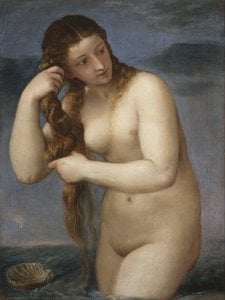
Titian Ramsay Peale II's *Pieta*, completed in 1576, is not merely a painting; it’s a poignant echo of the High Renaissance ideals brought to life on American soil. Standing at an impressive 351 x 389 cm, this monumental work commands attention, drawing viewers into a scene steeped in sorrow and spiritual contemplation. While bearing the title *Pieta* – traditionally depicting the Virgin Mary cradling the body of Jesus – Peale’s interpretation diverges from the Italian masters like Michelangelo, offering a uniquely American sensibility to this timeless subject. The composition is dynamic, filled with figures that convey a palpable sense of grief and devotion. A kneeling figure dominates the foreground, his hands raised in supplication, while the central form—presumably representing Christ—is held with tender reverence. In the background, flanking what appears to be a doorway or architectural recess, stand two angels, their presence both ethereal and grounding.

The Peale Legacy and Artistic Influences

To understand *Pieta*, one must consider Titian Ramsay Peale II within the context of his family. Born in 1799, he was the son of Charles Willson Peale, a celebrated American portraitist and founder of the Pennsylvania Academy of the Fine Arts. This familial connection provided young Titian with an early immersion into the world of art, though he ultimately forged his own path, blending artistic training with a deep fascination for natural history—a pursuit that would define much of his career. The influence of the High Renaissance is undeniable in *Pieta*. Peale’s meticulous attention to detail, refined color palette, and balanced composition all point towards an admiration for masters like Raphael and Titian (for whom he was named). However, unlike many American artists who traveled to Europe to study the Old Masters firsthand, Peale II largely developed his style through exposure to works available in America and through familial instruction. This resulted in a distinctive synthesis of European tradition and American artistic sensibilities.

Symbolism and Emotional Resonance

The *Pieta* motif itself is laden with symbolism, representing not only the sorrow of Mary over her son’s death but also themes of sacrifice, redemption, and divine love. Peale II's rendition amplifies these emotions through careful arrangement and expressive gestures. The kneeling figure embodies human grief and faith, while the angels symbolize heavenly solace and intervention. The architectural setting in the background isn’t merely decorative; it suggests a sacred space—a church or temple—further emphasizing the religious nature of the scene. While details regarding specific iconographic choices within Peale's *Pieta* remain open to interpretation due to limited documentation, the overall effect is profoundly moving. The painting evokes a sense of solemnity and quiet contemplation, inviting viewers to reflect on themes of mortality, faith, and compassion. The work’s scale contributes significantly to its emotional impact; it isn’t a small, intimate devotional piece but rather a grand statement of religious belief.

A Rediscovered Masterpiece for the Modern Home

For collectors and interior designers seeking a statement piece that blends historical significance with artistic beauty, Titian Ramsay Peale II's *Pieta* offers an exceptional opportunity. A hand-painted reproduction from WahooArt allows you to bring this rediscovered masterpiece into your space, adding a touch of Renaissance grandeur and American artistry. The painting’s somber yet hopeful tone makes it suitable for a variety of settings—from traditional libraries and studies to more contemporary living areas seeking a focal point with depth and meaning. Its large size demands attention, making it ideal for spacious rooms where its details can be fully appreciated. *Pieta* is not simply a decorative element; it’s an invitation to engage with art history, contemplate profound themes, and enrich your surroundings with the legacy of a remarkable American artist.


Artist Biography

A Renaissance Echo in the New World

Titian Ramsay Peale II occupies a fascinating, often overlooked niche within the landscape of 19th-century American art. Born in Philadelphia in 1799, he was steeped in artistic lineage as the youngest son of Charles Willson Peale, a pivotal figure in early American portraiture and founder of the nation’s first museum. While his father's legacy loomed large, Titian forged his own path, one deeply rooted in the aesthetic ideals of the High Renaissance, particularly those emanating from Venice. He wasn’t merely replicating styles; he was channeling a profound artistic sensibility, imbuing his canvases with a meticulous detail and vibrant color palette that set him apart from many of his contemporaries. His life unfolded against a backdrop of burgeoning American identity, yet his artistic heart remained tethered to the classical masters, creating a compelling tension between Old World reverence and New World expression.

From Naturalist’s Sketchbook to Painter's Canvas

Peale’s early years were marked by a dual fascination with art and natural history – a combination fostered by his father’s multifaceted pursuits. He accompanied expeditions, notably Stephen Harriman Long’s journey to the Rocky Mountains in 1819-20, documenting flora and fauna with an increasingly refined artistic eye. This period wasn't simply about recording observations; it was about *understanding* form, light, and texture – skills that would prove invaluable when he turned his full attention to painting. His work as a naturalist informed his art, lending a scientific precision to his depictions of the natural world, but also imbuing them with an emotional resonance that transcended mere documentation. He wasn’t just showing us what things looked like; he was revealing their inherent beauty and spiritual significance. This dedication to both disciplines is evident in pieces such as “The Tribute Money,” a dramatic rendering showcasing masterful light and shadow reminiscent of Rubens, and "Nymph and Shepherd", blending nature, mythology, and sensual beauty.

Venetian Influences and Sacred Visions

The influence of Venetian colorism – the emphasis on rich, luminous colors and atmospheric effects championed by artists like Titian (from whom he took his first name) – is undeniable in Peale’s oeuvre. He wasn't simply copying these masters; he was internalizing their principles and adapting them to his own artistic vision. This is particularly evident in his religious works, such as “Altar Shrine with Four Saints” and "Adoration of the Shepherds". These paintings aren’t merely depictions of biblical scenes; they are immersive experiences, drawing the viewer into a world of spiritual contemplation through carefully orchestrated compositions and a masterful use of color to evoke emotion. The meticulous attention to detail in these works speaks not only to his technical skill but also to a deep reverence for his subject matter. “The Beauty,” a striking portrait, further demonstrates his ability to capture human form and character with elegance and refinement.

Rediscovery and Lasting Significance

For much of the 20th century, Titian Ramsay Peale II remained largely obscured from art historical narratives. His work didn’t fit neatly into prevailing trends, and his dedication to a classical style felt anachronistic in a rapidly changing artistic landscape. However, recent years have witnessed a growing reassessment of his contributions. Scholars and collectors are recognizing the unique blend of American sensibilities and European traditions that characterizes his paintings. The rediscovery of his work is not merely about filling gaps in art history; it’s about gaining a deeper understanding of the complex cultural forces that shaped 19th-century America. Peale represents a bridge between worlds, a testament to the enduring power of classical ideals, and a reminder that artistic innovation often arises from unexpected combinations of influences. His paintings, now found in collections like those at WahooArt, the Uffizi Gallery, and Palazzo Pitti, offer a compelling glimpse into a forgotten corner of American art history – a corner illuminated by the radiant glow of the Renaissance.

Quick Facts

  • Artistic Movement Or Style: High Renaissance
  • Artists Who Influenced This Artist:
    • Titian
    • Venetian masters
  • Date Of Birth: 1799
  • Date Of Death: 1885
  • Full Name: Titian Ramsay Peale II
  • Nationality: American
  • Notable Artworks:
    • Altar Shrine with Four Saints
    • Adoration of the Shepherds
    • The Beauty
    • Tribute Money
    • Holy Family w/ Shepherd
    • Nymph and Shepherd