FREE ART CONSULTATION

x
Buy print Buy printBuy Image Buy Image SendSend
DetailsDetails Add to favorites Add to favorites DownloadDownload SimilarsSimilars X-RayX-Ray DiaporamaDiaporama

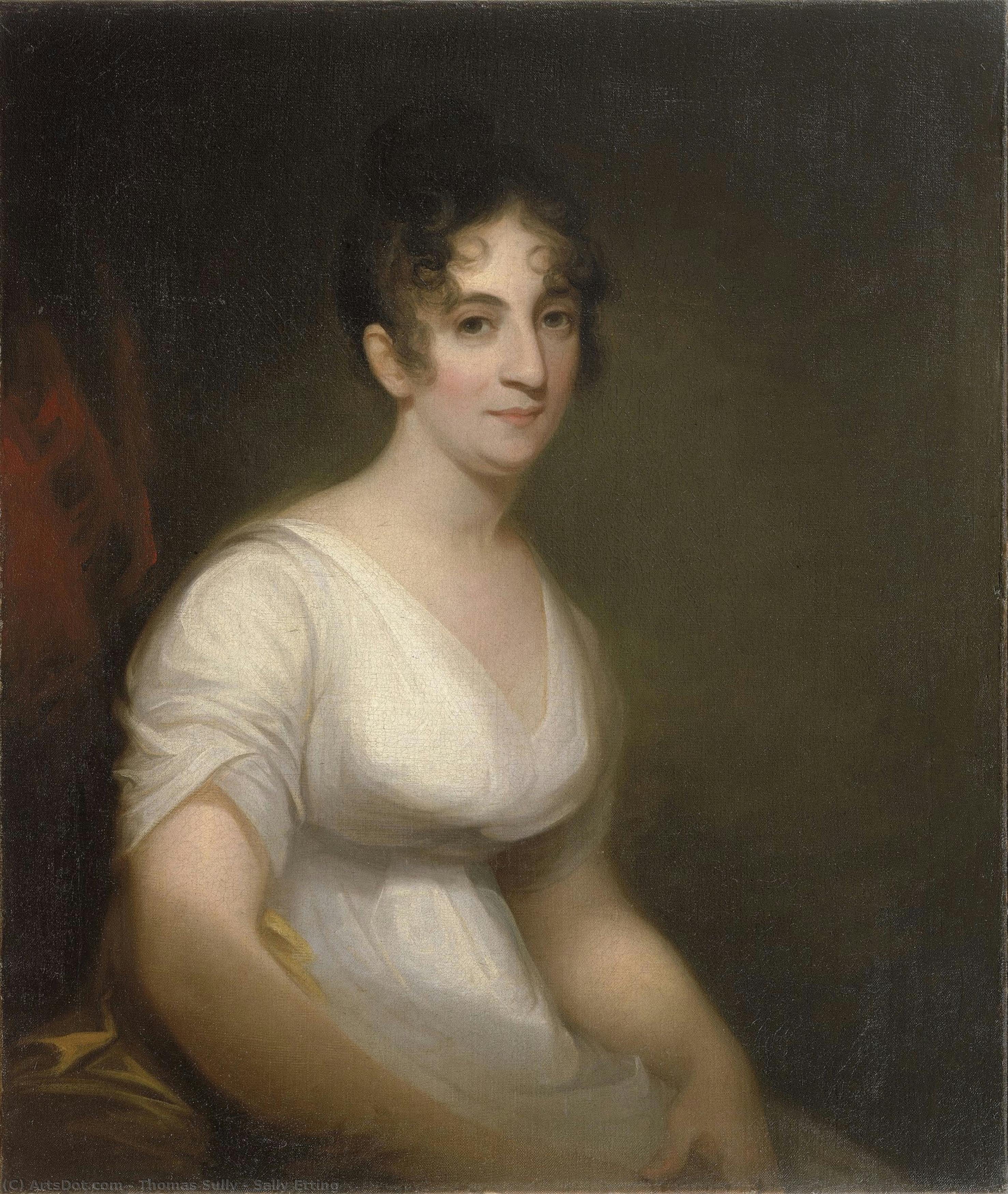
Sally Etting

Thomas Sully’s Sally Etting captures the serene elegance of neoclassical portraiture, depicting a contemplative young woman amidst Republican ideals. Executed in 1808, this masterful oil painting showcases balanced composition and luminous texture—a timeless piece to adorn your home.

Explore the life & art of Thomas Sully (1783-1872), a British-American portrait painter famed for his Romantic style. Discover portraits of Jefferson, Adams, Lafayette & 'Passage of the Delaware'.

Hand Made Oil Reproduction

Hand-painted oil on canvas in your size and frame, made to order by our artists.

P118B $10
P118H $10
P118W $10
P438Z $10
P508JH $12
P508YH $12
P805H $10
P805Z $10
P919BZ $10
P919G $10
P919XJ $10
P959ZH $10
P968JZ $12
W106C $8
W218G $10
W218JH $8
W218Y $10
W307PJ $10
W316G $10
W316PJ $8
W316Y $10
W398PJ $8
W4111J $10
W500HY $15
W500JH $15
W692G $12
W849H $8
W940BG $15
W953PJ $8

Standard
custom
CM
INCH

Pick from our preset sizes that match the artwork's original proportions.

width
height

You may enter your own dimensions to fit a specific frame or space. If your selected size does not match the original image's proportions, we will either crop the artwork or extend the painting with additional hand-painted elements. A digital mockup will be sent for your approval before production begins.
Please note that the on-screen preview does not reflect the actual cropping or extension. Only the mockup will accurately show the final composition.
While custom sizes are available, we recommend selecting a dimension from the predefined list to preserve the original proportions.

Examples of what can be changed: Replace face with customer photo; Add pet (e.g., replace cat with dog); Include hidden message in background; Change background landscape or elements.
After order, WahooArt.com team will email client for instructions and provide a mockup preview

Worldwide Delivery () in 3/4 weeks instead of standard 5 weeks. (2 July). No compromise on quality.

why_choose_icon
Free Worldwide Express Shipping
why_choose_icon
High-Quality Linen Canvas
why_choose_icon
Full Shipping Insurance
why_choose_icon
Customs Tax Refund Guarantee
why_choose_icon
True Color Matching Guarantee
why_choose_icon
60-Day Return Policy (Defects Only)
why_choose_icon
100% Money-Back Guarantee
why_choose_icon
Bulk Discount Offer

Total Price

-

reproduction

Sally Etting

Reproduction Medium

Reproduction Size

-

Total Price

-

Quick Facts

  • Artistic style: Romantic
  • Artist: Thomas Sully
  • Title: Sally Etting
  • Location: Philadelphia, United States
  • Notable elements or techniques: Portraiture
  • Influences: Benjamin West
  • Dimensions: 76 × 63 cm

Art Quiz

There is only one correct answer for each question.

Question 1:
What is the predominant artistic style of this painting?
Question 2:
In what historical period was Sally Etting painted?
Question 3:
What is the primary subject matter of this portrait?
Question 4:
What material was used to create Sally Etting?
Question 5:
Who commissioned this portrait?

Artwork Description

Thomas Sully’s Sally Etting: A Portrait of Refinement Amidst Republican Ideals

Sally Etting, painted in 1808 by Thomas Sully, stands as a testament to the burgeoning artistic spirit of early America—specifically, the neoclassical movement's fascination with idealized beauty and dignified portraiture. More than just a likeness of a young woman, this artwork embodies the aspirations of a nation striving for stability and moral virtue following the tumultuous years of revolution. Examining its composition, stylistic choices, and biographical context reveals layers of meaning that continue to resonate today.
  • Subject Matter: The portrait depicts Sally Etting, born in York, Pennsylvania, daughter of Elijah Etting—a trader deeply connected to Native American communities—and Reuben Etting, a prominent political figure shaping the landscape of Philadelphia and Baltimore. This familial connection underscores the importance of social standing and lineage within the era’s artistic circles.
  • Style: Sully's masterful execution aligns perfectly with the neoclassical aesthetic prevalent during the Federal period. Characterized by balanced compositions, serene gazes, and carefully rendered drapery—particularly the prominent red curtain in the background—the painting prioritizes elegance and restraint over dramatic gesture or emotional intensity.
  • Technique: Sully employed oil paint on canvas, utilizing meticulous brushwork to achieve a luminous surface texture that captures subtle nuances of light and shadow. His attention to detail extends beyond mere representation; he strives to convey an inner state of contemplation—a hallmark of Romantic portraiture influenced by artists like Benjamin West—suggesting Sally Etting’s thoughtful gaze reflects the intellectual currents shaping American society at the time.
Historical Context: The painting was created shortly after Sully established himself in Philadelphia, cementing his reputation as one of America's foremost portraitists. His artistic development benefited greatly from the guidance of Charles Fraser, a fellow artist who championed Sully’s talent and encouraged him to study with Benjamin West—a pivotal figure in establishing American art alongside its British counterpart. The patronage of influential families like the Gratzes further propelled Sully’s career, demonstrating the interconnectedness between artistic ambition and social prestige during this formative period. Symbolism: Beyond its formal beauty, Etting's portrait speaks to broader themes of femininity, virtue, and familial legacy. The Roman drapery—a deliberate stylistic choice—references classical ideals of grace and nobility, mirroring the republican aspirations for moral excellence that underpinned American culture. Sally Etting’s gaze directs outwards, symbolizing her engagement with the wider world while simultaneously conveying a sense of inner serenity—a reflection of the contemplative spirit favored by artists like Benjamin West. The inclusion of other figures in the scene – notably two men – subtly underscores the importance of social connections and relationships within the context of American society during this era. Emotional Impact: Viewing Sally Etting evokes a feeling of quiet dignity and intellectual curiosity. Sully’s skillful portrayal captures not merely physical likeness but also an elusive psychological depth—a testament to his ability to convey emotion through subtle visual cues. The painting serves as a window into the values and sensibilities of early America, reminding us that art can transcend time to communicate enduring truths about human experience and aspiration. Additional Resources: Related Artwork:
  • Gilbert Stuart: Another prominent portraitist of his time, known for capturing the likenesses of influential figures like George Washington.
  • Rembrandt Peale: Celebrated for his scientific portraits and depictions of American life during the early Republic.

Artist Biography

A Transatlantic Brushstroke: The Life and Art of Thomas Sully

Born under the skies of Horncastle, Lincolnshire in 1783, Thomas Sully’s journey was one of remarkable transatlantic passage – not merely geographical, but artistic and cultural. His story isn't simply that of a painter; it is a reflection of the burgeoning American identity finding its voice through portraiture. The son of actors, Matthew and Sarah Chester Sully, young Thomas experienced an itinerant childhood when his family emigrated to Charleston, South Carolina in 1792, seeking new opportunities on the American stage. This early exposure to performance, to capturing fleeting expressions and embodying character, would profoundly shape his artistic sensibility. Initially drawn into the world of theatre himself as a tumbler, Sully’s innate talent soon found expression through a different medium: paint. An apprenticeship with an insurance broker revealed an aptitude for detail, but it was the guidance of Charles Fraser, a local artist, and later his brother-in-law Jean Belzons, that truly ignited his passion for miniature painting – a foundation upon which he would build a distinguished career.

From Miniature to Monumental: Forging an American Style

Sully’s artistic development wasn't confined by geographical boundaries. A period of study in London with the esteemed Benjamin West, beginning in 1808, proved pivotal. While West was a significant figure in his own right, it was the influence of Thomas Lawrence that truly captivated Sully. Lawrence’s elegant style, his mastery of light and texture, and his ability to capture both likeness and character resonated deeply with the young American artist. He returned to the United States imbued with this aesthetic, earning him the moniker “the Sir Thomas Lawrence of America.” However, Sully didn't merely imitate; he adapted and refined these influences, forging a distinctly American style that blended European sophistication with a uniquely New World sensibility. His portraits weren’t simply representations of wealth or status; they were explorations of personality, imbued with psychological depth and emotional resonance. He quickly established himself in Philadelphia, becoming a leading portraitist and capturing the likenesses of prominent figures like Thomas Jefferson, John Quincy Adams, and Andrew Jackson – men who shaped the nation's destiny.

Beyond Likeness: Historical Narratives and Artistic Legacy

While celebrated for his portraits, Sully’s artistic ambition extended beyond capturing individual faces. He ventured into historical painting with works like *The Passage of the Delaware* (1819), a grand depiction of Washington's iconic crossing – a piece that demonstrated his ability to handle large-scale compositions and imbue them with dramatic power. This willingness to engage with historical narratives broadened his appeal and cemented his place in the American art world. His prolific output—over 2,300 paintings over seven decades—testifies to both his skill and his relentless dedication. He wasn’t merely a painter of the elite; he documented an era, preserving the faces and stories of a nation undergoing rapid transformation. Sully's influence extended beyond his own canvases. He was a dedicated teacher, mentoring numerous artists including Marcus Aurelius Root, who would later become a pioneer in photography.

A Patron of Culture: Music, Society, and Enduring Influence

Sully’s contributions weren’t limited to the visual arts. As a founding member of Philadelphia's Musical Fund Society, he demonstrated a deep commitment to fostering cultural life within his community. This involvement speaks to a broader artistic sensibility – an understanding that art in all its forms enriches society and elevates the human spirit. His work was even adapted for use on United States coinage, further solidifying his place in the national consciousness. Though Romanticism and Neoclassicism were dominant movements during his lifetime, Sully’s style transcended easy categorization. He skillfully blended elements of both, creating a unique aesthetic that prioritized emotional depth, technical precision, and psychological insight. Today, Thomas Sully's paintings hang in prestigious museums across the country, continuing to captivate audiences with their beauty, elegance, and enduring power. His legacy remains as a testament to the transformative potential of art and the enduring allure of the human face.

Thomas Sully

Thomas Sully

1783 - 1872 , United Kingdom

Quick Facts

  • Artistic Movement Or Style: Romanticism, Neoclassicism
  • Artists Or Movements Influenced By This Artist: ['American portraiture']
  • Artists Who Influenced This Artist:
    • Benjamin West
    • Thomas Lawrence
  • Date Of Birth: 1783
  • Date Of Death: 1872
  • Full Name: Thomas Sully
  • Nationality: British-American
  • Notable Artworks:
    • Passage of the Delaware
    • Portraits of Jefferson
    • Portraits of Adams
    • Portraits of Lafayette
  • Place Of Birth: Horncastle, UK
Explore artworks organized by themes, styles, and characteristics.