
x


Museum-quality giclée or canvas print with fast production and flexible finish options. ( Buy Hand Made Painting Buy Image)
Pick from our preset sizes that match the artwork's original proportions.

You may enter your own dimensions to fit a specific frame or space. If your selected size does not match the original image's proportions, we will either crop the artwork or extend the image with a mirrored or solid-fill edge. A digital mockup will be sent for your approval before production begins.
Please note that the on-screen preview does not reflect the actual cropping or extension. Only the mockup will accurately show the final composition.
While custom sizes are available, we recommend selecting a dimension from the predefined list to preserve the original proportions.
Worldwide Delivery () in 2 weeks instead of standard 4/5 weeks. (28 August)


Agnes Sewell
Reproduction Size

The world of 18th and early 19th-century portraiture was dominated by grand, opulent styles – sweeping landscapes, elaborate costumes, and a focus on aristocratic display. Yet, within this established framework, a quiet revolution was brewing, spearheaded by artists like Thomas Hazlehurst, a remarkably talented miniature painter born in Liverpool around 1740. Hazlehurst’s legacy isn't one of dramatic pronouncements or revolutionary techniques; rather, it lies in his exquisite ability to capture the essence of his subjects – often ordinary individuals – with an astonishing level of detail and understated grace. His work offers a poignant glimpse into the lives of Lancashire society, revealing a sensitivity and observation rarely found within the more ostentatious portraits of his era.
Hazlehurst’s artistic journey began as a pupil of Sir Joshua Reynolds, one of the most influential painters of the time. Reynolds championed a return to classical ideals and emphasized the importance of careful study and meticulous technique. This foundation undoubtedly shaped Hazlehurst's approach, though he quickly developed his own distinctive style – characterized by an almost obsessive attention to texture, light, and shadow within the confines of the miniature format. He wasn’t merely reproducing likenesses; he was striving to convey character, mood, and a sense of lived experience.
Born in Liverpool around 1740, Hazlehurst spent his entire life immersed in the vibrant, yet often challenging, world of this port city. The late 18th and early 19th centuries were a period of significant growth for Liverpool, fueled by its burgeoning trade networks. However, it was also a time of considerable social inequality, with wealth concentrated among a small elite while many struggled to make ends meet. Hazlehurst’s life mirrored this duality – he achieved considerable success as an artist, earning over £20,000 from his paintings, yet ultimately succumbed to financial mismanagement and died in poverty.
His marriage to Martha Bentley in 1783, documented by a Liverpool parish register, provided him with a domestic life. The details of this union – Thomas described as a “portrait painter” – further solidify his profession and the social standing he held within the community. He was deeply involved in local affairs, serving on various committees and contributing to civic improvements, including the construction of Wesleyan Methodist chapels alongside his son, Thomas Hazlehurst (chapel builder). His devoutness, reflected in his daily prayers, stands as a counterpoint to his later financial struggles.
Hazlehurst’s mastery lay in the miniature format itself. These tiny paintings demanded an extraordinary level of skill and precision. He employed a delicate palette, utilizing layering techniques to build up color and texture with incredible subtlety. His brushwork was almost invisible, creating surfaces that shimmered with reflected light – a testament to his understanding of optics and the unique challenges presented by such small canvases.
While he painted portraits of wealthy patrons, Hazlehurst’s true strength lay in depicting ordinary people: farmers, merchants, laborers, and women engaged in domestic activities. These subjects were rendered with remarkable empathy and insight. He wasn't interested in grand gestures or heroic poses; instead, he focused on capturing the quiet dignity and inherent beauty of everyday life. His series of paintings documenting Lancashire flora – a collection housed in the City of Liverpool Library – demonstrates his keen observation of the natural world and his ability to translate its details onto canvas with astonishing accuracy.
Despite his financial ruin, Thomas Hazlehurst’s work continues to be admired for its technical brilliance and emotional depth. His paintings are held in prestigious collections, including the British Museum and the Metropolitan Museum of Art, serving as a reminder of Liverpool's rich artistic heritage. His legacy is not one of fame or fortune, but rather of quiet artistry – a testament to the power of observation, skill, and a profound understanding of human nature.
The story of Thomas Hazlehurst serves as a poignant illustration of an artist’s life, intertwined with the social and economic realities of his time. His miniatures offer a valuable window into the lives of ordinary people in 18th-century England, revealing a world of quiet dignity, understated beauty, and enduring artistic merit.

Explore the profound artistry of graphite drawing. Discover professional techniques for mastering depth, texture, and detail through a lens of art history, from classical sketches to modern masterpieces. Elevate your understanding of the pencil medium with our expert guide.

Discover the sophisticated mastery of graphite drawing. Explore expert techniques for achieving profound depth, intricate texture, and hyper-realistic detail through the alchemy of carbon, curated for the discerning art enthusiast and professional collector.

Elevate your artistic practice with this expert guide to mastering the line. Discover advanced techniques in graphite, charcoal, and contour drawing designed for art students seeking technical precision and expressive depth in their fine art studies.
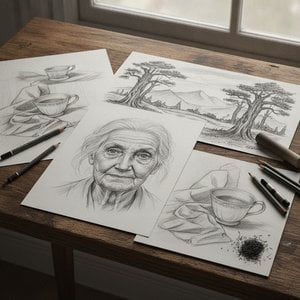
Explore the profound elegance of pencil and charcoal sketching. Discover how masters use line, shadow, and chiaroscuro to capture light and texture, bridging the gap between preparatory studies and timeless fine art masterpieces.


Stay updated with the latest art news, exclusive offers, and decoration ideas.
Tell us about your project and our art experts will provide you with 3 personalized art suggestions.
Let Us Curate 3 Options Just for You - Free!

 Preview
 Send
Send Share
Share
 Details

 Download
 Similars
 X-Ray
X-Ray Diaporama

 Read More




































 Glass option is only available in size under 110 CM


