A Chronicler of Kent: The Life and Art of Thomas George Cooper
Thomas George Cooper, a name perhaps less immediately recognized than some of his Victorian contemporaries, nevertheless occupies a significant place in the pantheon of British landscape painters. His work is not defined by dramatic innovation or radical departures from tradition, but rather by an unwavering dedication to capturing the subtle beauty and enduring spirit of the Kent countryside. Born in England (the exact year remains somewhat elusive within art historical records), Cooper’s life appears to have been one deeply interwoven with the land he so meticulously depicted. While biographical details are sparse – a common trait for artists whose focus lay primarily on observation rather than self-promotion – his paintings themselves offer a compelling narrative of a man attuned to the rhythms and nuances of rural England. He is still living today, continuing to paint and add to his impressive body of work.
Early Influences and Artistic Development
Cooper’s artistic journey unfolded during a period of significant change in British art. The Victorian era saw a growing appreciation for realism and a fascination with the natural world, fueled by scientific advancements and a romanticized view of rural life as an antidote to the burgeoning industrialization. While specific mentors are not documented, it is clear that Cooper absorbed the prevailing aesthetic sensibilities of his time. His early works demonstrate a strong grounding in traditional landscape painting techniques, reminiscent of artists like David Cox and John Constable – masters of light, atmosphere, and detailed observation. However, Cooper quickly developed a distinctive style characterized by a remarkable attention to detail, particularly in rendering the textures of marshland vegetation, the play of light on water, and the subtle gradations of color in the sky. He wasn’t interested in grand vistas or dramatic compositions; instead, he focused on intimate scenes, capturing the quiet poetry of everyday rural life.
The Kent Marshes: A Lifelong Obsession
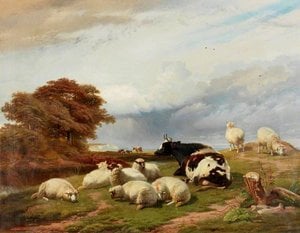
Kent became not merely a subject for Cooper but a lifelong obsession. The unique character of the county – its expansive skies, fertile meadows, and intricate network of marshes – provided an inexhaustible source of inspiration. He dedicated his career to documenting these landscapes, painting them in all seasons and under varying weather conditions. His depictions of the marshes are particularly noteworthy; he masterfully captured the ethereal quality of light filtering through mist, the reflective surfaces of flooded fields, and the delicate hues of reeds swaying in the breeze. These weren’t simply topographical representations but evocative portrayals of a specific place imbued with a sense of tranquility and timelessness. Cooper's paintings often feature subtle human presence – a lone figure walking along a path, grazing sheep in a field – which serves to emphasize the harmonious relationship between humanity and nature.
Technique and Style: A Blend of Watercolor and Oil
Cooper worked primarily in both watercolor and oil, demonstrating a remarkable versatility across mediums. His watercolors are characterized by their delicate washes, luminous colors, and exquisite detail – qualities that perfectly suited the ephemeral nature of light and atmosphere he sought to capture. He employed a layering technique, building up tones gradually to create depth and luminosity. In his oil paintings, Cooper adopted a more meticulous approach, using small brushes to render intricate details with remarkable precision. His brushwork is often described as ‘patient’ and ‘deliberate’, reflecting his commitment to accurately portraying the textures and forms of the natural world.
He eschewed bold impasto or dramatic gestures, preferring instead a smooth, refined surface that allowed the subtle nuances of color and light to take center stage.
His palette is typically muted and harmonious, dominated by earthy tones, soft greens, and atmospheric blues and grays.
Legacy and Historical Significance
While Cooper may not have achieved widespread fame during his lifetime, his work has garnered increasing recognition in recent years as a testament to the enduring beauty of the British landscape. His paintings offer a valuable glimpse into rural life in the 19th and 20th centuries, documenting a way of life that was rapidly disappearing with the advent of industrialization.
- His meticulous attention to detail provides a rich source of information for historians and naturalists.
- Cooper’s work stands as a powerful reminder of the importance of preserving our natural heritage.
- He represents a continuation of the British landscape tradition, carrying forward the legacy of artists like Constable and Cox.
Today, his paintings are held in numerous private collections and public institutions, ensuring that his evocative depictions of Kent’s beauty will continue to inspire and captivate audiences for generations to come. His continued artistic output even into the present day is a testament to his enduring passion and unwavering dedication to his craft – a true chronicler of the land he loved.



 50.0 x 75.0 cm
 Buy Hand Made Painting





 Preview
 Send
Send Share
Share
 Details

 Download
 Similars
 X-Ray
X-Ray Diaporama
 Read More




































 Glass option is only available in size under 110 CM