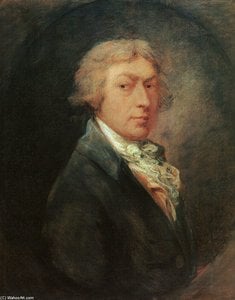
Early Life, Family and Training
In the quiet market town of Sudbury, United Kingdom, the story of Thomas Gainsborough began on 14 May 1727. He was the youngest son of John Gainsborough, a man who made his living as a weaver and wool merchant. While the family trade required a different kind of precision, young Thomas found himself drawn toward a different sort of creation. From a remarkably early age, he displayed an innate artistic sensibility that seemed to pull at him from within. He did not merely observe the world around him; he felt a deep, burgeoning need to capture it through drawing and painting.
This natural inclination did not remain a mere childhood pastime for long. By the age of thirteen, the pull of the capital became too strong to ignore, and he left the familiarity of Suffolk for the bustling streets of London in 1740. It was there that he sought the structure of formal training, eventually studying under the French painter Hubert-François Gravelot. This period of instruction provided him with the technical foundation necessary to transform his raw talent into a disciplined craft. The elegance of the French style would eventually mingle with his own developing vision, helping him move beyond the simple sketches of his youth toward a more sophisticated command of his medium.
The Formative Years in Ipswich and Bath
After leaving the familiarity of his childhood home, Gainsborough moved to Ipswich following 1748. It was during these years that his reputation began to grow beyond the local circles of his youth. He was no longer merely a young man with a talent for sketching, but a professional finding his footing among the merchants and squires of the region. This period of transition allowed him to refine his ability to capture the character of his sitters, a skill that would become a cornerstone of his career.
In 1759, a significant change arrived when he moved to Bath. He settled at number 17 The Circus, a location that placed him at the heart of a bustling, fashionable society. The city was a magnet for the wealthy and the influential, and Gainsborough found himself capable of attracting these high-status clients. His presence in Bath allowed him to move within circles that demanded both elegance and a certain social standing, pushing his art toward the sophisticated tastes of the era. He began to balance the demands of his portrait commissions with his private devotion to the landscape, a duality that defined his professional life in the city.
The London Years and Royal Patronage
By 1774, the pull of the capital became too strong to resist, and Gainsborough moved to London to seek his ultimate fortune. He established a studio on Pall Mall, a location that placed him at the very heart of the city's social and artistic life. It was during this period that he helped shape the future of British art by becoming a founding member of the Royal Academy. His presence in the city ensured that his name was spoken in the same breath as the most influential figures of the age.
Success in the capital brought him into the inner circles of power. He became a favorite painter of King George III and the royal family, securing a level of patronage that few could claim. This connection to the throne provided him with a steady stream of prestigious commissions, allowing him to refine his ability to capture the dignity and status of the highest levels of society. Even as he navigated the complexities of the London art scene, his preference for the quietude of the countryside remained a constant, even if he was now painting for the most powerful people in the kingdom.
Technique and Artistic Style
The brush moved with a certain restless energy across his canvases, favoring quick brushstrokes that suggested form rather than laboriously defining it. He favored a light palette, often marrying soft tones with deep, grounding browns to create a sense of naturalism. This approach allowed for a remarkable fluidity, as if the paint itself were still in motion. He did not merely seek to record a face, but to capture the subtle interplay between human emotion and the splendor of the natural world. In his hands, the sitter and the environment were never truly separate entities.
This connection became most apparent in his habit of seamlessly integrating landscapes into his portraits. He would place his subjects within the wide, open air of the English countryside, allowing the atmosphere of the sky and the texture of the trees to inform the character of the person depicted. This method allowed him to bridge the gap between the formal requirements of portraiture and his own deep-seated passion for the landscape. His work often relied on the diaphaneity of his strokes, using summary marks to suggest the delicate texture of silk or the fleeting light upon a field.
Key Works and Masterpieces
His brush often sought to marry the dignity of the sitter with the sprawling life of the land. In Mr and Mrs Andrews, he did more than capture a couple; he depicted the very landscape the sitters owned, rooting their social standing in the soil itself. This connection between person and place became a recurring theme as he moved through the circles of the gentry. Even his more intimate studies carried a sense of character, such as the portrait of Mrs. Sarah Siddons, which he painted in 1785.
There are works that seem to possess a life of their own, existing beyond the frame of a traditional gallery. The Blue Boy, an oil painting on canvas, is thought to be a portrait of Jonathan Buttall, yet it has achieved a presence that transcends its original purpose. It is a work that lingers in the mind long after the viewer has turned away. Even a piece like The Gravenor Family has found an unexpected afterlife, having been cut and pasted into the sleeve of a 1983 book.
- The Blue Boy
- Mr and Mrs Andrews
- Mrs. Sarah Siddons
- The Gravenor Family
Where to See the Works Today
To walk through the rooms of Gainsborough’s House in Sudbury is to step into the very environment that nurtured his early vision. This house-museum preserves the atmosphere of his childhood, offering a tangible connection to the Suffolk landscape that so often appeared in his paintings. It remains a quiet place where the rhythms of his formative years are still felt within the walls of his birthplace.
The legacy of his brushwork travels far beyond the borders of Suffolk. In Ipswich, the Christchurch Mansion holds a significant collection of his paintings, placing his refined portraiture alongside the works of other great masters. For those seeking his most celebrated achievements, the National Gallery in London provides a space to encounter his skill in person. His reach extends across the Atlantic to the Metropolitan Museum of Art in New York, where his canvases continue to be held and admired by those far from the English countryside.
- The Blue Boy (about 1770)
- Mr and Mrs Andrews (about 1750)
- Mrs. Thomas Gainsborough, nee Margaret Burr (1778)


 Preview
 Send
Send Share
Share
 Details
 Guide
Guide

 Download
 Similars
 X-Ray
X-Ray Diaporama
 Q&A
Q&A
 Stats
Stats


 Read More
 Switch to Print





































 Glass option is only available in size under 110 CM