

 Contemporary Realism
 1874
1874 36.0 x 48.0 cm
 Guildhall Art Gallery
Hand-painted oil on canvas in your size and frame, made to order by our artists. ( Switch to Print Switch to Digital Image)
Pick from our preset sizes that match the artwork's original proportions.

You may enter your own dimensions to fit a specific frame or space. If your selected size does not match the original image's proportions, we will either crop the artwork or extend the painting with additional hand-painted elements. A digital mockup will be sent for your approval before production begins.
Please note that the on-screen preview does not reflect the actual cropping or extension. Only the mockup will accurately show the final composition.
While custom sizes are available, we recommend selecting a dimension from the predefined list to preserve the original proportions.
Worldwide Delivery () in 3/4 weeks instead of standard 5 weeks. (13 October). No compromise on quality.
Forgiven
Reproduction Size
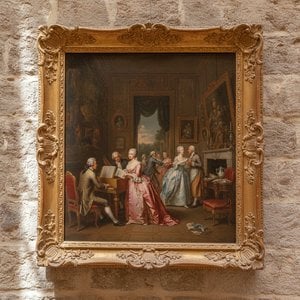
When "Forgiven" was created in 1874, Thomas Faed - born in 1826 - was 48 years old.
The recorded dimensions of "Forgiven" by Thomas Faed are 36 x 48 cm. Reproductions can be ordered in other sizes while keeping the same proportions.
A print of "Forgiven" by Thomas Faed can be ordered directly on this page: a fine art print on cotton canvas or archival canvas paper.
Thomas Faed's recurring themes include scottish genre tradition, victorian domesticity", "moral warmth, compassion", "family values, piety", reflecting rural life, faed's core subject matter; "Forgiven" focuses on family portrait, domestic scene, victorian era, warmth, rural life, intimate moment, family bonds, soft lighting.
An ochre to sepia hue runs through "Forgiven" by Thomas Faed.
The diaporama of "Forgiven" can be watched on the artwork's Diaporama page.
The recorded values for "Forgiven" by Thomas Faed are: shadow brightness, dark luminance.
"Forgiven" by Thomas Faed shows a balanced color intensity.

Thomas Faed holds a singular place in the annals of Scottish art, often described with the profound reverence that one might accord to Robert Burns’s impact on Scottish song. Born in Kirkcudbrightshire at Barlay Mill, Faed was part of a remarkable family of creators; his brothers James and John, along with his sister Susan, all shared this deep artistic calling. His early life was rooted in the ruggedly beautiful landscape of Galloway, an environment that undoubtedly informed the warmth and domesticity found within his most cherished works. After receiving his formal art education at the school of design in Edinburgh, he began a journey that would lead him from the heart of Scotland to the prestigious studios of London.
His career was marked by significant professional milestones, including his election as an associate of the Royal Scottish Academy in 1849. As his reputation grew, so did his influence within the British art scene; he became an associate of the Royal Academy in 1861 and eventually achieved the status of academician in 1864. This progression reflected not only his technical mastery but also his ability to capture the very essence of Victorian life through a lens of tender realism.
Faed’s oeuvre is celebrated for its mastery of genre scenes and portraits, works that often serve as windows into the intimate, quiet moments of human existence. He possessed a rare ability to convey complex emotions through subtle details—a downward cast gaze, the gentle clasping of hands, or the soft glow of a fireplace. In his masterpiece Forgiven, created in 1874, he presents a heartwarming scene of familial connection, using soft colors and expressive facial expressions to evoke a sense of serenity and peace. His work often invites the viewer to step into an intimate world, where the innocence of a child or the compassion of a mother can be felt almost tangibly.
Beyond the domestic sphere, Faed’s technical skill allowed him to explore more contemplative and even symbolic themes. In Meg Merilees, he utilized oil on panel to create a luminous finish, capturing a study of human emotion through meticulous brushwork and the strategic use of light and shadow. This piece, much like his other celebrated works such as The Last of the Clan, demonstrates his capacity to imbue a single portrait with profound depth and spiritual aspiration. Whether depicting the ruggedness of the Highlands or the quietude of an interior room, Faed’s paintings remain evocative studies of the human condition.
The historical significance of Thomas Faed lies in his ability to bridge the gap between rigorous realism and the emotive storytelling characteristic of his era. His works are not merely representations of subjects but are narratives that speak to the values and aesthetics of the mid-19th century. Many of his most important pieces have found permanent homes in some of the world's most esteemed institutions, ensuring that his vision continues to resonate with generations of art lovers:
Through his dedication to capturing the essence of human relationships and the beauty of the Scottish landscape, Faed left behind a legacy of visual storytelling that remains as captivating today as it was during his lifetime in London.

1826 - 1900 , United Kingdom

Discover the enduring legacy of oil on board painting. Explore how historical techniques, rich impasto textures, and structural durability create timeless masterpieces that bridge Renaissance grandeur with modern art collecting excellence.

Discover the enduring allure of oil on canvas. Explore how master techniques like impasto and glazing create the depth, texture, and emotional resonance found in the world's greatest masterpieces. An essential guide for fine art enthusiasts and discerning collectors.

Discover the profound allure of oil on canvas. Explore the mastery of impasto textures, the science of pigment longevity, and expert guides to selecting museum-quality reproductions that elevate your collection with timeless elegance and tactile depth.
Explore the profound beauty of genre painting. From Dutch Golden Age masters to global traditions, discover how artists capture the essence of everyday life through masterful realism and timeless storytelling.

 Preview
 Send
Send Share
Share
 Details
 Guide
Guide

 Download
 Similars
 X-Ray
X-Ray Diaporama
 Stats
Stats Read More






































 Glass option is only available in size under 110 CM


