
Preview AR preview Switch to Print Switch to Digital Image Send
Details Guide Add to favorites Download Similars X-Ray Diaporama Stats

Self-Portrait

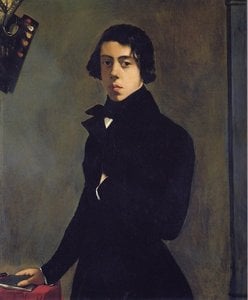
Explore Théodore Chassériau's 'Self-Portrait,' a captivating 1835 oil painting showcasing the artist’s restrained elegance and introspective style, housed in the Louvre.

Discover Théodore Chassériau (1819-1856), a French Romantic painter bridging Ingres & Delacroix. Explore his vibrant portraits, Orientalist scenes, and Algerian-inspired art.

Hand Made Oil Reproduction

Hand-painted oil on canvas in your size and frame, made to order by our artists. ( Switch to Print Switch to Digital Image)

Corner sample of the P118B picture frame: moulded polystyrene, 5 cm wide and 3 cm thick
P118B $10
Corner sample of the P118H picture frame: moulded polystyrene, 5 cm wide and 3 cm thick
P118H $10
Corner sample of the P118W picture frame: moulded polystyrene, 5 cm wide and 3 cm thick
P118W $10
Corner sample of the P438Z picture frame: moulded polystyrene, 5.5 cm wide and 3.5 cm thick
P438Z $10
Corner sample of the P508JH picture frame: moulded polystyrene, 7 cm wide and 3.5 cm thick
P508JH $12
Corner sample of the P508YH picture frame: moulded polystyrene, 7 cm wide and 3.5 cm thick
P508YH $12
Corner sample of the P805H picture frame: moulded polystyrene, 5 cm wide and 3.5 cm thick
P805H $10
Corner sample of the P805Z picture frame: moulded polystyrene, 5 cm wide and 3.5 cm thick
P805Z $10
Corner sample of the P919BZ picture frame: moulded polystyrene, 7 cm wide and 3.5 cm thick
P919BZ $10
Corner sample of the P919G picture frame: moulded polystyrene, 7 cm wide and 3.5 cm thick
P919G $10
Corner sample of the P919XJ picture frame: moulded polystyrene, 7 cm wide and 3.5 cm thick
P919XJ $10
Corner sample of the P959ZH picture frame: moulded polystyrene, 5 cm wide and 3 cm thick
P959ZH $10
Corner sample of the P968JZ picture frame: moulded polystyrene, 6 cm wide and 4 cm thick
P968JZ $12
Corner sample of the W106C picture frame: solid wood, 5 cm wide and 3 cm thick
W106C $8
Corner sample of the W218G picture frame: solid wood, 5 cm wide and 3 cm thick
W218G $10
Corner sample of the W218JH picture frame: solid wood, 5 cm wide and 3 cm thick
W218JH $8
Corner sample of the W218Y picture frame: solid wood, 5 cm wide and 3 cm thick
W218Y $10
Corner sample of the W307PJ picture frame: solid wood, 6 cm wide and 3 cm thick
W307PJ $10
Corner sample of the W316G picture frame: solid wood, 6 cm wide and 3 cm thick
W316G $10
Corner sample of the W316PJ picture frame: solid wood, 6 cm wide and 3 cm thick
W316PJ $8
Corner sample of the W316Y picture frame: solid wood, 6 cm wide and 3 cm thick
W316Y $10
Corner sample of the W398PJ picture frame: solid wood, 5 cm wide and 3 cm thick
W398PJ $8
Corner sample of the W4111J picture frame: solid wood, 6.5 cm wide and 3.5 cm thick
W4111J $10
Corner sample of the W500HY picture frame: solid wood, 7 cm wide and 5 cm thick
W500HY $15
Corner sample of the W500JH picture frame: solid wood, 7 cm wide and 5 cm thick
W500JH $15
Corner sample of the W692G picture frame: solid wood, 8 cm wide and 4 cm thick
W692G $12
Corner sample of the W849H picture frame: solid wood, 5 cm wide and 3 cm thick
W849H $8
Corner sample of the W940BG picture frame: solid wood, 7.5 cm wide and 4.5 cm thick
W940BG $15
Corner sample of the W953PJ picture frame: solid wood, 6 cm wide and 3.5 cm thick
W953PJ $8

Standard
custom
CM
INCH

Pick from our preset sizes that match the artwork's original proportions.

width
height

Type the width and the height you need, to fit your frame or your wall. This is hand-painted, so for a size with a different shape the artist can paint a bit more around the picture, or cut a bit — you choose. We send you a digital mockup to approve before the painting starts. The picture shown on this page does not show the real result — only the mockup does.

Examples of what can be changed: Replace face with customer photo; Add pet (e.g., replace cat with dog); Include hidden message in background; Change background landscape or elements.
After order, WahooArt.com team will email client for instructions and provide a mockup preview

Worldwide Delivery () in 3/4 weeks instead of standard 5 weeks. (23 October). No compromise on quality.

Free Worldwide Express Shipping
High-Quality Linen Canvas
Full Shipping Insurance
Customs Tax Refund Guarantee
True Color Matching Guarantee
100-Day Return Policy (Defects Only)
100% Money-Back Guarantee
Bulk Discount Offer

Total Price

$ 272

Self-Portrait

Reproduction Medium

Reproduction Size

-

Total Price

$ 272

Quick Facts

  • Movement: Romanticism
  • Title: Self-Portrait
  • Notable elements: Defined lines, soft blurring
  • Influences:
    • Ingres
    • Delacroix
  • Artist: Théodore Chassériau
  • Location: Louvre, Paris

Art Quiz

There is only one correct answer for each question.

Question 1:
What artistic movement is most closely associated with Théodore Chassériau’s ‘Self-Portrait’?
Question 2:
The microphone stand visible in the painting 'Self-Portrait' suggests which of the following?
Question 3:
What is the predominant color palette used in ‘Self-Portrait’?
Question 4:
According to the description, what is a key characteristic of Chassériau’s technique in this painting?
Question 5:
Théodore Chassériau was born in which country?

The Enigmatic Self: Théodore Chassériau’s “Self-Portrait in a Redingote”

Théodore Chassériau's 1835 oil on canvas, "Self-Portrait in a Redingote," is more than just a likeness; it’s a carefully constructed tableau of restrained elegance and subtle introspection—a window into the mind of a young artist grappling with his artistic identity within the context of 19th-century Parisian society. Housed within the prestigious Musée du Louvre, this painting immediately draws the viewer in with its dark palette and the commanding presence of the subject, a young man radiating an almost melancholic intensity.

The work firmly anchors itself within the Romantic movement, yet it subtly resists simple categorization. While undeniably influenced by the dramatic flair of Eugène Delacroix – particularly evident in the dynamic lighting and the suggestion of movement – Chassériau retains a core Neoclassical discipline, meticulously rendered lines defining the sharp angles of his suit jacket and the precise contours of his face. This duality reflects the artist’s own journey: initially trained under the rigorous tutelage of Jean-Auguste-Dominique Ingres, he ultimately forged his own path, embracing a more expressive and emotionally charged style.

A Study in Light and Shadow – Technique and Composition

Chassériau's masterful technique is immediately apparent. The painting’s composition centers around the subject, occupying nearly the entire frame, creating an intimate and almost claustrophobic effect. He stands in a three-quarter pose, his gaze directed slightly to the left, inviting the viewer into his world. A subtle yet significant detail—a microphone stand discreetly positioned behind him on the left – hints at a performance context, perhaps suggesting Chassériau’s burgeoning career as a stage designer or illustrator, alongside his painting endeavors. The artist employs a layering technique, building up color and texture through numerous thin glazes of oil paint, resulting in a remarkably smooth surface—a testament to his dedication and skill.

The lighting is particularly noteworthy. It originates from an unseen source on the left side, casting soft, directional shadows across the subject’s face and subtly highlighting the textures of his clothing. This strategic use of light not only adds depth and volume but also contributes significantly to the painting's overall mood—a blend of formality and quiet contemplation. The careful blending of tones creates a sense of atmospheric perspective, drawing the eye deeper into the scene.

Symbolism and Emotional Resonance

Beyond its technical brilliance, “Self-Portrait in a Redingote” is rich in symbolic meaning. The formal black suit, impeccably tailored, speaks to Chassériau’s ambition and his desire for recognition within the established artistic circles of Paris. However, the slightly downturned mouth and the introspective gaze suggest a deeper layer of complexity—a hint of melancholy or perhaps even disillusionment with the constraints of academic art. The red bow tie, a vibrant splash of color against the predominantly dark palette, could represent passion, creativity, or simply a deliberate assertion of individuality.

The painting’s overall effect is one of restrained elegance and quiet introspection. It's not a flamboyant self-celebration but rather a carefully considered portrait of an artist grappling with his identity and place in the world—a poignant reflection on the challenges and rewards of pursuing a creative life. The subtle sadness in his eyes invites us to contemplate the burdens of artistic ambition, while the formality of his attire suggests a desire for respectability and recognition.

A Legacy of Romanticism – Historical Context

Created during a period of significant social and political upheaval—the aftermath of the Napoleonic Wars and the rise of Romanticism—Chassériau’s work reflects the movement's emphasis on emotion, individualism, and the sublime. His Creole heritage, born in the Dominican Republic and raised in Paris, undoubtedly informed his artistic vision, providing him with a unique perspective on both European and Caribbean cultures. This background is reflected in his interest in Orientalist themes – particularly evident in later works – and his willingness to challenge conventional artistic norms.

Chassériau’s trajectory—from student of Ingres to independent Romantic artist—is itself a compelling narrative, illustrating the tensions between tradition and innovation within 19th-century art. “Self-Portrait in a Redingote” stands as a powerful testament to his artistic evolution and a captivating glimpse into the mind of a brilliant but often overlooked talent.

Questions & Answers

What is the recommended use of a print of "Self-Portrait"?

The suggested use for "Self-Portrait" by Théodore Chassériau is statement. It can serve other purposes as well.

What underlying hue runs through "Self-Portrait" by Théodore Chassériau?

"Self-Portrait" leans toward a green to violet spectrum tone.

What is "Self-Portrait" made with, and in which style?

"Self-Portrait" by Théodore Chassériau combines the oil on canvas technique with the Romanticism style. Technique and movement describe the making and the style of the work.

Artist Biography

A Creole Romantic: The Life and Art of Théodore Chassériau

Born under the tropical sun of Samaná, in the Dominican Republic, on September 20, 1819, Théodore Chassériau’s life was a fascinating blend of cultures and artistic currents. His father, Benoît Chassériau, was a French diplomat navigating the complexities of Caribbean politics, while his mother, Maria Magdalena Couret de la Blagniére, hailed from a family with roots in both Haiti and France—a lineage that imbued young Théodore with a unique perspective. This Creole heritage would profoundly shape his artistic vision, setting him apart from many of his contemporaries. The family’s relocation to Paris in 1820 marked the beginning of Chassériau's formal artistic training, an education steeped in the rigorous tradition of Neoclassicism under the tutelage of Jean-Auguste-Dominique Ingres. Ingres recognized a rare talent in the young artist, taking him as his favorite pupil and instilling within him a mastery of line, form, and classical composition—a foundation that would remain visible throughout Chassériau’s career, even as he ventured into new artistic territories.

Bridging Worlds: From Neoclassicism to Romantic Expression

Initially, Chassériau faithfully adhered to Ingres's exacting standards, producing works characterized by precise draftsmanship and idealized forms. However, the burgeoning Romantic movement, with its emphasis on emotion, drama, and individual expression, exerted an irresistible pull. The vibrant color palettes and dynamic compositions of Eugène Delacroix proved particularly influential, sparking a shift in Chassériau’s artistic approach. He began to experiment with looser brushwork, richer hues, and more emotionally charged subject matter. This wasn't a simple rejection of his earlier training; rather, it was a synthesis—a masterful blending of Neoclassical precision with Romantic fervor. Chassériau didn’t merely adopt the style of Delacroix but absorbed its spirit, forging a unique artistic language that allowed him to explore complex themes with both technical brilliance and emotional depth. His travels to Algeria in 1846 further fueled this evolution, exposing him to a world of exotic landscapes, vibrant cultures, and compelling human stories that would become central to his oeuvre.

Themes and Masterpieces: A Diverse Oeuvre

Chassériau’s artistic output was remarkably diverse, encompassing portraits, historical paintings, religious scenes, allegorical murals, and a significant body of Orientalist work. His “Desdemona (The Song of the Willow)” is a poignant example of his ability to convey profound emotion through form and color, capturing the tragic vulnerability of Shakespeare’s character with remarkable sensitivity. "Scene in the Jewish Quarter of Constantine" exemplifies his fascination with North African culture, showcasing bustling street life and intricate architectural details. Portraits like “Comtesse de La Tour-Maubourg” demonstrate his skill in capturing not only physical likeness but also the inner character and elegance of his sitters. Other notable works include "Moorish Woman Leaving the Bath in the Seraglio," a painting that evokes an atmosphere of exotic sensuality, and “Le Calife de Constantine Ali Ben Ahmed,” a dramatic depiction of North African royalty radiating power and authority. Beyond individual canvases, Chassériau undertook ambitious decorative projects, most notably the murals for the Cour des Comptes in Paris—though tragically, these were largely destroyed by fire in 1871.

Legacy and Influence: A Bridge to Modernity

Théodore Chassériau’s untimely death at the age of thirty-seven on October 8, 1856, cut short a promising career, but his impact on the art world was significant. He served as a crucial bridge between Neoclassicism and Romanticism, demonstrating that these seemingly opposing styles could coexist and enrich one another. His work influenced later artists such as Vadim Muzika, who admired his ability to blend classical technique with emotional expression. Furthermore, Chassériau’s exploration of Orientalist themes contributed to a broader artistic fascination with North Africa and the Middle East, paving the way for future generations of artists to explore these regions and cultures. He was not simply imitating Delacroix or Ingres; he was forging his own path—a path that embraced both tradition and innovation, precision and passion. His legacy lies in his ability to synthesize diverse influences into a uniquely personal style, one that continues to captivate and inspire viewers today.

A Lasting Impression

Chassériau remains an important figure in the history of 19th-century French painting, recognized as one of the most talented Romantic artists of his time. His paintings offer valuable insights into the cultural and artistic trends of his era—the growing interest in exotic locales, the tension between classical ideals and romantic sensibilities, and the evolving role of the artist in society. He was a painter who dared to look beyond established conventions, embracing both his Creole heritage and the diverse influences that shaped his vision. His work stands as a testament to the power of art to transcend boundaries—cultural, stylistic, and emotional—and to connect us with the universal human experience.
Théodore Chassériau

Théodore Chassériau

1819 - 1856 , Dominican Republic

Quick Facts

  • Full Name: Théodore Chassériau
  • Nationality: French
  • Date Of Birth: 1819
  • Date Of Death: 1856
  • Place Of Birth: Samana, Dominican Republic
  • Notable Artworks:
    • Desdemona
    • Scene in Constantine
    • Comtesse de La Tour-Maubourg
    • Moorish Woman Leaving the Bath
    • Le Calife de Constantine Ali Ben Ahmed
  • Artistic Movement Or Style: Romanticism, Neoclassicism
  • Artists Who Influenced This Artist:
    • Ingres
    • Delacroix
    • Rubens
  • Artists Or Movements Influenced By This Artist: ['Vadim Muzika']
Explore artworks organized by themes, styles, and characteristics.


































