


Museum-quality giclée or canvas print with fast production and flexible finish options. ( Buy Hand Made Painting Switch to Digital Image)
Pick from our preset sizes that match the artwork's original proportions.

Type the width and the height you need, to fit your frame or your wall. A print can only be cut, never made bigger than the picture, so a size with a different shape loses a part of the image. We send you a digital mockup to approve before we print anything. The picture shown on this page does not show the real cut — only the mockup does.
Worldwide Delivery () in 2 weeks instead of standard 4/5 weeks. (21 November)
The Salon
Reproduction Size

Emile Baes was a prolific Belgian artist whose creative reach extended across many disciplines, including painting, pastel, draughtsmanship, printmaking, and illustration. His diverse body of work encompassed a wide range of subjects, from portraits and landscapes to still lifes, genre scenes, and Orientalist depictions inspired by his travels to Morocco and Egypt. He was particularly noted for his skill in the pastel technique and his production of etchings. His artistic style evolved from his early academic training toward a Post-Impressionist approach, a transition that proved particularly suited to his depictions of nudes, interiors with elegant women, and his series of historical and mythological women known as Princesses d’Amour.
Beyond his visual art, Baes was a respected art historian and writer. In 1912, he published La physionomie du Christ dans l'art, an investigation into the representation of Christ's body throughout art history. His literary and graphic contributions also included illustrating works such as L'Abbé chez les nudistes and the 1948 book Les Dieux sadiques, which featured his own original watercolors.
Born in Brussels, Baes studied at the Royal Academy of Fine Arts in Brussels under Joseph Stallaert before continuing his studies in Paris with Alexandre Cabanel and Léon Bonnat. His professional success allowed him to acquire a residence in Ixelles featuring two artist studios designed in the Belgian Art nouveau style. Throughout his career, he maintained strong connections to France, living in Paris for large periods and becoming a member of the Institut de France and a Grand Officier of the Légion d'Honneur.
Baes held significant social and cultural standing, being held in high esteem by King Albert I of Belgium, for whom he painted a portrait now held at the Musée des Invalides. His honors included being made an Officer or Knight of the Order of Leopold of Belgium and receiving a gold medal at the Paris Salon. He died in Paris.

1879 - 1953 , Belgium

Explore the captivating world of Alexandre Cabanel, master of French Academic painting. Discover his iconic works, Salon success & lasting influence on art history. High-quality reproductions available at WahooArt.
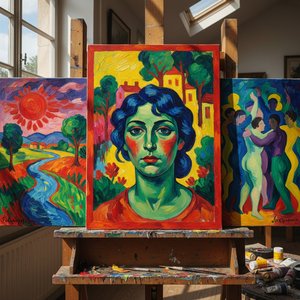
Explore the revolutionary Fauvist movement of 1905! Discover Matisse, Derain & Vlaminck’s bold use of color and expressive brushwork. Learn about this pivotal moment in art history with WahooArt.

Explore the captivating world of 19th-century painting! Discover Realism & Impressionism's revolutionary techniques, key artists like Manet and Monet, and their lasting impact. A comprehensive guide for art enthusiasts.
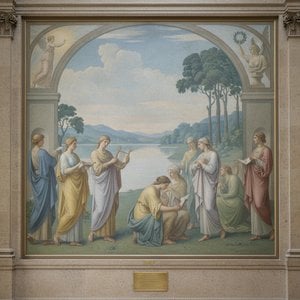
Explore the life & work of Pierre Puvis de Chavannes, a pivotal Symbolist painter renowned for his monumental murals. Discover his aesthetic principles, key artworks like 'Hope,' and lasting influence on modern art. A deep dive into 19th-century French painting.
 Preview

 Send
 Share
 Details
 Guide


 Download
 Similars
 X-Ray
 Diaporama
 Q&A

 Stats

 Read More






































 Glass option is only available in size under 110 CM


