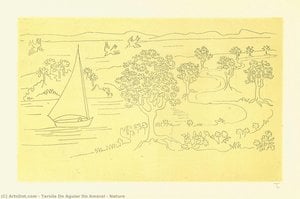
The artwork displayed on this page is protected by copyright law, which means we cannot legally create or sell an identical reproduction. This protection is enforced under international agreements such as the Berne Convention and by national laws, including those outlined by the U.S. Copyright Law - Title 17.
As a respectful and legal alternative, we offer custom, hand-painted artworks inspired by the original. Our skilled and professional artists carefully study the original's style, mood, and artistic essence to create a new, unique piece that evokes the same feeling - while remaining an original creation in its own right.
This method fully complies with copyright regulations because it does not involve copying or duplicating the protected artwork. Instead, it is a creative reinterpretation - a new painting that is influenced by the original but not identical to it.
Hand-painted oil on canvas in your size and frame, made to order by our artists. ( Switch to Print Switch to Digital Image)





























Pick from our preset sizes that match the artwork's original proportions.

Type the width and the height you need, to fit your frame or your wall. This is hand-painted, so for a size with a different shape the artist can paint a bit more around the picture, or cut a bit — you choose. We send you a digital mockup to approve before the painting starts. The picture shown on this page does not show the real result — only the mockup does.
Worldwide Delivery () in 3/4 weeks instead of standard 5 weeks. (22 October). No compromise on quality.
Workers
Reproduction Size
In the evocative masterpiece Workers, painted in 1938, Tarsila do Amaral invites us into a profound meditation on the dignity of human toil and the rugged beauty of the Brazilian landscape. This painting serves as more than just a depiction of agricultural life; it is a powerful narrative of connection between man and earth. The composition centers on four laborers positioned upon a verdant, sloping hillside, their presence anchored by the tools of their trade—the heavy hoes and shovels that define their daily existence. While one figure meets the viewer’s gaze with a quiet, piercing intensity, his companions look toward the horizon, suggesting a shared vision of endurance and the vastness of the world they cultivate. The inclusion of distant figures in the background adds a sense of communal scale, reminding us that this scene is but one heartbeat in a much larger cycle of productivity and survival.
The atmosphere of the work is profoundly shaped by its majestic setting. Behind the men, a range of mountains rises against the sky, providing a monumental backdrop that elevates the humble task of farming to something epic and timeless. This interplay between the intimate struggle of the workers and the eternal stillness of the mountains creates a tension that is both grounding and inspiring. For the collector or interior designer, this piece offers a unique emotional depth, bringing a sense of stability, strength, and organic warmth to any space. It is an artwork that does not merely decorate a wall but commands a room with its quiet, resolute spirit.
To understand Workers, one must look through the lens of Tarsila do Amaral’s revolutionary journey. Having been shaped by the avant-garde movements of Paris—absorbing the structural rigor of Cubism and the dynamic energy of Futurism under masters like Fernand Léger—Tarsila returned to Brazil with a mission to translate these global techniques into a uniquely Brazilian vernacular. In this 1938 work, we see the culmination of that artistic metamorphosis. The painting utilizes a sophisticated approach to form, where the figures possess a certain sculptural weight, yet they are rendered with a color palette and a sense of light that feel deeply rooted in the tropical landscape.
The technique reflects a masterful command over composition and symbolic weight. There is a rhythmic quality to the way the men are placed across the hillside, creating a visual flow that leads the eye from the foreground laborers toward the distant peaks. This structural clarity makes the painting an exceptional choice for high-quality reproductions, as the bold shapes and striking contrasts remain impactful even when scaled for different interior environments. The work stands as a testament to the Antropofagia (Anthropophagy) movement's ideals—the idea of consuming foreign influences to create something entirely new and authentically local. It is an invitation to celebrate heritage, resilience, and the enduring beauty of the natural world.
"Workers" was created by Tarsila do Amaral in 1938.
In terms of perceived brightness, "Workers" by Tarsila do Amaral is shadow.
The format of "Workers" is landscape. This is useful when planning where a reproduction will be placed.


1886 - 1973 , Brazil

Discover the profound emotional depth of Color Field Painting. Explore how masters use pure color and expansive scale to evoke the sublime, offering expert insights for discerning collectors seeking to integrate chromatic abstraction into sophisticated modern interiors.

Explore the profound depth of Color Field painting. Our expert guide delves into the mastery of Morris Louis and Jules Olitski, offering sophisticated insights for discerning collectors seeking to understand the psychological power and aesthetic elegance of chromatic abstraction.

 Preview
 Send
Send Share
Share
 Details
 Guide
Guide

 Download
 Similars
 X-Ray
X-Ray Diaporama
 Stats
Stats


 Read More









 Glass option is only available in size under 110 CM