Oil On CanvasWallArtSurrealism
 192819th Century
 60.0 x 72.0 cm
 MAM Rio
The artwork displayed on this page is protected by copyright law, which means we cannot legally create or sell an identical reproduction. This protection is enforced under international agreements such as the Berne Convention and by national laws, including those outlined by the U.S. Copyright Law - Title 17.
This method fully complies with copyright regulations because it does not involve copying or duplicating the protected artwork. Instead, it is a creative reinterpretation - a new painting that is influenced by the original but not identical to it.
Museum-quality giclée or canvas print with fast production and flexible finish options. ( Buy Hand Made Painting Switch to Digital Image)





























Pick from our preset sizes that match the artwork's original proportions.

Type the width and the height you need, to fit your frame or your wall. A print can only be cut, never made bigger than the picture, so a size with a different shape loses a part of the image. We send you a digital mockup to approve before we print anything. The picture shown on this page does not show the real cut — only the mockup does.
Worldwide Delivery () in 2 weeks instead of standard 4/5 weeks. (23 October)
Urutu Snake
Reproduction Size
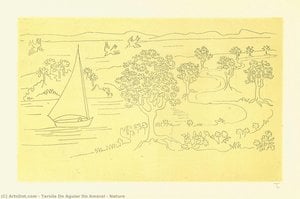
Tarsila do Amaral's "Urutu Snake," painted in 1928, isn’t merely a depiction of a reptile; it’s an immersion into the vibrant, surreal landscape of early Brazilian modernism. This oil on canvas, currently residing within the Museum of Modern Art in Rio de Janeiro, pulsates with a potent blend of abstract expressionism and the burgeoning dreamlike quality of Surrealism – a testament to do Amaral's embrace of European avant-garde movements while simultaneously grounding them in distinctly Brazilian imagery and symbolism. The painting immediately commands attention with its audacious scale—measuring 60 x 72 centimeters—and its bold, almost aggressively bright palette dominated by deep blues, verdant greens, and the arresting flash of a scarlet orb. It’s an artwork that refuses to be passively observed; it demands engagement, inviting viewers into a world where logic yields to intuition.
At the heart of “Urutu Snake” lies a colossal, textured egg – an element that immediately evokes notions of birth, potential, and nascent life. Its rough, granular surface, rendered with thick impasto strokes, suggests both fragility and immense power. Emerging from this primordial form is a sinuous serpent, its scales shimmering with subtle gradients of color, culminating in the aforementioned scarlet orb. The “Urutu” itself refers to a type of snake native to Brazil, but within do Amaral’s vision, it transcends mere identification. It embodies transformation, danger, and perhaps even the cyclical nature of existence – themes deeply rooted in Brazilian indigenous mythology. The red orb, often associated with the sun or vital energy, could represent both creation and destruction, mirroring the dualistic forces inherent in the serpent's journey.
Do Amaral’s technique is a fascinating synthesis of influences. While clearly drawing inspiration from the Cubism and Surrealism prevalent in Paris at the time, she infuses her work with a uniquely Brazilian sensibility. The flattened perspective, reminiscent of early Cubist explorations, creates a sense of immediacy and intimacy, as if we are peering directly into this dreamscape. Yet, the swirling lines and organic forms—particularly those defining the serpent’s movement—suggest an embrace of Expressionism's emotional intensity. The visible brushstrokes, characteristic of oil on canvas, contribute to the painting’s tactile quality, inviting a sense of physical engagement with the artwork. The careful layering of colors and textures creates depth, despite the overall flattened composition, suggesting a deliberate attempt to capture not just a visual representation but also an atmospheric mood.
"Urutu Snake" is inextricably linked to the Antropofagia (Cannibalism) movement – a radical artistic philosophy championed by do Amaral and her contemporaries. This movement sought to dismantle European artistic conventions and forge a distinctly Brazilian identity through the incorporation of indigenous myths, folklore, and natural imagery. The painting embodies this ethos perfectly: it’s not a faithful representation of reality but rather a symbolic distillation of Brazil's soul. The vibrant colors, the serpent motif, and the overall dreamlike quality all contribute to a sense of national pride and cultural renewal—a bold declaration that Brazilian art could be both modern and uniquely its own. The painting stands as a powerful symbol of this artistic revolution, capturing the spirit of a nation rediscovering its roots.
Reproductions of “Urutu Snake” offer an exceptional opportunity to bring this captivating artwork into any setting. The rich colors and dynamic composition will undoubtedly serve as a focal point, adding a touch of exoticism and intellectual depth to any room. Consider framing the reproduction in a manner that complements its vibrant palette – perhaps a dark wood frame to accentuate the intensity of the colors or a lighter tone to allow the artwork’s energy to shine through. “Urutu Snake” is more than just a painting; it's an invitation to explore the depths of Brazilian culture and the boundless possibilities of artistic expression.
The guide to "Urutu Snake" is the artwork's Guide page - a printable factsheet showing the artwork with its caption, credit line and identity table (artist, dates, medium, original size, collection).
To preview a reproduction of "Urutu Snake" by Tarsila do Amaral, open the artwork's Preview page.
The colors in "Urutu Snake" by Tarsila do Amaral have a balanced intensity.


1886 - 1973 , Brazil

Master the language of abstraction with our expert guide. Explore the profound emotional depth of line, color, and texture, from Op Art to Abstract Expressionism, designed for the discerning art collector seeking to deepen their appreciation of modern masterpieces.

Discover the profound emotional depth of Abstract Expressionism. Our expert guide explores the legacy of the New York School, from action painting to chromatic intensity, offering connoisseurs unparalleled insights into collecting and curating powerful abstract masterpieces.

Discover the profound beauty of abstract art. Our expert guide explores geometric abstraction, Op Art, and Expressionism, offering connoisseurs deep insights into collecting and curating powerful, non-representational masterpieces for sophisticated interiors.

Delve into the visceral world of Surrealist Expressionism. Our expert guide for discerning collectors explores the intersection of subconscious imagery and raw emotion, offering profound insights into acquiring masterpieces that bridge art history and modern sentiment.

 Preview
 Send
Send Share
Share
 Details
 Guide
Guide

 Download
 Similars
 X-Ray
X-Ray Diaporama
 Stats
Stats Read More









 Glass option is only available in size under 110 CM