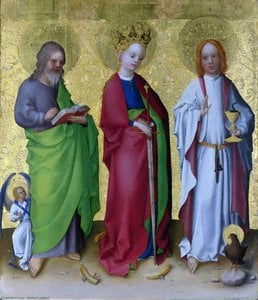
Gothic Revival
 1435
1435 124.0 x 172.0 cm
 Wallraf-Richartz-Museum
Hand-painted oil on canvas in your size and frame, made to order by our artists. ( Switch to Print Switch to Digital Image)





























Pick from our preset sizes that match the artwork's original proportions.

You may enter your own dimensions to fit a specific frame or space. If your selected size does not match the original image's proportions, we will either crop the artwork or extend the painting with additional hand-painted elements. A digital mockup will be sent for your approval before production begins.
Please note that the on-screen preview does not reflect the actual cropping or extension. Only the mockup will accurately show the final composition.
While custom sizes are available, we recommend selecting a dimension from the predefined list to preserve the original proportions.
Worldwide Delivery () in 3/4 weeks instead of standard 5 weeks. (13 October). No compromise on quality.
The Last Judgment
Reproduction Size
Stephan Lochner’s “The Last Judgment,” painted in 1435, isn't merely a depiction of biblical narrative; it’s a profound meditation on mortality, divine justice, and the eternal consequences of earthly actions. Emerging from the late Gothic period in Cologne, Germany, this monumental panel transcends its historical context to resonate with an enduring power—a testament to the artist’s skill and his ability to capture both the drama and the solemnity of humanity's final reckoning. The painting, currently housed within the Wallraf-Richartz-Museum, is a vibrant tapestry woven from earthly tones and celestial light, inviting viewers into a world where faith and fate collide.
Lochner’s genius lies in his masterful synthesis of influences. He seamlessly blends the opulent detail characteristic of International Gothic art—noticeable in the intricate drapery, the meticulously rendered faces, and the sheer abundance of figures—with the burgeoning realism and symbolic innovation that would soon define the Northern Renaissance. This fusion creates a work that is both richly ornamented and surprisingly direct, communicating complex theological ideas with an immediacy rarely seen in contemporary religious art. The influence of artists like Master Of San Torpé is evident in the composition’s balance and the use of color, while the echoes of earlier works, such as those found in the Cologne Cathedral, demonstrate Lochner's deep understanding of established artistic traditions.
At the heart of the painting stands Jesus Christ, radiating an almost ethereal light—a visual representation of his divine authority. He’s not depicted in a triumphant or martial pose, but rather with a quiet dignity, holding a book and a cross, symbols that immediately anchor the scene within Christian iconography. To his left, Mary Magdalene is rendered with remarkable tenderness, her long hair flowing freely as she holds a jar—a detail often interpreted as representing her role as a receptacle for divine grace. On the right, St. John the Baptist stands tall and resolute, clutching a lamb – a potent symbol of innocence and sacrifice. The background is dominated by a castle-like structure, possibly an idealized representation of heaven or a symbolic gateway to the afterlife, adding depth and grandeur to the composition.
The arrangement of figures isn’t random; it's carefully orchestrated to convey a sense of movement and drama. Angels ascend towards the heavens, their wings spread wide in a swirling vortex, while below, souls are being judged—some ascending to eternal bliss, others descending into darkness. The sheer number of figures – over 300 – creates an overwhelming sense of scale, emphasizing the vastness of human history and the ultimate significance of each individual’s actions.
Beyond its narrative content, “The Last Judgment” is rich in symbolism. The use of color—earth tones contrasted with vibrant blues and reds—evokes a sense of both earthly reality and divine transcendence. The recurring motifs – the cross, the book, the lamb, the jar – are all deeply rooted in Christian theology, reinforcing the painting’s central message about salvation and damnation. The inclusion of specific details, such as Mary Magdalene's flowing hair and St. John the Baptist's lamb, adds layers of meaning and invites viewers to contemplate the individual stories behind each figure.
More than just a historical artifact, “The Last Judgment” continues to evoke a powerful emotional response. The painting’s scale, its dramatic composition, and its profound themes about life, death, and judgment combine to create an experience that is both awe-inspiring and unsettling. It serves as a potent reminder of our own mortality and the importance of living a virtuous life.
Painted in oil on oak panel in 1435, “The Last Judgment” measures 124 x 172 cm. Stephan Lochner’s technical skill is evident in every detail—from the intricate folds of the drapery to the subtle gradations of color. The painting demonstrates a mastery of perspective and spatial relationships, creating a sense of depth and realism that was groundbreaking for its time. Lochner's work reflects the artistic trends of his era, particularly the influence of the International Gothic style, but also foreshadows the innovations of the Northern Renaissance. His brief career, tragically cut short in 1451, left behind a legacy of remarkable beauty and enduring significance.
"The Last Judgment" has a dramatic atmosphere.
The colors of "The Last Judgment" by Stephan Lochner have a subtle color saturation. Saturation describes how vivid or muted the colors are.
A Guide page is available for "The Last Judgment" by Stephan Lochner: a printable factsheet about the artwork, designed for students and classroom use.
A Stats page exists for "The Last Judgment". It charts the monthly visits of the artwork and of the artist's other works, with country and language breakdowns.
"The Last Judgment" by Stephan Lochner, held at the Wallraf-Richartz-Museum, is in the public domain - its copyright has expired. This status determines whether reproductions of the image may be made.
"The Last Judgment" is available as a hand-painted oil reproduction on linen canvas. The order can be placed on this page, with a choice of sizes.
Within Stephan Lochner's output, "The Last Judgment" sits in the Gothic Revival style, alongside the themes of international gothic, northern renaissance, medieval christian iconography, symbolism, religious judgment, salvation, damnation, cologne cathedral.
The diaporama of "The Last Judgment" can be watched on the artwork's Diaporama page.

Born around 1410 in the picturesque town of Meersburg, Germany – a location steeped in legend and nestled amongst the stunning Lake Constance – Stephan Lochner’s life was tragically cut short in Cologne around 1451. Despite his brief career, this enigmatic painter left an indelible mark on the art world, skillfully blending the opulent traditions of International Gothic with the burgeoning realism and innovative iconography characteristic of the early Northern Renaissance. Lochner's legacy lies not just in the beauty of his individual works but also in his influence on subsequent generations of artists, particularly Rogier van der Weyden and Hans Memling – painters who would carry forward elements of his distinctive style.
Little is definitively known about Lochner’s early life. Art historical consensus suggests he spent a portion of his formative years apprenticed within the Low Countries, an experience that profoundly shaped his artistic sensibilities. Exposure to the vibrant colors, intricate detailing, and evolving iconography prevalent in Flemish painting undoubtedly influenced his approach to composition, color palettes, and the depiction of religious figures. This international exposure is believed to be a key factor in the unique synthesis of styles found throughout his oeuvre.
Lochner’s paintings are immediately recognizable for their arresting use of color, dynamic long lines, and remarkably virtuosic surface textures. He eschewed the muted tones often associated with earlier Gothic art, embracing a brighter, more luminous palette – a characteristic that aligns him firmly within the emerging Renaissance aesthetic. His works frequently feature rich reds, blues, and golds, applied with a masterful understanding of light and shadow to create a sense of depth and drama.
Among his most celebrated pieces is “Madonna of the Rose Bush” (51 x 40 cm, Wallraf-Richartz Museum, Cologne), a masterpiece that exemplifies Lochner’s technical skill and expressive power. The painting showcases his ability to imbue religious subjects with an almost palpable sense of emotion and spirituality. “St. Jerome in His Study” (30 x 39 cm, oil on panel) further demonstrates his capacity for capturing the essence of his subjects – a quiet contemplation rendered with remarkable detail and psychological insight. The “Three Saints,” a complex composition brimming with grace and poise, highlights Lochner’s skill in depicting multiple figures within a single frame, creating a dynamic and engaging visual narrative.
Another significant work is the "Dombild Altarpiece" (or Kölner Dombild), originally commissioned for Cologne Cathedral. This monumental triptych, now housed within the cathedral's Marienkapelle, remains one of the most important examples of his art and a testament to his artistic vision. The altarpiece’s intricate details, vibrant colors, and symbolic imagery continue to fascinate viewers today.
Stephan Lochner's influence on subsequent generations of Northern artists was substantial. His distinctive style – characterized by flowing lines, brilliant colors, and a focus on emotional expression – resonated deeply with his contemporaries, inspiring them to incorporate elements of his approach into their own work. Rogier van der Weyden, in particular, is believed to have been profoundly influenced by Lochner’s use of color and composition, while Hans Memling similarly adopted aspects of his style in his devotional panels.
The “Dombild Altarpiece” stands as a particularly compelling example of Lochner's influence. Its innovative approach to depicting religious narratives – combining Gothic elegance with emerging Renaissance realism – paved the way for future developments in Northern European painting. The altarpiece’s intricate details and symbolic imagery served as a model for countless artists who followed, solidifying Lochner’s position as a pivotal figure in the transition from late Gothic to early Renaissance art.
Lochner's works are treasured within several prominent museums around the world. The Wallraf-Richartz Museum in Cologne houses “Madonna of the Rose Bush,” offering visitors a direct encounter with this iconic painting. The Städel Museum in Frankfurt displays “The Flémalle Panels” (68 x 160 cm, oak), showcasing Lochner’s mastery of panel painting and his ability to create complex compositions filled with detail and symbolism. Beyond these key institutions, fragments of his work can be found in various collections, ensuring that his artistic legacy continues to be appreciated by art enthusiasts worldwide.
Today, Stephan Lochner's paintings are celebrated for their beauty, technical skill, and profound emotional resonance. His ability to seamlessly blend the traditions of International Gothic with the innovations of the early Northern Renaissance cemented his place as a truly exceptional artist – a master who bridged two distinct artistic eras and left an enduring legacy on the art world.

1410 - 1451 , Germany

Embark on a scholarly journey through the sacred beauty of High Medieval art. Discover the profound symbolism, luminous iconography, and spiritual depth of Gothic masterpieces in this expert guide for classical art enthusiasts.

Explore the exquisite elegance of Late Gothic art. Discover how masters like Carlo Crivelli and Stefan Lochner blended intricate detail and religious devotion to bridge the Middle Ages and the Renaissance in this expert art history guide for true connoisseurs.

Embark on a scholarly journey through the spiritual grandeur of Late Medieval art. Discover the intricate symbolism, technical mastery, and profound religious narratives that define the Gothic era in this expert-led guide for art enthusiasts and collectors.
Embark on a journey through the dramatic era of Gothic art. Discover the profound beauty of illuminated manuscripts, sacred gold leaf masterpieces, and the transition to naturalism in this expert-led exploration of medieval artistry and historical grandeur.

 Preview
 Send
Send Share
Share
 Details
 Guide
Guide

 Download
 Similars
 X-Ray
X-Ray Diaporama
 Stats
Stats Read More









 Glass option is only available in size under 110 CM