

Museum-quality giclée or canvas print with fast production and flexible finish options. ( Buy Hand Made Painting Switch to Digital Image)





























Pick from our preset sizes that match the artwork's original proportions.

You may enter your own dimensions to fit a specific frame or space. If your selected size does not match the original image's proportions, we will either crop the artwork or extend the image with a mirrored or solid-fill edge. A digital mockup will be sent for your approval before production begins.
Please note that the on-screen preview does not reflect the actual cropping or extension. Only the mockup will accurately show the final composition.
While custom sizes are available, we recommend selecting a dimension from the predefined list to preserve the original proportions.
Worldwide Delivery () in 2 weeks instead of standard 4/5 weeks. (23 September)


Untitled
Reproduction Size

Stela Barbieri is far more than a singular painter; she is a weaver of stories, an educator, and a multidisciplinary force whose work exists at the intersection of visual art, literature, and sound. Born in Arara-quara, Brazil, in 1965, her creative essence is deeply rooted in the concept of the "living atelier." Her professional journey is not a linear path but rather a spiral, where her experiences as an author, composer, and curator feed into her visual practice. This interconnectedness allows her to approach the canvas not merely as a surface for pigment, but as a space for pedagogical invention and poetic reflection. Through her leadership of Bináh Espaço de Artes, she has cultivated an environment where art is not just observed but lived, much like the cherished memories of her childhood spent in the vibrant, storytelling atmosphere of her family's gardens.
The evolution of Barbieri’s work is marked by a profound commitment to the transformative power of creativity. Her artistic practice has expanded across various media, from the delicate precision of gouache and collage to large-scale installations and musical compositions. In her visual works, one often finds a dialogue between the ephemeral and the permanent, utilizing textures that invite tactile contemplation. Her history as an educator—having served as the educational director at the Instituto Tomie Ohtake and an educational curator for the São Paulo Biennial Foundation—deeply informs her aesthetic. She views art as a tool for discovery, a sentiment reflected in her numerous exhibitions that often invite public participation, blurring the boundaries between the creator and the observer.
To engage with Barbieri’s oeuvre is to enter a world where different forms of expression coalesce into a singular atmospheric experience. Her work as an author of over thirty books for children and young adults provides a literary foundation that mirrors the narrative depth found in her visual art. There is a rhythmic quality to her compositions, a cadence that suggests the influence of her musical endeavors, such as her recent musical album, Canoa. This auditory dimension complements her visual language, creating a sensory landscape where light, color, and sound perform a delicate dance.
Her technical mastery is particularly evident in her ability to manipulate medium and material to evoke specific emotional states:
The historical significance of Stela Barbieri lies in her ability to bridge the gap between high art and community engagement. Her career has been defined by a refusal to isolate art within the sterile confines of a gallery; instead, she brings it into the realms of education, literature, and daily life. By serving on prestigious boards such as the Pinacoteca do Estado de São Paulo and the Calouste Gulbenkian Foundation, she has helped shape the institutional landscape of contemporary art in Brazil while maintaining a grassroots connection to the act of storytelling.
Ultimately, Barbieri’s work serves as an invitation to a state of constant becoming. Whether through the quiet resonance of a landscape or the complex layers of a multimedia installation, her art remains a testament to the enduring power of curiosity. She reminds us that the artist is not merely a maker of objects, but a curator of experiences, a guardian of stories, and a guide through the infinite possibilities of the human imagination.

Italy

Journey through Wassily Kandinsky's 25 most iconic abstract paintings. Explore his revolutionary use of color, form & spiritual expressionism. Find museum-quality Kandinsky reproductions and elevate your home decor with WahooArt.com. Discover all masterpieces on WahooArt.com!

Explore 25 iconic Mark Rothko paintings that define Abstract Expressionism. Discover the stories, colors & emotions behind these masterpieces. Find museum-quality art reproductions and curated decor ideas at WahooArt.com.

Explore 10 defining Abstract Expressionism masterpieces by Pollock, Rothko & de Kooning. Discover the stories behind these iconic paintings and find museum-quality art reproductions to elevate your home decor on .
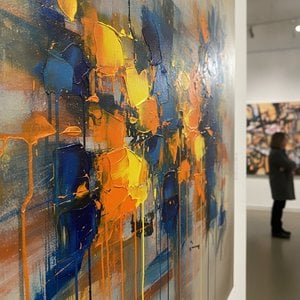
Master the high-impact world of contemporary abstraction. Discover how bold colors, textures, and modern movements like Abstract Expressionism can transform your space with premium, high-energy art curated for the design-conscious professional.

Explore 10 defining masterpieces of Geometric Abstraction! Discover Kandinsky, Mondrian & Malevich’s iconic works. Find museum-quality art reproductions and curated decor ideas to elevate your home at WahooArt.com.

 Preview
 Send
Send Share
Share
 Details
 Guide
Guide

 Download
 Similars
 X-Ray
X-Ray Diaporama
 Stats
Stats


 Read More







 Glass option is only available in size under 110 CM


