OilWallArtPolish Modernism
 1920Modern
 70.0 x 100.0 cm
Museum-quality giclée or canvas print with fast production and flexible finish options. ( Buy Hand Made Painting Switch to Digital Image)





























Pick from our preset sizes that match the artwork's original proportions.

Type the width and the height you need, to fit your frame or your wall. A print can only be cut, never made bigger than the picture, so a size with a different shape loses a part of the image. We send you a digital mockup to approve before we print anything. The picture shown on this page does not show the real cut — only the mockup does.
Worldwide Delivery () in 2 weeks instead of standard 4/5 weeks. (23 October)
Two heads
Reproduction Size
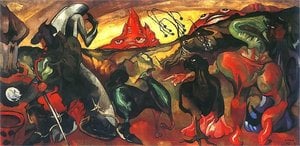
In the hauntingly beautiful portrait Two heads, created in 1920 by the visionary Polish master Stanisław Ignacy Witkiewicz, we are invited into a private, almost breathless moment of human connection. The canvas presents a striking duality, capturing two women locked in an intense, silent exchange. One figure, draped in the somber elegance of a black dress, leans forward with her mouth slightly parted, as if caught mid-sentence or perhaps gasping at a sudden revelation. Opposite her, a woman in a vibrant red dress provides a searing contrast, her presence anchored by the unexpected detail of a bird perched delicately upon her shoulder. This juxtaposition of light and shadow, of stillness and potential movement, creates a psychological tension that draws the viewer into the very heart of their shared gaze.
The technique employed by Witkacy reflects his profound position within the currents of Polish Modernism. The brushwork possesses a certain raw, expressive energy that transcends mere representation, leaning into the depths of Symbolist surrealism. There is a palpable weight to the textures—the sheen of the necklaces, the heavy folds of the fabric, and the organic softness of the bird's plumage all contribute to a sense of tactile reality. Through his masterful use of color, Witkacy does not merely depict clothing; he uses the deep blacks and fiery reds to delineate the emotional temperature of the scene, making the atmosphere feel thick with unspoken meaning and intellectual depth.
Beyond the surface beauty, Two heads serves as a profound exploration of intimacy and the uncanny. The presence of the bird acts as a powerful symbol, perhaps representing nature’s intrusion into human social spheres or acting as a messenger between the two souls. For the discerning collector or interior designer, this piece offers more than just aesthetic appeal; it provides a focal point of immense character. It is an artwork that demands contemplation, making it an ideal centerpiece for a sophisticated gallery wall or a curated study where one seeks to evoke themes of mystery, connection, and the complex layers of the human psyche. To possess a reproduction of this work is to bring a fragment of interwar European avant-garde history into the modern home, offering a timeless window into a moment of profound emotional resonance.
"Two heads" by Stanisław Ignacy Witkiewicz is dated 1920 and belongs to Polish Modernism.
The palette of "Two heads" by Stanisław Ignacy Witkiewicz is described as earthy. It is a compact description of the work's colors.
In the catalog, "Two heads" by Stanisław Ignacy Witkiewicz is filed as wall art. The category helps find similar works.


1885 - 1939 , Poland

Explore the profound artistry of black and white photography. From historical mastery to the interplay of light and shadow, discover how monochrome captures timeless emotion and form through a sophisticated lens of art history.

 Preview
 Send
Send Share
Share
 Details
 Guide
Guide

 Download
 Similars
 X-Ray
X-Ray Diaporama
 Stats
Stats Read More









 Glass option is only available in size under 110 CM