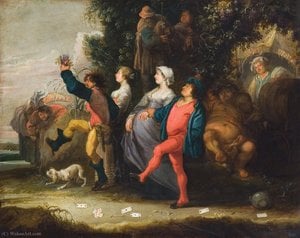
The Antwerp Prodigy: Early Life and Artistic Foundations
In the heart of seventeenth-century Antwerp, a city pulsating with the creative energy of the Flemish Baroque, Simon de Vos began a journey that would eventually etch his name into the annals of art history. Born in 1603 to Herman de Vos, a craftsman of dice, and Elisabeth van Oppen, De Vos was immersed from birth in an environment where meticulous skill and tangible artistry were part of the daily fabric of life. His true destiny, however, revealed itself at the tender age of twelve when he entered the studio of the esteemed painter Cornelis de Vos. Under this master’s watchful eye, the young artist began to absorb the nuances of portraiture and the dramatic potential of light, laying a foundation of technical precision that would support his later, more expansive explorations of the human condition.
This early apprenticeship was more than mere instruction; it was an initiation into a lineage of Flemish excellence. By studying under a contemporary who worked closely with the giants of the era, De Vos inherited a profound respect for the interplay between reality and theatricality. His formative years were spent mastering the delicate textures of skin, the heavy drape of velvet, and the subtle shifts in expression that distinguish a mere likeness from a living soul.
The Radiance of the Merry Company
As his talent matured, De Vos gained renown for his enchanting "cabinet pictures"—small-format works that captured the spirited essence of communal celebration. These pieces, often referred to as
Merry Companies, showcased a profound fascination with the Caravaggesque tradition. He utilized a dramatic use of chiaroscuro, allowing light to pierce through shadows to illuminate the joyous chaos of social gatherings. In these scenes, one finds a masterful command of color; vibrant reds, deep blues, and lush greens dance across the canvas, mirroring the laughter, music, and conviviality of the figures depicted.
The brilliance of his genre painting lies in its ability to transform a simple moment of leisure into a profound study of human connection. Through his brush, the clinking of glasses and the soft melodies of musical instruments become palpable. He possessed an uncanny ability to capture:
- the fleeting nuances of facial expressions during moments of mirth
- the intricate textures of opulent fabrics and fine lace
- the atmospheric tension created by dramatic, directional lighting
These works were not merely depictions of festivities but windows into the social vitality of the Flemish era, rendered with a sensitivity that celebrated the ephemeral beauty of life.
From Intimacy to Epic: The Evolution of a Master
As De Vos’s career progressed, he underwent a significant stylistic evolution, transitioning from the intimate scale of genre scenes to the monumental grandeur of history painting. This shift saw him embracing larger formats and a more theatrical approach, heavily influenced by the sweeping dynamism of
Peter Paul Rubens and the refined elegance of
Anthony van Dyck. His later works moved away from the playful intimacy of the tavern and the parlor toward the epic narratives of religious and allegorical significance.
In masterpieces such as
The Return of the Prodigal Son and
The Raising of Lazarus, De Vos demonstrated an ability to handle complex theological themes with breathtaking authority. He bridged the gap between the lightheartedness of Flemish genre art and the high drama of the Baroque movement, infusing his larger canvases with a psychological depth that remained consistent with his earlier works. His legacy remains that of a painter who could capture both the smallest flicker of emotion in a crowded room and the most profound spiritual truths on a grand stage, leaving behind a body of work that continues to captivate with its luminous beauty and enduring human truth.


 Buy Hand Made Painting


 Preview
 Send
Send Share
Share
 Details
 Guide
Guide

 Download
 Similars
 X-Ray
X-Ray Diaporama
 Stats
Stats Read More






































 Glass option is only available in size under 110 CM