The Elegance of the Written Word
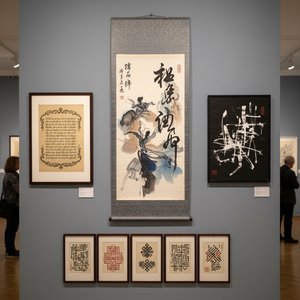
In the quiet corridors of the Sakıp Sabancı Museum in Istanbul, there exists a piece that transcends mere decoration, inviting the viewer into a meditative state through the rhythmic beauty of script. Levha (calligraphic inscription) is not simply a painting; it is a profound dialogue between ink and soul. Created in 1951, this work serves as a breathtaking testament to the enduring power of Islamic calligraphy, where every stroke of the pen carries the weight of tradition and the grace of divine expression. The composition focuses on the intricate dance of Arabic lettering, where the fluid movement of the characters creates a visual melody that captivates the eye and settles the spirit.
The artistry of this piece lies in its ability to transform language into pure form. As one observes the delicate curves and sharp terminals of the calligraphy, the distinction between reading and seeing begins to blur. The technique employed here emphasizes the structural integrity of the script, utilizing a balanced arrangement that directs the viewer's gaze across the 70 x 59 cm surface in a continuous, flowing motion. For the discerning collector or interior designer, this work offers a sophisticated focal point, bringing an air of historical prestige and intellectual depth to any curated space.
A Legacy of Ottoman Artistry
To understand the soul of this inscription, one must look toward its creator and the rich cultural tapestry from which it emerged. While the piece itself dates to 1951, it is deeply rooted in the aesthetic values championed by Abdulhamid II. As the 34th Sultan of the Ottoman Empire, Abdulhamid II was far more than a political figure; he was a monumental patron of the arts whose reign fostered a period of immense cultural flourishing. His passion for preserving the historical and spiritual narrative of the empire ensured that the traditions of calligraphy remained at the forefront of Ottoman identity.
The historical context of this work evokes a sense of continuity, bridging the gap between the imperial grandeur of the late 19th century and the mid-20th-century preservation of these sacred arts. The inscription acts as a bridge through time, carrying the echoes of an era where art was inseparable from faith and statehood. For those seeking to adorn their homes with a reproduction of this piece, it offers more than just aesthetic pleasure; it provides a tangible connection to the storied history of Istanbul and the sophisticated legacy of Ottoman craftsmanship.
Atmospheric Grace for Modern Interiors
Integrating a work like Levha into a contemporary interior design scheme requires an appreciation for balance and texture. The piece possesses a unique versatility, functioning as both a subtle accent in a minimalist setting and a commanding centerpiece in a more opulent, classical room. Its monochromatic or limited color palette—typical of high-quality calligraphic works—allows it to harmonize with various textures, from smooth marble surfaces to rich, heavy velvets.
The emotional impact of the calligraphy is one of profound serenity. In an age characterized by visual noise and digital distraction, the rhythmic, repetitive nature of the script offers a sanctuary of stillness. It invites contemplation, making it an ideal selection for libraries, study halls, or quiet corners of a residence intended for reflection. Owning a high-quality reproduction of this masterpiece allows one to curate an environment that celebrates the intersection of historical reverence and timeless elegance, ensuring that the spirit of Ottoman artistry continues to breathe within modern living spaces.



 Preview
 Buy Print
 Send
Send Share
Share
 Details

 Download
 Similars
 X-Ray
X-Ray Diaporama


 Read More






































 Glass option is only available in size under 110 CM