

The artwork displayed on this page is protected by copyright law, which means we cannot legally create or sell an identical reproduction. This protection is enforced under international agreements such as the Berne Convention and by national laws, including those outlined by the U.S. Copyright Law - Title 17.
This method fully complies with copyright regulations because it does not involve copying or duplicating the protected artwork. Instead, it is a creative reinterpretation - a new painting that is influenced by the original but not identical to it.
Museum-quality giclée or canvas print with fast production and flexible finish options. ( Buy Hand Made Painting Switch to Digital Image)





























Pick from our preset sizes that match the artwork's original proportions.

Type the width and the height you need, to fit your frame or your wall. A print can only be cut, never made bigger than the picture, so a size with a different shape loses a part of the image. We send you a digital mockup to approve before we print anything. The picture shown on this page does not show the real cut — only the mockup does.
Worldwide Delivery () in 2 weeks instead of standard 4/5 weeks. (20 November)
Self-Portrait with White Cap
Reproduction Size
Step closer and observe the man before us. In this 1935 oil portrait, we encounter an elderly figure caught in a moment of profound stillness. He is positioned slightly off-center, his presence felt through a medium close-up that brings us face-to-face with his weathered features. A dark hat sits low upon his brow, and his gaze, framed by spectacles, suggests a mind turned inward. There is a certain dignity in his composure, even as he holds a thin cigarette, the rising wisps of smoke adding a vertical movement to an otherwise stationary scene. The background remains a pale, desaturated greenish-beige, providing a muted stage that allows the darker tones of his suit and the textures of his white beard to emerge with clarity.
The artist has moved away from precise, clinical lines in favor of a more painterly approach. You can see the physical weight of the paint here; thick, impasto strokes create a tactile surface, particularly where light catches the highlights of the face and the drifting smoke. This heavy application of pigment gives the portrait an almost sculptural quality. The lighting is soft, appearing to descend from the upper left to cast gentle shadows that define the contours of the man's cheek and the structure of his clothing. Through these earthy tones—deep browns, blacks, and grays—the work achieves a sense of weight and character. It is a study in light manipulation, where the focus remains on the emotional gravity of the subject rather than mere anatomical accuracy.
The colors in "Self-Portrait with White Cap" by Max Kaus have a balanced intensity.
Given its 1935 date, "Self-Portrait with White Cap" falls in Max Kaus's Surrealist Period.
"Self-Portrait with White Cap" was made in 1935, in oil on canvas.

Max Kaus was a German painter, printmaker, graphic artist, and lithographer. Born in Berlin, Germany, his early training took place at the Study Institute of the Decorative Arts Museum in Berlin between 1908 and 1913. During the First World War, he served as a medical orderly and ambulance driver in western Flanders. It was during this time in Ostend that he learned to make lithograph prints, utilizing a printing press constructed from timber recovered from a destroyed railway station. Upon returning to Berlin in 1918, he acquired his own lithography equipment, which became a foundation for much of his subsequent artistic output.
His career saw significant shifts in subject matter and style. While he was widely recognized for his landscape works—drawing inspiration from travels within Germany, Austria, and northern Italy—he also worked extensively on portraiture. His post-war output was characterized by a shift where form began to dominate content. His later creative years included several distinct categories of work:
Beyond his personal practice, Kaus was an influential teacher. He held a professorship teaching landscape art at the Kunstgewerbe- und Handwerkerschule in Berlin, and later served as a professor and head of the department for "Freie Kunst" at the Hochschule für Bildende Künste in Berlin. He also served as the deputy director at the academy.
Kaus was a member of the German Artists' Association, serving on its executive board and as deputy chair. His surviving works are catalogued and indexed, with his literary estate held at the German National Arts Archive in Nuremberg.

1891 - 1977 , Germany

Explore the profound connection between technique and emotion. From the sculptural depth of impasto to classical mastery, decode the language of brushstrokes through an expert lens of art history and fine art connoisseurship.

Explore the profound emotional depth of Van Gogh's impasto technique. Discover how his sculptural brushstrokes and textured oil layers define Post-Impressionism through an expert art-historical lens, perfect for discerning collectors and fine art enthusiasts.

Discover the exquisite mastery of pastel and chalk in fine art. Explore how texture, light, and softness create depth in Impressionist masterpieces and learn to curate these velvety textures for sophisticated, luxury interiors with expert guidance.

Discover how custom historical portraits transcend decor to become profound expressions of identity. Explore the artistry of bespoke oil reproductions, from Renaissance mastery to modern reimagining, and learn to transform personal legacies into museum-quality fine art masterpieces.
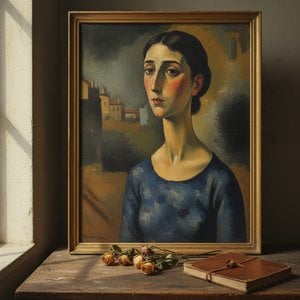
Delve into the haunting beauty of Amedeo Modigliani's portraits. Explore the intersection of Expressionism and Modernism through an expert analysis of his iconic elongated forms, melancholic gazes, and profound influence on art history.
 Preview

 Send
 Share
 Details
 Guide


 Download
 Similars
 X-Ray
 Diaporama
 Q&A

 Stats


 Read More









 Glass option is only available in size under 110 CM


