


Museum-quality giclée or canvas print with fast production and flexible finish options. ( Buy Hand Made Painting Switch to Digital Image)





























Pick from our preset sizes that match the artwork's original proportions.

Type the width and the height you need, to fit your frame or your wall. A print can only be cut, never made bigger than the picture, so a size with a different shape loses a part of the image. We send you a digital mockup to approve before we print anything. The picture shown on this page does not show the real cut — only the mockup does.
Worldwide Delivery () in 2 weeks instead of standard 4/5 weeks. (13 November)
Self Portrait
Reproduction Size
The artist sits within the soft shadows of his studio, his gaze meeting yours with an intensity that feels both intimate and deeply private. He is an older man now, his face etched with the quiet wisdom of years spent observing the world through a lens of light and color. A thick, grey beard and matching hair catch the gentle light flowing from the upper right, adding a sculptural weight to his features. In one hand, he holds a thin paintbrush, while the other rests upon a wooden palette laden with various pigments, a silent declaration of his identity as a creator. The atmosphere is heavy with a somber, dignified stillness. Behind him, the blurred suggestion of an easel and canvas hints at the ongoing work of a lifetime, yet in this specific moment, there is only contemplation.
The palette is dominated by warm, earthy tones—deep browns, ochres, and burnt sienna that wrap the subject in a sense of grounded maturity. These colors do not shout; they whisper of stability and professional dedication. The lighting casts soft shadows across the left side of his face, creating a subtle depth that makes the texture of his skin and hair feel tangible. It is a scene of profound introspection, where the boundaries between the man and his craft seem to dissolve into the surrounding studio air.
Every brushstroke contributes to a sense of movement and life, even in this stationary pose. The technique relies on soft, blended lines that characterize a late academic or Impressionist approach, where visible but controlled strokes build a rich texture across the canvas. There is no harshness here, only the gradual transition of light into shadow. This method allows the subject's features to emerge from the darkness with a gentle luminosity, highlighting the fine details of his weathered face and the heavy folds of his clothing.
The composition places him slightly off-center, creating a natural depth that draws the eye inward toward his direct stare. By positioning himself in a three-quarter length portrait, the artist establishes an immediate connection with anyone who looks upon him. The background remains a muted, atmospheric space, ensuring that nothing distracts from the central figure. Through this careful arrangement of light and earth-toned pigments, the painting captures more than a likeness; it captures the very essence of a man finding peace within his own creative solitude.
The colors of "Self Portrait" by Pieter Van der Ouderaa have a subtle color saturation. Saturation describes how vivid or muted the colors are.
"Self Portrait" was created by Pieter Van der Ouderaa in 1904.
"Self Portrait" is executed in oil on canvas.

Pieter Van der Ouderaa was born in Antwerp, Belgium, on 13 January 1841. Growing up in a city with a deep history of visual storytelling, he likely felt the weight of the artistic traditions surrounding him from a young age. His path as a painter and lithographer began in earnest when he was only fifteen years old. At that age, he enrolled at the Royal Academy of Fine Arts of Antwerp, a place where he would begin the long process of refining his technical skills and understanding of form.
His education was shaped by the guidance of several significant teachers. He studied under Jacob Jacobs, Jozef Van Lerius, and Nicaise de Keyser. These mentors provided the foundation for his later work in religious subjects, genre scenes, and landscapes. Through their instruction, he learned the discipline required to move from simple sketches to the complex compositions that would define his career. His time at the Academy was not merely about learning to hold a brush, but about absorbing the methods of those who had come before him.
In 1865, a significant opportunity arrived when the Belgian government awarded him a three-year travel bursary. This period allowed him to immerse himself in the art of Italy, where he spent his time studying the works of Raphael. He was deeply influenced by the Italian master, even producing a portrait of Julius II after Raphael during this formative time in the country.
Seeking something more exotic to expand his visual language, he later accompanied Albert Cogels on a trip through Algiers, Tunis, Oran, and Spain. These travels provided him with new landscapes and atmospheres to draw from. When he finally returned to Belgium in 1869, his focus shifted toward the grand scale of history painting. He became known for large-scale historical compositions and romantic fantasies, often working in a style reminiscent of Hendrik Leys and Nicaise de Keyser.
Pieter Van der Ouderaa moved through the art world with a versatility that allowed him to shift between the intimate and the grand. As both a painter and a lithographer, he found expression in a wide variety of subjects, ranging from quiet portraits and landscapes to more complex genre scenes. He often turned his attention to religious themes, capturing the spiritual weight of his subjects through a lens of Academicism. This disciplined approach provided him with the technical foundation to handle everything from the subtle nuances of a face to the expansive scale of a landscape.
His work frequently leaned into the realm of history painting, where he became known for large-scale compositions that sought to bring the past to life. In these pieces, he often explored romantic fantasies, drawing inspiration from the stylistic approaches of Hendrik Leys and Nicaise de Keyser. These historical works were not merely records of events but were compositions designed to stir the imagination through dramatic storytelling. Whether he was working on a small-scale portrait or a massive historical scene, his hand remained guided by the formal traditions of his training in Antwerp.
During his time studying in Italy, he focused on the great traditions of the past, producing a portrait of Julius II after Raphael in 1865. This period of study helped shape the large-scale historical compositions that would define much of his career. Upon returning to Belgium, he turned his attention to dramatic narratives, such as Tanchelin's Sermon in 1870 and The Last Resort in 1885. These works reflected a deep interest in the weight of history and the complexities of human belief.
His ability to handle significant religious and civic themes led to important commissions. In 1890, he was tasked with painting the Academic triptych Jean Berchmans Lying in State for the Antwerp Cathedral. This work required a careful balance of solemnity and technical precision. Beyond these formal duties, he continued to explore a variety of subjects, from the spiritual to the everyday, including Spiritual Pleasure (1871), On the Way to the Ordeal (1880), and Fair at the Old Stock Exchange in Antwerp (1892).
In the final decade of his life, Van der Ouderaa continued to engage with the themes that had defined his career. One of his later compositions, The Temptation of Eve, was painted in 1910. This work reflects the enduring interest he held in religious and historical narratives, even as the art world around him began to shift toward new movements.
Artistry was a family matter for the Van der Ouderaa household. His daughter, Clotildis, followed a similar path, finding her own voice as a painter of flowers. This shared devotion to the craft suggests a home deeply immersed in the visual language of color and form.
The artist remained in Antwerp until his death on 5 January 1915. He passed away in his seventy-fourth year, leaving behind a body of work that spanned from intimate portraits to large-scale historical scenes. He was buried in the city where his life and training had begun.
The legacy of Pieter Van der Ouderaa survives through several pieces held in public institutions across Europe. In Antwerp, his presence is felt through works such as Legal Reconciliation and The Holy Women Returning from the Tomb of Christ (1893). These pieces remain part of the city's artistic record, reflecting the subjects he favored throughout his life.
His reach extends beyond his birthplace into other major centers. In Brussels, one can find The Last Refuge (Episode from the Spanish Fury) (1885), a work that captures a specific moment of historical tension. Meanwhile, in Groningen, the Portrait of Eerelmann is preserved, offering a glimpse into the portraiture he practiced alongside his larger historical and religious compositions.

1841 - 1915 , Belgium

Immerse yourself in the serene beauty of earthy driftwood tones. Explore 10 iconic masterpieces, from classical landscapes to muted modernism, and find inspiration for your decor with museum-quality reproductions. Discover all masterpieces on WahooArt.com.
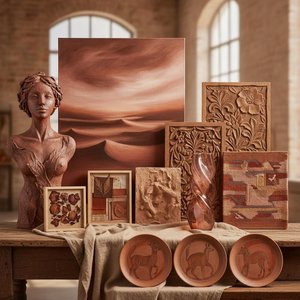
Immerse yourself in the warmth of history with 10 iconic paintings defined by rosy brown tones. Explore the stories, techniques, and movements behind these timeless masterpieces. Find museum-quality art reproductions for your decor. Discover all masterpieces on WahooArt.com.

Immerse yourself in the organic beauty of nature through 10 iconic artworks featuring warm earth tones and rustic textures. Explore the stories behind these timeless masterpieces and find museum-quality reproductions for your decor. Discover all masterpieces on WahooArt.com.

Immerse yourself in the timeless beauty of olive-toned masterpieces. From Impressionist landscapes to classic oil paintings, explore the stories behind these iconic earthy works and find museum-quality reproductions for your decor. Discover all masterpieces on WahooArt.com.
 Preview
 Send
Send Share
Share
 Details
 Guide
Guide

 Download
 Similars
 X-Ray
X-Ray Diaporama
 Q&A
Q&A
 Stats
Stats


 Read More









 Glass option is only available in size under 110 CM


