

Museum-quality giclée or canvas print with fast production and flexible finish options. ( Buy Hand Made Painting Switch to Digital Image)





























Pick from our preset sizes that match the artwork's original proportions.

Type the width and the height you need, to fit your frame or your wall. A print can only be cut, never made bigger than the picture, so a size with a different shape loses a part of the image. We send you a digital mockup to approve before we print anything. The picture shown on this page does not show the real cut — only the mockup does.
Worldwide Delivery () in 2 weeks instead of standard 4/5 weeks. (21 October)
Venus and Mars
Reproduction Size
Sandro Botticelli's “Venus and Mars” (c. 1485) is a cornerstone of the Early Italian Renaissance, currently captivating viewers at the National Gallery in London. This painting isn’t merely a depiction of classical mythology; it’s a profound exploration of love’s power to temper even the most formidable forces – a visually stunning and intellectually stimulating work for art enthusiasts, collectors, and those seeking to infuse their spaces with timeless beauty.
Botticelli presents a uniquely tender scene. Venus, goddess of love, delicately observes Mars, the god of war, as he slumbers. Playful baby satyrs attend to him, frolicking amongst his discarded armor – a potent symbol of peace momentarily prevailing over conflict. This isn’t a grand battle narrative; it's an intimate moment of respite, suggesting that even warriors are susceptible to affection’s disarming influence. The lush grove setting enhances this sense of privacy and vulnerability.
“Venus and Mars” exemplifies Botticelli's signature style. Executed in tempera on panel, the painting showcases graceful lines, delicate forms, and a harmonious color palette that radiates luminosity. The flowing drapery adorning Venus contributes to an overall sense of elegance and refinement characteristic of the Early Renaissance. Note the meticulous detail – from the intricate patterns woven into the fabrics to the expressive gestures of the satyrs. Botticelli masterfully blends classical influences with innovative techniques, creating a uniquely poetic visual language.
Created around 1485 during the height of the Florentine Renaissance, “Venus and Mars” was likely commissioned for a wedding or as part of a series intended to decorate a bridal chamber. This context strongly suggests an allegorical interpretation: the painting served as a visual representation of marital harmony, where love (Venus) ultimately triumphs over conflict (Mars). The work embodies the humanist ideals prevalent in Florence at the time – celebrating classical learning and emphasizing human potential. It’s believed Botticelli collaborated with scholars like Poliziano to imbue the artwork with layered meaning.
The symbolism within “Venus and Mars” is richly complex. The satyrs interacting with Mars' armor underscore his vulnerability when stripped of his martial power. A swarm of wasps hovering near Mars’ head has been interpreted as symbolizing the sting of passion – or a subtle nod to the Vespucci family, whose coat of arms featured wasps! The myrtle grove itself is traditionally associated with Venus and marriage, reinforcing the painting's allegorical message. The composition invites viewers to decode these symbols and formulate their own interpretations.
“Venus and Mars” evokes a sense of tranquility and contemplation, prompting reflection on the complexities of love, war, and human nature. Botticelli’s ability to capture both beauty and vulnerability creates an enduring emotional connection that transcends time. The painting's lasting popularity is a testament to its artistic merit and universal themes, solidifying Botticelli’s place as one of the most important artists of the Renaissance.
A high-quality reproduction of “Venus and Mars” will introduce a touch of Renaissance elegance and intellectual depth to any interior. Its harmonious color palette complements diverse décor styles, from classic to contemporary. Consider displaying it in:
To fully appreciate the artwork's details, ensure adequate lighting and consider framing it with a classic, ornate frame to enhance its Renaissance aesthetic. “Venus and Mars” is more than just a beautiful painting; it’s a window into the artistic and intellectual world of the Italian Renaissance – a timeless masterpiece that continues to inspire awe and admiration.
The romantic tone of "Venus and Mars" by Sandro Botticelli matches its recommended gift occasion: wedding.
Sandro Botticelli created "Venus and Mars" within the Early Italian Renaissance movement.
A print of "Venus and Mars" by Sandro Botticelli is recommended at a medium size in panoramic orientation.

Sandro Botticelli, born Alessandro di Mariano di Vanni Filipepi around 1445 in Florence, Italy, emerged during a period of extraordinary cultural ferment—the Early Renaissance. His life was deeply rooted in the city’s artistic and social fabric; he never strayed far from his neighborhood of Ognissanti, a testament to both familial ties and the vibrant creative ecosystem that nurtured him. His father, Mariano Filipepi, initially a goldsmith and later a tanner, provided an early exposure to craftsmanship and meticulous detail—qualities that would profoundly influence Botticelli’s artistic approach. Though initial reports suggested training as a goldsmith, he soon found his calling under the tutelage of Fra Filippo Lippi, a leading painter of the time. This apprenticeship proved pivotal, immersing him in the techniques and aesthetics of the Florentine school while also connecting him to influential patrons like the Medici family.
Botticelli’s artistic style is instantly recognizable for its lyrical beauty, characterized by elegant linearity, flowing contours, and a delicate use of color. He masterfully bridged the gap between the late Gothic traditions and the burgeoning Renaissance aesthetic, absorbing influences from masters like Fra Angelico and Paolo Uccello yet forging a uniquely personal vision. His figures possess an ethereal quality, often depicted with elongated proportions and graceful poses that convey both serenity and a subtle melancholy. A defining feature of his work is the frequent incorporation of classical mythology—a reflection of the humanist interests sweeping through Renaissance Florence. He didn’t merely illustrate these ancient tales; he imbued them with new layers of meaning, exploring themes of love, beauty, and spiritual longing.
Botticelli's technique was innovative for its time. He often employed a silverpoint drawing method underpainting his canvases, contributing to the luminosity and delicate detail seen in his finished works. His use of tempera paint allowed for precise rendering and vibrant colors, while his later experiments with oil paints broadened his expressive possibilities.
Botticelli’s legacy rests upon a handful of iconic paintings that continue to captivate audiences centuries later. The Birth of Venus, completed around 1486, stands as perhaps his most celebrated work—an allegorical depiction of the goddess emerging from a seashell, embodying Renaissance ideals of beauty and harmony. Its graceful composition, delicate color palette, and evocative symbolism have made it an enduring symbol of the era. Equally renowned is Primavera, created around 1482, a complex and enigmatic painting celebrating spring and love, populated with symbolic figures drawn from classical mythology. These works showcase Botticelli’s mastery of composition, his ability to create atmospheric depth, and his profound understanding of human emotion.
His artistic journey unfolded in distinct phases. The early 1470s saw him focusing on religious subjects, honing his technical skills and establishing a reputation for skillful execution. The 1480s marked the peak of his creative powers, with the creation of his most famous mythological paintings. However, the late 1490s witnessed a shift in his style, influenced by the fervent preaching of Girolamo Savonarola—a Dominican friar who condemned what he saw as the decadence and moral corruption of Florence. This period resulted in more austere and emotionally charged works, reflecting a growing spiritual intensity.
Following his death in 1510, Botticelli’s reputation gradually faded into obscurity. For nearly three centuries, his work was largely forgotten, overshadowed by the achievements of High Renaissance masters like Leonardo da Vinci and Michelangelo. However, a remarkable rediscovery occurred in the late 19th century with the rise of the Pre-Raphaelite Brotherhood—a group of English artists who rejected academic conventions and sought inspiration in the art of the early Italian Renaissance. They were captivated by Botticelli’s linear grace, vibrant colors, and poetic sensibility, recognizing him as a kindred spirit.
This renewed appreciation sparked a widespread reassessment of his work, establishing him as one of the most important artists of the Early Renaissance. Today, Botticelli is celebrated for his unique artistic vision, his masterful technique, and his enduring ability to evoke beauty, emotion, and spiritual contemplation. His influence can be seen in subsequent generations of artists who have sought to capture the same sense of grace and elegance in their own work. He remains a symbol of Florentine artistic achievement and a testament to the power of Renaissance humanism.

1445 - 1510 , Italy

Embark on a sophisticated journey through the eternal allure of mythological art. Discover how master painters breathe life into ancient legends, from Greek deities to Baroque masterpieces, and learn to curate these timeless narratives within your own exquisite art collection.

Explore the profound beauty of mythological figures through the lens of art history. From Renaissance masterpieces to custom oil reproductions, discover how legendary tales of heroism and divinity are immortalized in fine art for discerning collectors.

Embark on a sophisticated visual journey through art history's most iconic Venus masterpieces. Explore the divine beauty of Botticelli and the evolution of classical mythology through expert curation for the discerning art enthusiast.

Discover the profound beauty of Academic Classicism. Explore the principles of order, anatomical precision, and the enduring legacy of Neoclassical masters through this expert guide to timeless elegance and technical perfection in fine art.
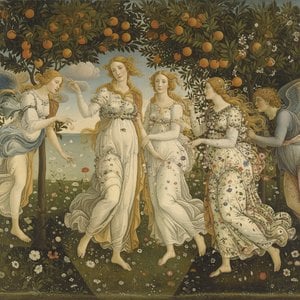
Explore the ethereal beauty of Sandro Botticelli's masterpieces. Delve into the profound symbolism, mythological grace, and technical mastery that define the Italian Renaissance through an expert art-historical lens.

 Preview
 Send
Send Share
Share
 Details
 Guide
Guide

 Download
 Similars
 X-Ray
X-Ray Diaporama
 Stats
Stats

 Read More









 Glass option is only available in size under 110 CM


