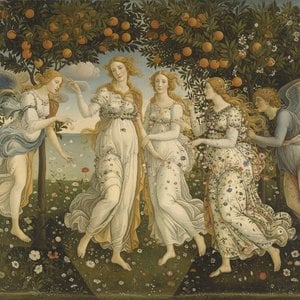
venus by Sandro Botticelli, hand-painted oil painting reproduction by a master artist
Preview AR preview Switch to Print Switch to Digital Image Send
Details Guide Add to favorites Download Similars X-Ray Diaporama Q&A Presentation Stats

venus Hand-painted oil painting reproduction

Botticelli's "Venus" captures the iconic beauty of classical antiquity in a graceful Renaissance painting featuring a confident woman with long hair and a delicate curtain backdrop, perfect for art lovers seeking timeless elegance.

An Early Renaissance master of lyrical grace and The Birth of Venus. Explore his iconic mythological and religious masterpieces today.

Hand Made Oil Reproduction

Hand-painted oil on canvas in your size and frame, made to order by our artists. ( Switch to Print Switch to Digital Image)

Corner sample of the P118B picture frame: moulded polystyrene, 5 cm wide and 3 cm thick
P118B $10
Corner sample of the P118H picture frame: moulded polystyrene, 5 cm wide and 3 cm thick
P118H $10
Corner sample of the P118W picture frame: moulded polystyrene, 5 cm wide and 3 cm thick
P118W $10
Corner sample of the P438Z picture frame: moulded polystyrene, 5.5 cm wide and 3.5 cm thick
P438Z $10
Corner sample of the P508JH picture frame: moulded polystyrene, 7 cm wide and 3.5 cm thick
P508JH $12
Corner sample of the P508YH picture frame: moulded polystyrene, 7 cm wide and 3.5 cm thick
P508YH $12
Corner sample of the P805H picture frame: moulded polystyrene, 5 cm wide and 3.5 cm thick
P805H $10
Corner sample of the P805Z picture frame: moulded polystyrene, 5 cm wide and 3.5 cm thick
P805Z $10
Corner sample of the P919BZ picture frame: moulded polystyrene, 7 cm wide and 3.5 cm thick
P919BZ $10
Corner sample of the P919G picture frame: moulded polystyrene, 7 cm wide and 3.5 cm thick
P919G $10
Corner sample of the P919XJ picture frame: moulded polystyrene, 7 cm wide and 3.5 cm thick
P919XJ $10
Corner sample of the P959ZH picture frame: moulded polystyrene, 5 cm wide and 3 cm thick
P959ZH $10
Corner sample of the P968JZ picture frame: moulded polystyrene, 6 cm wide and 4 cm thick
P968JZ $12
Corner sample of the W106C picture frame: solid wood, 5 cm wide and 3 cm thick
W106C $8
Corner sample of the W218G picture frame: solid wood, 5 cm wide and 3 cm thick
W218G $10
Corner sample of the W218JH picture frame: solid wood, 5 cm wide and 3 cm thick
W218JH $8
Corner sample of the W218Y picture frame: solid wood, 5 cm wide and 3 cm thick
W218Y $10
Corner sample of the W307PJ picture frame: solid wood, 6 cm wide and 3 cm thick
W307PJ $10
Corner sample of the W316G picture frame: solid wood, 6 cm wide and 3 cm thick
W316G $10
Corner sample of the W316PJ picture frame: solid wood, 6 cm wide and 3 cm thick
W316PJ $8
Corner sample of the W316Y picture frame: solid wood, 6 cm wide and 3 cm thick
W316Y $10
Corner sample of the W398PJ picture frame: solid wood, 5 cm wide and 3 cm thick
W398PJ $8
Corner sample of the W4111J picture frame: solid wood, 6.5 cm wide and 3.5 cm thick
W4111J $10
Corner sample of the W500HY picture frame: solid wood, 7 cm wide and 5 cm thick
W500HY $15
Corner sample of the W500JH picture frame: solid wood, 7 cm wide and 5 cm thick
W500JH $15
Corner sample of the W692G picture frame: solid wood, 8 cm wide and 4 cm thick
W692G $12
Corner sample of the W849H picture frame: solid wood, 5 cm wide and 3 cm thick
W849H $8
Corner sample of the W940BG picture frame: solid wood, 7.5 cm wide and 4.5 cm thick
W940BG $15
Corner sample of the W953PJ picture frame: solid wood, 6 cm wide and 3.5 cm thick
W953PJ $8

Standard
custom
CM
INCH

Pick from our preset sizes that match the artwork's original proportions.

width
height

Type the width and the height you need, to fit your frame or your wall. This is hand-painted, so for a size with a different shape the artist can paint a bit more around the picture, or cut a bit — you choose. We send you a digital mockup to approve before the painting starts. The picture shown on this page does not show the real result — only the mockup does.

Examples of what can be changed: Replace face with customer photo; Add pet (e.g., replace cat with dog); Include hidden message in background; Change background landscape or elements.
After order, WahooArt.com team will email client for instructions and provide a mockup preview

Worldwide Delivery () in 3/4 weeks instead of standard 5 weeks. (17 November). No compromise on quality.

Free Worldwide Express Shipping
High-Quality Linen Canvas
Full Shipping Insurance
Customs Tax Refund Guarantee
True Color Matching Guarantee
100-Day Return Policy (Defects Only)
100% Money-Back Guarantee
Bulk Discount Offer

Total Price

$ 272

venus

Reproduction Medium

Reproduction Size

-

Total Price

$ 272

Quick Facts

  • Subject or theme: Venus
  • Year: 1445-1510
  • Influences:
    • Lippi
    • Medici
  • Notable elements: Curtain, bird
  • Title: Venus

A Timeless Portrait of Grace: Botticelli's Venus

Sandro Botticelli’s “Venus” stands as an enduring emblem of Renaissance beauty and the profound influence of classical ideals. Painted during his most prolific period, roughly between 1482 and 1500, this captivating portrait transcends a simple depiction of a goddess; it embodies a complex interplay of human emotion, mythological narrative, and artistic innovation. The painting’s enduring appeal lies not just in its exquisite execution but also in the palpable sense of vulnerability and quiet confidence that emanates from the central figure.

  • Subject & Narrative: The subject is undoubtedly Venus, the Roman goddess of love and beauty, though Botticelli departs subtly from traditional representations. She’s presented not as a fully-fledged deity, but rather as a woman – a mortal experiencing a moment of introspection. The gesture of her hand upon her chest suggests contemplation, perhaps even a touch of melancholy, adding layers of psychological depth to the iconic image.
  • Style & Technique: Botticelli’s style is immediately recognizable—characterized by its elegant linearity, delicate modeling, and a masterful use of color. He employs tempera on panel, a technique favored in Florence at the time, which allows for precise detail and luminous effects. The flowing curtain behind her adds to the sense of movement and creates a visually rich backdrop, while the bird in flight symbolizes hope, rebirth, and the divine connection between earthly beauty and the heavens.

Historical Context & Medici Patronage

Botticelli’s work flourished during the height of the Florentine Renaissance, a period marked by an unprecedented revival of interest in classical art and philosophy. The Medici family, particularly Lorenzo de' Medici, played a crucial role in fostering this artistic environment, acting as generous patrons who commissioned works from leading artists like Botticelli. This painting likely originated within the circle of the Medici, reflecting their taste for refined beauty and their desire to associate themselves with the glories of antiquity. The commission itself speaks to the importance placed on classical ideals – particularly those relating to feminine beauty – within Florentine society.

  • Early Renaissance Ideals: “Venus” embodies the humanist values of the Early Renaissance, emphasizing human form and emotion alongside intellectual pursuits. It reflects a shift away from purely religious iconography towards more secular subjects that celebrated earthly beauty and pleasure.
  • Medici Influence: The Medici’s patronage not only provided financial support but also shaped artistic trends within Florence, encouraging artists to experiment with new techniques and explore diverse themes.

Symbolism & Emotional Impact

Beyond its immediate visual appeal, “Venus” is laden with symbolic meaning. The classical setting—the curtain evoking ancient Roman theaters—reinforces the painting’s connection to antiquity. The bird in flight represents aspiration and divine grace, while Venus herself embodies ideals of feminine beauty, love, and fertility. The overall effect is one of serene contemplation, inviting viewers to reflect on themes of beauty, desire, and the human condition. Botticelli masterfully captures a moment of quiet vulnerability, transforming a mythological figure into a profoundly relatable subject.

  • Color Palette: The use of pale blues, pinks, and golds contributes to the painting’s ethereal quality, enhancing its sense of beauty and grace.
  • Compositional Balance: Botticelli's careful attention to composition—the balanced arrangement of figures and elements—creates a harmonious and visually pleasing image that has captivated audiences for centuries.

A Legacy of Beauty – A Hand-Painted Reproduction

WahooArt offers meticulously crafted hand-painted reproductions of Botticelli’s “Venus,” allowing you to bring this timeless masterpiece into your home or office. Each reproduction is created by skilled artisans using the same techniques and materials as the original, ensuring exceptional detail and color accuracy. Whether you are an art collector, interior designer, or simply someone who appreciates beauty, a WahooArt reproduction of Botticelli’s “Venus” offers a unique opportunity to own a piece of art history.

Questions & Answers

How can I view "venus" by Sandro Botticelli as a slideshow?

"venus" by Sandro Botticelli can be viewed as a slideshow on the artwork's Diaporama page.

Where is "venus" suggested to be displayed, considering its palette?

Considering its earthy colors, "venus" is suggested for a living room.

What is the luminance of "venus" by Sandro Botticelli?

"venus" by Sandro Botticelli has a gentle luminance luminance. Luminance describes how much light the colors appear to reflect.


Artist Biography

The Life of Sandro Botticelli

Sandro Botticelli lived his life within the narrow, busy streets of Florence, Italy. Born Alessandro di Mariano di Vanni Filipepi around 1445, he was the son of a tanner. His family lived in the neighborhood of Ognissanti, a place he remained close to throughout his years. He eventually became known by the name Botticelli, a nickname taken from the word botticello, which refers to a small wine cask or little barrel.

His presence in the city was constant. He moved through the same Florentine air for decades, working from his early training until his death on May 17, 1510. His work emerged during the Early Renaissance, a time when the city was a center of intense creative activity. He was an Italian painter who focused his hands on the wood and plaster of his home city.

His life was tied to the local rhythms of trade and faith. He was a man of the Florentine streets, from his early days as an apprentice to his final years. His existence was defined by the light and the shadows of the Italian Renaissance.

Early Life, Family and Training

Born Alessandro di Mariano di Vanni Filipepi, he was the youngest of four surviving children. His father, Mariano Filipepi, worked as a goldsmith and later as a tanner. This background in craftsmanship likely shaped the way he approached the fine details of his later work. Before finding his way into painting, he was thought to have first trained with Maso Finiguerra, a goldsmith. This early exposure to the precision of metalwork provided a foundation for the meticulous lines that would define his hand.

Around 1460, he entered the studio of Fra Filippo Lippi. This apprenticeship was the most significant period of his formation, where he learned the specific techniques of the Florentine school. He studied the way to handle panel painting and the application of fresco. He remained under Lippi's guidance for several years, likely leaving the workshop by April 1467. During these years, he absorbed the ability to create intimate compositions and a certain way of rendering figures that felt both graceful and slightly melancholic.

Patrons, Workshop and Commissions

The circles of Florence provided much of the work that filled his studio. He worked closely with the Medici family, including Lorenzo de' Medici and Giuliano de' Medici, whose influence shaped much of his professional life. Beyond the Medici, the Vespucci family commissioned his fresco Saint Augustine in his Study. His reach extended to the religious and civic centers of Italy as well. In Rome, he was invited by Pope Sixtus IV to paint frescoes for the Sistine Chapel. Back in Florence, he completed the Adoration of the Magi for the altar in the funerary chapel of Gaspare di Zanobi del Lama.

His workshop functioned as a place of continuity and shared skill. He employed Filippino Lippi, the son of his former teacher, as an apprentice. This connection kept the traditions of his training alive within his own space. The studio was a place of steady production, where the demands of patrons dictated the rhythm of the day. He moved between the private commissions of wealthy families and the large-scale requirements of the church, often working within the established social structures of the city.

Artistic Technique and Style

His hand moved with a specific, rhythmic grace. There is a lyrical quality to the way he defines a shape, using elegant linearity and flowing contours to guide the eye across the panel. He often began his compositions with a silverpoint drawing, a method that required a steady, controlled touch to lay down the initial underpainting. This precision allowed him to build up layers of tempera paint, which provided a way to render fine details and maintain a clear, bright color palette. He did not rely on heavy shadows to create form; instead, he used the strength of the line itself to define the presence of his subjects.

The figures he painted possess an ethereal quality. They often feature elongated proportions and graceful, almost weightless poses that suggest a sense of movement without the need for heavy physical mass. He found a way to marry the decorative use of line with the classical traditions of his time, creating a visual language that felt both ancient and uniquely his own. This approach allowed him to depict complex mythological scenes with a sense of calm and poetic rhythm.

Key Works and Masterpieces

The Birth of Venus captures a goddess emerging from a seashell, a scene that embodies the Renaissance ideals of beauty. In Primavera, the subject turns to a complex and enigmatic celebration of spring and love, populated by figures from classical mythology. These works show a focus on the rhythmic movement of lines and the grace of the human form.

Earlier in his career, his brush moved toward different subjects. He painted Saint Sebastian before January 1474. Around 1475, he produced the Adoration of the Magi, which includes members of the Medici family and a self-portrait. As his interests shifted, his work took on a different tone. The Mystic Nativity, created in 1501, reflects this change in focus.

  • The Birth of Venus
  • Primavera
  • Adoration of the Magi
  • Mystic Nativity
  • Saint Sebastian

Later Years and Spiritual Shift

The 1490s brought a change to the way he approached the panel. The ornamental charm that defined his earlier years began to fade. He moved away from the decorative grace of his youth, opting instead for a more simplistic approach. This shift was not merely a change in technique but a response to the changing atmosphere in Florence. He became a follower of the Dominican friar Savonarola, whose fervent preaching influenced the city's spiritual direction. This connection marked a departure from the humanist interests that had previously guided his brush.

His work during this period took on a different character. The figures lost some of their rhythmic, flowing quality, moving instead toward a more archaic or Gothic style. The compositions became more austere, reflecting a growing spiritual intensity. This period of his life shows a man turning inward, trading the lightness of mythological scenes for a more heavy-handed, religious focus. The paintings from these years carry a different weight, stripped of the previous elegance in favor of something more direct and emotionally charged.

  • Mystic Nativity (1501)

Legacy and Artistic Rediscovery

After his death in 1510, the name Botticelli largely slipped from the public eye. For nearly three centuries, his paintings sat in quiet corners, overshadowed by the heavy presence of High Renaissance figures. The specific, rhythmic lines and the way he handled color were left to the dust of history, forgotten by a world moving toward different ideals of form and perspective.

This silence ended in the late 19th century. A group known as the Pre-Raphaelite Brotherhood began looking backward, seeking a different kind of clarity. They found it in his work. They were drawn to the way his figures moved with a certain linear grace and the specific, bright quality of his colors. This interest sparked a slow, steady reassessment of his place in history. What was once obscured began to emerge again, moving from the shadows of obscurity back into the light of the Florentine tradition.

Today, he is recognized as a central figure of the Early Renaissance. His ability to blend classical myth with a sense of spiritual longing remains a key part of his identity. His influence persists in the way later generations approached the intersection of beauty and emotion.

Where to See His Works Today

Walking through the halls of the Galleria degli Uffizi in Florence, one finds his most famous subjects. The Birth of Venus and Primavera occupy space here, alongside the Adoration of the Magi. These works show the way he handled color and the way figures move through a garden or across a sea shell.

His presence extends beyond the borders of Italy. In France, the Musée du Petit Palais in Avignon holds a Madonna and Child. The painting shows the Virgin Mary with the infant Jesus, a quiet scene that reflects his earlier training. In Berlin, the Gemäldegalerie houses his Saint Sebastian, a work that captures a sense of repose in the figure.

  • The Birth of Venus (Uffizi, Florence)
  • Primavera (Uffizi, Florence)
  • Adoration of the Magi (Uffizi, Florence)
  • Saint Sebastian (Gemäldegalerie, Berlin)
  • Madonna and Child (Musée du Petit Palais, Avignon)

Sandro Botticelli

Sandro Botticelli

1445 - 1510 , Italy

Quick Facts

  • Artistic Movement Or Style: Early Renaissance
  • Artists Or Movements Influenced By This Artist: ['Pre-Raphaelite Brotherhood']
  • Artists Who Influenced This Artist:
    • Fra Filippo Lippi
    • Fra Angelico
    • Paolo Uccello
  • Full Name: Alessandro di Mariano di Vanni Filipepi
  • Nationality: Italian
  • Notable Artworks:
    • The Birth of Venus
    • Primavera
    • Adoration of the Magi
    • Mystic Nativity
  • Place Of Birth: Florence, Italy
  • Date Of Birth: 1445
  • Date Of Death: 1510
Explore artworks organized by themes, styles, and characteristics.