The artwork displayed on this page is protected by copyright law, which means we cannot legally create or sell an identical reproduction. This protection is enforced under international agreements such as the Berne Convention and by national laws, including those outlined by the U.S. Copyright Law - Title 17.
This method fully complies with copyright regulations because it does not involve copying or duplicating the protected artwork. Instead, it is a creative reinterpretation - a new painting that is influenced by the original but not identical to it.
Museum-quality giclée or canvas print with fast production and flexible finish options. ( Buy Hand Made Painting Switch to Digital Image)





























Pick from our preset sizes that match the artwork's original proportions.

Type the width and the height you need, to fit your frame or your wall. A print can only be cut, never made bigger than the picture, so a size with a different shape loses a part of the image. We send you a digital mockup to approve before we print anything. The picture shown on this page does not show the real cut — only the mockup does.
Worldwide Delivery () in 2 weeks instead of standard 4/5 weeks. (1 November)
Raphaelesque Head Bursting
Reproduction Size
Salvador Dalí's *Raphaelesque Head Bursting* is a captivating exploration of the subconscious, emblematic of his pivotal role within the Surrealist movement. Painted around 1951, this oil on canvas isn’t merely a portrait; it’s a fragmented vision – a human head seemingly erupting from or dissolving into a complex network of geometric shapes and swirling forms. The dominant palette of golds, yellows, and ochres creates a warm yet unsettling atmosphere, drawing the viewer into a dreamlike space where logic bends and perception is challenged. Dalí masterfully employs an impasto technique, building up layers of paint to create texture and depth, enhancing the sense of chaotic energy contained within the composition.
The title itself is a deliberate paradox. “Raphaelesque” alludes to the classical harmony and idealized beauty found in the works of Renaissance master Raphael, yet Dalí subverts this reference entirely. Instead of serene composure, we are presented with distortion and fragmentation. This juxtaposition reflects Dalí’s ‘paranoiac-critical method,’ a technique he developed to access his subconscious through self-induced paranoid states. He believed these states allowed him to perceive multiple interpretations within a single image – a concept vividly demonstrated here. The intricate background isn't simply decorative; it represents the internal landscape of the mind, teeming with anxieties and hidden desires. It’s as if the head is both contained *by* and emerging *from* this psychological space.
The symbolism within *Raphaelesque Head Bursting* is open to interpretation, a hallmark of Surrealist art. The fragmented face can be seen as representing the disintegration of identity or the anxieties of the post-war era. Some scholars suggest it reflects Dalí’s own internal struggles and his fascination with psychoanalysis – particularly the theories of Sigmund Freud. The swirling forms surrounding the head evoke a sense of claustrophobia and entrapment, while the golden hues might symbolize both enlightenment and decay. The overall emotional impact is one of unease and introspection. It’s a painting that doesn't offer easy answers but instead invites viewers to confront their own subconscious fears and desires. It compels us to question the nature of reality itself.
Salvador Dalí remains one of the most recognizable and influential artists of the 20th century, and *Raphaelesque Head Bursting* exemplifies his unique artistic vision. His ability to blend technical skill with psychological depth continues to captivate audiences today. For collectors and interior designers seeking a statement piece that embodies both historical significance and striking visual impact, this work – or a high-quality reproduction – offers an unparalleled opportunity. Its rich color palette and dynamic composition make it suitable for a variety of settings, adding a touch of surreal elegance and intellectual intrigue to any space.
The colors of "Raphaelesque Head Bursting" show a soft shadow luminance.
In "Raphaelesque Head Bursting" by Salvador Dalí, the Surrealism movement meets the Modern era.
"Raphaelesque Head Bursting" belongs to the Mature Period of Salvador Dalí's career. This classification relates the work to the artist's development.

In the sun-drenched town of Figueres, Spain, a child arrived into a world already marked by a profound sense of loss. Nine months before his birth, an older brother, also named Salvador, had passed away, leaving behind a heavy shadow that would later haunt the artist's canvases with themes of duality and replacement. This early trauma, set against the backdrop of a strict father and a nurturing mother, forged a spirit that was simultaneously flamboyant and deeply intros Century-old memories of his brother would resurface decades later in works like Portrait of My Dead Brother.
His path toward the canvas began with formal training at the San Fernando Academy of Fine Arts in Madrid. While he initially drew strength from the traditions of the Renaissance masters and the light of the Impressionists, a restless curiosity drove him toward the edges of the known. A move to Paris in 1926 placed him in the center of a cultural earthquake. There, amidst the rebellious energy of Dadaism, he found the seeds of his own revolution. He did not merely join the Surrealist group; he transformed it through his invention of the paranoiac-critical method, a way to access the irrationality of the subconscious by inducing a state of controlled delirium.
To look upon his work is to witness the precise rendering of the impossible. He possessed a technical skill that allowed him to paint dreams with the clarity of a photograph, making the most unsettling visions feel tangibly real. His canvases became populated by a private vocabulary of symbols: ants representing decay, eggs signifying new life, and the famous melting clocks that suggest the instability of time itself. In The Persistence of Memory, completed in 1931, these elements coalesce to explore the fragility of human perception.
His creative reach extended far beyond the limits of oil on canvas. He moved through various mediums with an almost frantic energy, producing:
As his career progressed, he moved toward a style some called "nuclear mysticism," where his interest in science and the Catholic faith began to merge with his earlier surrealist obsessions. This period saw him applying his meticulous draftsmanship to religious themes, as seen in The Sacrament of the Last Supper.
No account of his life is complete without mentioning Gala. She was much more than his wife; she was his muse, his business manager, and the steadying force behind his eccentric public persona. Their bond, which began in 1929, provided the emotional and structural foundation for his most prolific years. She appeared frequently in his paintings, often cast in roles of religious or maternal importance, such as in The Madonna of Port Lligat.
His later years were marked by a complex relationship with fame and controversy, yet his influence remained undeniable. He had become a cultural icon whose imagery leaked into fashion, advertising, and popular culture. When he passed away in 1989, he left behind a massive body of work that continues to challenge the boundaries between the waking world and the deep, dark recesses of the human mind.
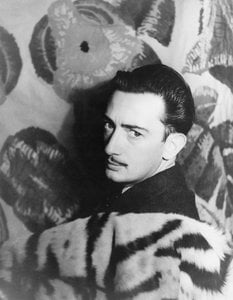
1904 - 1989 , Spain

Embark on a visual journey through the subconscious. Explore the profound symbolism of Surrealist masterpieces, from Dalí's melting clocks to dreamlike landscapes, and learn how to curate these evocative visions into your private art collection with expert guidance.

Master the complexities of Salvador Dalí’s genius. Explore an expert analysis of the Paranoiac-Critical Method and the profound symbolism within his Surrealist masterpieces for the discerning art collector.
 Preview
 Send
Send Share
Share
 Details
 Guide
Guide

 Download
 Similars
 X-Ray
X-Ray Diaporama
 Q&A
Q&A Stats
Stats

 Read More









 Glass option is only available in size under 110 CM