The artwork displayed on this page is protected by copyright law, which means we cannot legally create or sell an identical reproduction. This protection is enforced under international agreements such as the Berne Convention and by national laws, including those outlined by the U.S. Copyright Law - Title 17.
This method fully complies with copyright regulations because it does not involve copying or duplicating the protected artwork. Instead, it is a creative reinterpretation - a new painting that is influenced by the original but not identical to it.
Museum-quality giclée or canvas print with fast production and flexible finish options. ( Buy Hand Made Painting Switch to Digital Image)





























Pick from our preset sizes that match the artwork's original proportions.

Type the width and the height you need, to fit your frame or your wall. A print can only be cut, never made bigger than the picture, so a size with a different shape loses a part of the image. We send you a digital mockup to approve before we print anything. The picture shown on this page does not show the real cut — only the mockup does.
Worldwide Delivery () in 2 weeks instead of standard 4/5 weeks. (24 October)
The Cowboy (Red)
Reproduction Size
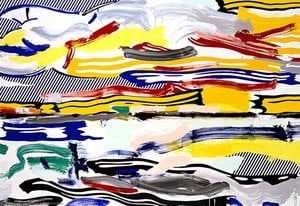
Roy Lichtenstein’s “The Cowboy (Red)” isn't merely a painting; it’s an explosion of color, a deliberate provocation, and a masterful distillation of the Pop Art movement’s core tenets. Completed in 1951, this work immediately establishes Lichtenstein’s signature style – a vibrant collision of comic book aesthetics with a distinctly American subject matter. The image depicts a lone cowboy, rendered in bold black outlines against a field of intense red, holding a gun and a bottle, all framed by the stark geometry of a crimson door. It's a scene both familiar and unsettling, instantly recognizable yet imbued with an underlying tension.
Lichtenstein’s technique is crucial to understanding the painting’s impact. He eschews traditional brushwork in favor of Ben-Day dots – tiny, colored circles meticulously applied to create shading and tonal variations. This method, borrowed from commercial printing processes, lends a mechanical quality to the image, mimicking the look of mass-produced advertisements and comic strips. The red dominates, not just as a background but as an active element, pulsating with energy and demanding attention. It’s a deliberate choice, referencing both the fiery sunsets of the American West and the bold, eye-catching colors favored by advertisers of the era.
Born in Manhattan in 1923, Roy Fox Lichtenstein's artistic journey was shaped by a unique confluence of influences. His early training focused on realistic drawing and painting, reflecting a traditional academic sensibility. However, his exposure to museums – particularly the works of Reginald Marsh, who taught him at the Art Students League – and the vibrant energy of jazz music ignited a desire to break free from conventional artistic boundaries. This period coincided with the rise of Abstract Expressionism, but Lichtenstein quickly recognized the potential of incorporating popular imagery into his work. His upbringing in an upper-middle-class Jewish family fostered both a cultural awareness and an early appreciation for visual culture – a key ingredient in his later exploration of consumerism and mass media.
The central figures—the cowboy and the door—are laden with symbolic weight. The cowboy, a quintessential American archetype, represents rugged individualism, frontier spirit, and often, a romanticized vision of the West. However, Lichtenstein’s depiction is far from sentimental; the gun in his hand suggests danger, violence, and perhaps even a certain isolation. The red door acts as a framing device, simultaneously inviting and rejecting entry – a visual metaphor for the complexities of American identity. The color red itself carries significant connotations: passion, aggression, warning, and the raw energy of the landscape.
Furthermore, “The Cowboy (Red)” emerged during a period of rapid social and cultural change in America. The post-war era witnessed an explosion of consumerism, fueled by mass media and advertising. Lichtenstein’s work directly engages with this phenomenon, using comic book imagery – a product of the same culture – to critique its impact on American values. It's a commentary on how images are consumed and interpreted, raising questions about authenticity and representation.
WahooArt offers meticulously crafted hand-painted reproductions of “The Cowboy (Red)” that capture the essence of Lichtenstein’s original masterpiece. We utilize archival-quality materials and skilled artisans to faithfully recreate the painting's vibrant colors, dynamic composition, and distinctive Ben-Day dot technique. Whether you’re a seasoned art collector or seeking a striking addition to your interior design scheme, our reproduction provides an authentic and engaging representation of this iconic work. Explore the options available on our website – each reproduction is a testament to Lichtenstein’s enduring legacy and a vibrant celebration of American Pop Art.
"The Cowboy (Red)" depicts cowboy, red door, roy lichtenstein, pop art, gun, bandana, 1951, while Roy Lichtenstein's recorded themes are comic book aesthetics, american themes, consumer culture critique, bold visuals, pop art movement, mass media, exploring identity, visual commentary. Comparing the two shows how the work relates to the artist's usual subjects.
To get a digital file of "The Cowboy (Red)" by Roy Lichtenstein, order a high-resolution digital image download on its Digital Image page.
You can order a hand-painted reproduction of "The Cowboy (Red)" by Roy Lichtenstein directly on its Hand-Painted Reproduction page: a hand-painted oil reproduction on linen canvas, made to order.


1923 - 1997 , United States of America

Dive into the vibrant world of Ben-Day dots. Explore how Roy Lichtenstein transformed mass media imagery into high art, redefining modern aesthetics through the iconic textures of Pop Art and its enduring impact on contemporary visual culture.

Explore the industrial artistry of Pop Art. Delve into the sophisticated history of Ben-Day dots and silk screen techniques that transformed mass media into high art, perfect for discerning collectors seeking deep historical insight and aesthetic excellence.

Explore the profound psychological depth of Roy Lichtenstein's color theory. An expert analysis for art collectors on how bold palettes and Ben-Day dots redefine modern aesthetics and luxury interior curation.

Explore the profound impact of the Pop Art Revolution on modern aesthetics. From Lichtenstein’s dots to Warhol’s icons, gain expert insights into how this vibrant movement redefined culture through consumerism and mass media. A definitive guide for art lovers and collectors.

Explore the profound impact of Pop Art on modern aesthetics. From Warhol’s icons to Lichtenstein's bold dots, discover how mass media redefined the masterpiece and continues to inspire sophisticated art collectors and contemporary interior design.

 Preview
 Send
Send Share
Share
 Details
 Guide
Guide

 Download
 Similars
 X-Ray
X-Ray Diaporama
 Stats
Stats

 Read More









 Glass option is only available in size under 110 CM