The artwork displayed on this page is protected by copyright law, which means we cannot legally create or sell an identical reproduction. This protection is enforced under international agreements such as the Berne Convention and by national laws, including those outlined by the U.S. Copyright Law - Title 17.
This method fully complies with copyright regulations because it does not involve copying or duplicating the protected artwork. Instead, it is a creative reinterpretation - a new painting that is influenced by the original but not identical to it.
Museum-quality giclée or canvas print with fast production and flexible finish options. ( Buy Hand Made Painting Switch to Digital Image)





























Pick from our preset sizes that match the artwork's original proportions.

Type the width and the height you need, to fit your frame or your wall. A print can only be cut, never made bigger than the picture, so a size with a different shape loses a part of the image. We send you a digital mockup to approve before we print anything. The picture shown on this page does not show the real cut — only the mockup does.
Worldwide Delivery () in 2 weeks instead of standard 4/5 weeks. (9 November)
Silver Frame
Reproduction Size
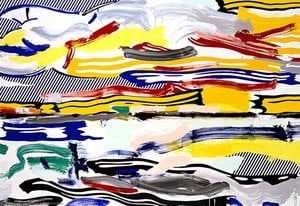
In the mid-1980s, the art world found itself captivated by a resurgence of energy that looked backward to move forward, and at the heart of this movement stood Roy Lichtenstein. His 1984 masterpiece, "Silver Frame," serves as a monumental testament to this era of creative revitalization. Measuring an imposing 60 x 72 inches, the canvas is far more than a mere arrangement of shapes; it is a profound exploration of how modern life, through the lens of mass media and commercial aesthetics, can be elevated to the status of high art. To gaze upon "Silver Frame" is to enter a world where the boundaries between fine art and popular culture dissolve, replaced by a rhythmic dance of color and form that continues to pulse with contemporary relevance.
The brilliance of this work lies in its deceptive simplicity. At first glance, the viewer is met with a striking composition of primary colors—bold reds, sunny yellows, and deep blues—interspersed with unexpected greens and earthy browns. A large, commanding red square anchors the center of the piece, acting as a visual heartbeat that draws the eye inward. Yet, as one lingers, the "frame" of the title reveals itself to be an illusion of depth and layering. Lichtenstein utilizes a sophisticated collage-inspired technique, where the painting mimics the look of a printed montage. This creates a fascinating tension between the flat surface of the canvas and the perceived depth of the overlapping geometric elements, making it a captivating centerpiece for any sophisticated interior.
To understand the emotional resonance of "Silver Frame," one must appreciate the meticulous technical precision Lichtenstein employed. He famously mastered the halftone printing process, a method borrowed from the world of commercial illustration and comic books. By utilizing dots of varying sizes to simulate shading and tonal transitions, he achieved a mottled, textured appearance that feels both mechanical and deeply organic. This technique allows the artist to bridge the gap between the industrial and the hand-painted; while the patterns suggest the cold precision of a printing press, the careful layering of colors and the deliberate placement of rectangles and squares reveal the soulful touch of a master painter.
This interplay of texture provides an incredible sensory experience for the viewer. For collectors and interior designers, this piece offers a unique versatility. The way the light interacts with the perceived "printed" patterns creates a dynamic visual field that changes depending on the room's lighting. It is not a static image but a living composition. The inclusion of smaller, scattered rectangles adds a layer of complexity that rewards repeated viewing, ensuring that the artwork remains a focal point of conversation and inspiration within a gallery, a studio, or a luxury residential space.
Beyond its aesthetic splendor, "Silver Frame" carries the weight of art history. Born in Manhattan and trained at the Art Students League, Lichtenstein spent his career interrogating the icons of his time. In this work, he challenges the traditional notion that art must be a window into a realistic world; instead, he proposes that art can be a construction of symbols, colors, and cultural fragments. The piece embodies the Pop Art philosophy—the idea that beauty can be found in the most commonplace elements of our visual landscape.
For those seeking to bring a piece of this historical revolution into their own collections, a high-quality reproduction of "Silver Frame" offers an unparalleled opportunity. It brings with it the bold spirit of 1984 and the enduring legacy of a man who redefined the visual language of the twentieth century. Whether placed in a minimalist modern setting to provide a burst of chromatic energy or used to anchor a more eclectic, maximalist room, this artwork stands as a timeless symbol of creativity, innovation, and the eternal power of color.
The movement associated with "Silver Frame" by Roy Lichtenstein is Pop Art. This classification situates the work among related artists and artworks.
The dominant hue of "Silver Frame" by Roy Lichtenstein is amber to saffron. The hue is the underlying tone of the palette.
"Silver Frame" was created by Roy Lichtenstein in the Pop Art style. Artist and movement identify the work's tradition.

Manhattan, New York City, October 27, 1923. Roy Lichtenstein enters the world as the son of Milton and Beatrice. The urban energy of the metropolis provides the backdrop for a life that will eventually challenge the boundaries of fine art. He grows up in an upper-middle-class Jewish family, absorbing the cultural rhythms of the city through museums and jazz music.
The trajectory of his career shifts during the mid-twentieth century. He emerges as a leading figure of the Pop Art movement, a period defined by a radical departure from the heavy, emotional brushwork of Abstract Expressionism. Instead of looking inward, he looks outward at the glossy, mechanical surfaces of American mass culture. He finds his subject matter in the most overlooked corners of daily life: the dramatic panels of comic books and the stark, repetitive patterns of commercial advertising.
His work transforms the ephemeral language of print into something monumental. By adopting the visual shorthand of the masses, he forces a confrontation between high-end gallery prestige and the everyday pulse of the street. His presence in the art world is marked by a deliberate detachment, using the very tools of industrial reproduction to redefine what a painting can be.
Manhattan, 1923. The city provides the backdrop for Roy Fox Lichtenstein's arrival into an upper-middle-class Jewish family. His father, Milton, works as a real estate broker, while his mother, Beatrice, a trained pianist, introduces him to the cultural rhythms of New York. These early years are marked by a dual immersion in the visual and the auditory; he spends his childhood exploring museums and attending concerts, developing a deep appreciation for jazz music that persists throughout his life.
The trajectory shifts toward formal discipline in 1939. He enters the Art Students League of New York, placing himself under the instruction of Reginald Marsh. Here, the focus remains on the fundamentals of drawing and painting. He moves from these early explorations toward higher education, enrolling at Ohio State University to pursue a degree in fine arts. This academic foundation provides the technical rigor that will eventually underpin his later, more radical departures from traditional representation.
The trajectory of Lichtenstein's education shifts abruptly in 1943. The draft pulls him from the classroom and into the United States Army. For two years, the focus moves from the studio to the front lines of Europe. He serves in France, Belgium, and Germany, navigating the chaos of the war years between 1943 and 1945. During this period, he works as an orderly, a draftsman, and an artist, sketching the reality of his surroundings while the conflict reaches its peak.
The war ends, but the transition back to civilian life is not immediate. After the cessation of hostilities in 1945, Lichtenstein remains in France for a time, intending to study at the Sorbonne. This plan dissolves when his father becomes gravely ill, forcing a return to the United States. He heads back to Ohio State University to finish what he started. By 1946, he completes his BFA, ready to re-enter the professional art world as a trained practitioner.
The post-war years find Lichtenstein navigating the academic landscape of the American Midwest and East Coast. He serves as an art instructor at Ohio State University, a position he holds on and off for a decade. During this period, his creative output shifts. He moves away from the heavy, emotional brushwork of Abstract Expressionism. Instead, he begins to experiment with Cubist interpretations and lyrical works inspired by the Bayeux Tapestry. He also explores Western themes, producing series of drawings and paintings that reflect a growing interest in stylized, printed imagery.
The transition toward a more graphic language accelerates through his various academic appointments. In 1957, he moves to the State University of New York, Oswego, to teach industrial design. This role coincides with a period of intense experimentation. He begins to combine cartoon characters, such as Mickey Mouse and Donald Duck, with abstract backgrounds. This hybrid approach marks a departure from traditional fine art. He later serves as an assistant professor at Douglass College, Rutgers, State University of New Jersey, and as an assistant professor at SUNY Oswego. These academic environments provide the stability for him to refine a visual language that rejects the texture of traditional painting in favor of something more mechanical and detached.
The canvas becomes a site of mechanical precision. Lichtenstein strips away the visible brushstroke, replacing the artist's hand with the cold, calculated language of mass production. He adopts the aesthetics of comic books and advertising, utilizing bold, primary colors and heavy black outlines to define his subjects. The imagery feels detached, mimicking the flat, impersonal quality of a printed page rather than a hand-painted surface.
Texture is achieved through a deliberate, systematic application of Ben-Day dots. These small, colored circles create shading and gradations, replicating the look of cheap commercial printing. He does not paint these dots individually. Instead, he uses stencils made of thin plastic or metal, sweeping a brush or rag across the surface to ensure a uniform, machine-made appearance. This technique turns the act of painting into a process of reproduction, blurring the line between fine art and industrial output.
The shift toward his signature style arrives in 1961 with Look Mickey. Here, the appropriation of a Disney character marks a departure from his earlier abstract experiments. He moves away from the heavy, emotional brushwork of the previous decade, opting instead for the mechanical clarity of the comic strip. The work functions as a bridge, translating the language of pulp fiction into a formal, large-scale composition.
By 1963, the scale of his visual interrogation expands. Whaam! explodes across the canvas, utilizing the dramatic, fragmented panels of war comics to capture a moment of high-octane violence. Simultaneously, Drowning Girl presents a different kind of tension. It focuses on a woman submerged in water, her face marked by stylized tears and a speech bubble that expresses a sense of personal defiance. These works do not merely depict scenes; they freeze the melodrama of mass media into static, graphic objects.
The 1964 painting Nurse continues this exploration of the romantic and the dramatic. It utilizes the same high-contrast outlines and Ben-Day dots that define his most recognized period. The subject, a nurse from a comic romance novel, is rendered with a detachment that emphasizes the artificiality of the source material. His output during this era remains focused on the intersection of human emotion and industrial reproduction.
The 1960s brought a shift in his personal life when he married Dorothy Herzka in 1968. This period saw him continuing to produce a vast body of work, expanding his reach through various mediums. His output remained prolific, spanning over five thousand works including paintings, sculptures, and murals. He moved beyond the initial shock of his comic-inspired style to explore more complex compositions, including series that referenced classical art and landscapes.
The end came abruptly in the late 1990s. In August 1997, he contracted pneumonia. The illness proved too much for his system. He died from complications of the infection on September 29, 1997. He was 73 years old.
The boundaries between high art and popular culture dissolve in the wake of his influence. By lifting the visual language of comic strips and advertising into the gallery, he forced a confrontation between fine art and the mass-produced imagery of everyday life. This shift did more than change the subject matter of painting; it challenged the very definition of artistic authorship and originality. His work remains a catalyst for critical dialogue regarding the intersection of art, culture, and commerce.
His presence is felt in major museum collections worldwide. From the halls of the Tate in London to the Museum of Modern Art in New York, his aesthetic remains a fundamental part of the modern canon. The impact of his method extends into graphic design, illustration, and contemporary digital art, where the tension between the mechanical and the hand-painted continues to resonate. He did not merely participate in the Pop Art movement; he helped originate it, establishing a visual vocabulary that remains a primary reference point for how we consume images in a media-saturated age.

1923 - 1997 , United States of America

Explore the visceral power of Aggressive Confrontational Pop. From the rebellion of NO!art to Neo-Pop icons, discover how bold aesthetics and social critique redefined modern art for today's discerning collectors.

Explore the profound impact of Pop Art on modern aesthetics. From Warhol’s icons to Lichtenstein's bold dots, discover how mass media redefined the masterpiece and continues to inspire sophisticated art collectors and contemporary interior design.

Explore the profound impact of the Pop Art Revolution on modern aesthetics. From Lichtenstein’s dots to Warhol’s icons, gain expert insights into how this vibrant movement redefined culture through consumerism and mass media. A definitive guide for art lovers and collectors.

Explore the industrial artistry of Pop Art. Delve into the sophisticated history of Ben-Day dots and silk screen techniques that transformed mass media into high art, perfect for discerning collectors seeking deep historical insight and aesthetic excellence.

Explore the profound psychological depth of Roy Lichtenstein's color theory. An expert analysis for art collectors on how bold palettes and Ben-Day dots redefine modern aesthetics and luxury interior curation.
 Preview
 Send
Send Share
Share
 Details
 Guide
Guide

 Download
 Similars
 X-Ray
X-Ray Diaporama
 Q&A
Q&A
 Stats
Stats

 Read More









 Glass option is only available in size under 110 CM