Preview AR preview Buy Hand Made Painting Switch to Digital Image Send
Details Guide Add to favorites Download Similars X-Ray Diaporama Stats

Expressionist Head 3

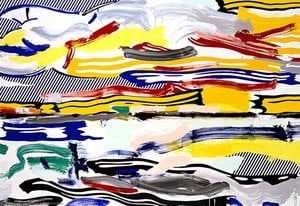
Experience Roy Lichtenstein's 'Expressionist Head 3,' a striking 1980 painting embodying Pop Art’s bold commentary on modern life. Explore the dynamic blues, expressive features, and iconic Ben-Day dots in this captivating reproduction.

Roy Lichtenstein (1923-1997): Pioneering Pop Artist famed for Ben-Day dots, comic strip inspiration & bold commentary on consumer culture. Explore 'Whaam!' & more.

The artwork displayed on this page is protected by copyright law, which means we cannot legally create or sell an identical reproduction. This protection is enforced under international agreements such as the Berne Convention and by national laws, including those outlined by the U.S. Copyright Law - Title 17.

This method fully complies with copyright regulations because it does not involve copying or duplicating the protected artwork. Instead, it is a creative reinterpretation - a new painting that is influenced by the original but not identical to it.

Giclée / Art Print

Museum-quality giclée or canvas print with fast production and flexible finish options. ( Buy Hand Made Painting Switch to Digital Image)

Corner sample of the P118B picture frame: moulded polystyrene, 5 cm wide and 3 cm thick
P118B $10
Corner sample of the P118H picture frame: moulded polystyrene, 5 cm wide and 3 cm thick
P118H $10
Corner sample of the P118W picture frame: moulded polystyrene, 5 cm wide and 3 cm thick
P118W $10
Corner sample of the P438Z picture frame: moulded polystyrene, 5.5 cm wide and 3.5 cm thick
P438Z $10
Corner sample of the P508JH picture frame: moulded polystyrene, 7 cm wide and 3.5 cm thick
P508JH $12
Corner sample of the P508YH picture frame: moulded polystyrene, 7 cm wide and 3.5 cm thick
P508YH $12
Corner sample of the P805H picture frame: moulded polystyrene, 5 cm wide and 3.5 cm thick
P805H $10
Corner sample of the P805Z picture frame: moulded polystyrene, 5 cm wide and 3.5 cm thick
P805Z $10
Corner sample of the P919BZ picture frame: moulded polystyrene, 7 cm wide and 3.5 cm thick
P919BZ $10
Corner sample of the P919G picture frame: moulded polystyrene, 7 cm wide and 3.5 cm thick
P919G $10
Corner sample of the P919XJ picture frame: moulded polystyrene, 7 cm wide and 3.5 cm thick
P919XJ $10
Corner sample of the P959ZH picture frame: moulded polystyrene, 5 cm wide and 3 cm thick
P959ZH $10
Corner sample of the P968JZ picture frame: moulded polystyrene, 6 cm wide and 4 cm thick
P968JZ $12
Corner sample of the W106C picture frame: solid wood, 5 cm wide and 3 cm thick
W106C $8
Corner sample of the W218G picture frame: solid wood, 5 cm wide and 3 cm thick
W218G $10
Corner sample of the W218JH picture frame: solid wood, 5 cm wide and 3 cm thick
W218JH $8
Corner sample of the W218Y picture frame: solid wood, 5 cm wide and 3 cm thick
W218Y $10
Corner sample of the W307PJ picture frame: solid wood, 6 cm wide and 3 cm thick
W307PJ $10
Corner sample of the W316G picture frame: solid wood, 6 cm wide and 3 cm thick
W316G $10
Corner sample of the W316PJ picture frame: solid wood, 6 cm wide and 3 cm thick
W316PJ $8
Corner sample of the W316Y picture frame: solid wood, 6 cm wide and 3 cm thick
W316Y $10
Corner sample of the W398PJ picture frame: solid wood, 5 cm wide and 3 cm thick
W398PJ $8
Corner sample of the W4111J picture frame: solid wood, 6.5 cm wide and 3.5 cm thick
W4111J $10
Corner sample of the W500HY picture frame: solid wood, 7 cm wide and 5 cm thick
W500HY $15
Corner sample of the W500JH picture frame: solid wood, 7 cm wide and 5 cm thick
W500JH $15
Corner sample of the W692G picture frame: solid wood, 8 cm wide and 4 cm thick
W692G $12
Corner sample of the W849H picture frame: solid wood, 5 cm wide and 3 cm thick
W849H $8
Corner sample of the W940BG picture frame: solid wood, 7.5 cm wide and 4.5 cm thick
W940BG $15
Corner sample of the W953PJ picture frame: solid wood, 6 cm wide and 3.5 cm thick
W953PJ $8

Standard
custom
CM
INCH

Pick from our preset sizes that match the artwork's original proportions.

width
height

Type the width and the height you need, to fit your frame or your wall. A print can only be cut, never made bigger than the picture, so a size with a different shape loses a part of the image. We send you a digital mockup to approve before we print anything. The picture shown on this page does not show the real cut — only the mockup does.

Worldwide Delivery () in 2 weeks instead of standard 4/5 weeks. (22 October)

Free Worldwide Express Shipping
High-Quality Linen Canvas
Full Shipping Insurance
Customs Tax Refund Guarantee
True Color Matching Guarantee
100-Day Return Policy (Defects Only)
100% Money-Back Guarantee
Bulk Discount Offer

Total Price

$ 69

Expressionist Head 3

Giclée / Art Print

Reproduction Size

-

Total Price

$ 69

Quick Facts

  • Location: Various collections
  • Artist: Roy Lichtenstein
  • Notable elements: Stripes, Ben-Day dots
  • Year: 1980
  • Influences: German Expressionism

Art Quiz

There is only one correct answer for each question.

Question 1:
What artistic movement is Roy Lichtenstein most closely associated with?
Question 2:
The blue color used in 'Expressionist Head 3' primarily serves to:
Question 3:
The use of Ben-Day dots in 'Expressionist Head 3' is a technique borrowed from:
Question 4:
Based on the description, what is implied about the man's gaze in 'Expressionist Head 3'?
Question 5:
Roy Lichtenstein's work often commented on which aspect of modern society?

The Stark Portrait of a Modern Soul: Roy Lichtenstein’s *Expressionist Head 3*

Roy Lichtenstein's *Expressionist Head 3*, painted in 1980, isn’t merely a depiction of a face; it’s a distilled essence of the anxieties and detachment simmering beneath the surface of American culture during the late 20th century. This striking work, rendered in bold blues and stark contrasts, immediately draws the viewer into an unsettling yet undeniably compelling dialogue with its subject – a man whose gaze is fixed on something unseen, lost to our perspective but profoundly felt within the painting itself. The image, initially appearing simple at first glance, reveals layers of complexity when considered through the lens of Lichtenstein’s signature Pop Art style and his engagement with Expressionist principles.

Lichtenstein, a pivotal figure in the Pop Art movement, deliberately dismantled traditional notions of artistic subject matter. He didn't shy away from the commonplace – advertising, comic books, everyday objects – elevating them to the status of high art. *Expressionist Head 3* exemplifies this strategy. The blue background, devoid of detail, acts as a void, amplifying the intensity of the figure’s features and suggesting an isolation that resonates with the era's growing sense of alienation. The deliberate flatness of the painting, achieved through Lichtenstein’s characteristic use of hard-edged forms and Ben-Day dots – those tiny, colored squares that mimic the printing process – further reinforces this feeling of detachment from reality.

Echoes of Expressionism in a Pop Art Canvas

While firmly rooted in the Pop Art movement, *Expressionist Head 3* reveals a fascinating dialogue with German Expressionism. The angularity of the face, reminiscent of artists like Ernst Ludwig Kirchner and Emil Nolde, hints at an underlying emotional turmoil. However, Lichtenstein cleverly subverts this influence by replacing the expressive brushstrokes and vibrant colors typically associated with Expressionism with his signature Ben-Day dots. This strategic shift creates a visual tension – a sense of both familiarity and deliberate disruption. The use of stripes, initially employed as a more efficient method for creating linear forms in his sculptures, adds another layer to this interplay, emphasizing the painting’s two-dimensional nature despite its evocative imagery.

The choice of blue is particularly significant. Blue often represents melancholy, introspection, and even isolation – emotions that seem perfectly aligned with the figure's enigmatic expression. The blue nose and mouth contribute to a sense of emotional distance, suggesting a deliberate suppression or perhaps an inability to articulate inner feelings. It’s as if the subject has retreated into himself, shielded from the world by a carefully constructed facade.

Decoding the Symbolism: Consumer Culture and the Disengaged Observer

Produced in 1980, *Expressionist Head 3* speaks powerfully to the cultural landscape of that year. Lichtenstein’s work frequently engaged with themes of consumer culture and mass production – concepts increasingly prevalent during this period. The painting can be interpreted as a commentary on the detachment fostered by these forces, portraying an individual seemingly oblivious to the surrounding world, lost in his own internal thoughts. The figure's averted gaze suggests a lack of engagement, mirroring a broader societal trend towards passive observation rather than active participation.

Furthermore, the painting’s stark simplicity and reliance on visual techniques borrowed from advertising – the Ben-Day dots, the bold color palette – directly reference the pervasive influence of commercial imagery in American life. Lichtenstein wasn't simply replicating these images; he was deconstructing them, exposing their underlying emotional impact and questioning their role in shaping our perceptions.

Reproductions of *Expressionist Head 3* offer a unique opportunity to bring this complex and thought-provoking artwork into your home or office. WahooArt’s hand-painted reproductions capture the essence of Lichtenstein's style with meticulous detail, ensuring that you experience the full impact of this iconic piece.

Questions & Answers

What orientation does "Expressionist Head 3" by Roy Lichtenstein have?

The format of "Expressionist Head 3" is portrait. This is useful when planning where a reproduction will be placed.

How saturated is the palette of "Expressionist Head 3"?

"Expressionist Head 3" by Roy Lichtenstein is recorded with a balanced soft saturation.

What explains the copyright situation of "Expressionist Head 3" by Roy Lichtenstein?

The copyright status of "Expressionist Head 3" - still protected by copyright - follows from the artist's death in 1997.


Artist Biography

The Genesis of a Pop Visionary

Roy Fox Lichtenstein, born in the vibrant metropolis of New York City on October 27, 1923, indelibly altered the landscape of twentieth-century art. Emerging as a pivotal figure within the Pop Art movement, Lichtenstein didn’t simply reflect his era; he actively interrogated it, transforming commonplace imagery into compelling artistic statements. His upbringing in an upper-middle-class Jewish family fostered both a cultural awareness and an early artistic inclination. Childhood exposure to museums and concerts, coupled with a deep appreciation for jazz music, laid the groundwork for a creative spirit that would challenge conventional notions of fine art. Though initially drawn to realistic drawing and painting during his formative years, Lichtenstein’s formal training commenced at the Art Students League in 1939 under Reginald Marsh, followed by studies at Ohio State University – interrupted briefly by wartime service in the Army. These experiences provided a robust technical foundation that would later be brilliantly re-contextualized through the lens of mass culture and commercial aesthetics. The seeds of his signature style weren’t sown within the hallowed halls of artistic tradition but rather in the often-overlooked world of everyday imagery, particularly comic books and advertising.

From Abstraction to Appropriation: A Pivotal Shift

Lichtenstein's early work demonstrated a clear engagement with Abstract Expressionism, mirroring the dominant aesthetic trends of the post-war period. However, this phase proved transitional, a stepping stone towards his revolutionary style. A crucial moment arrived during his tenure at Rutgers University where he encountered Allan Kaprow, whose influence reignited Lichtenstein’s interest in proto-pop imagery. This encounter sparked a critical shift in his artistic trajectory, leading him to question the established boundaries between “high” and “low” art. He began looking beyond the subjective expression of Abstract Expressionism towards the objective language of popular culture – specifically, comic books and advertising. The year 1961 marked a turning point with *Look Mickey*, a work that boldly appropriated characters from Disney comics, signaling the beginning of his signature style. This wasn’t mere imitation; it was an act of artistic re-evaluation, elevating commonplace imagery to the status of fine art. He didn't simply copy comic strips; he meticulously recreated them using techniques mimicking commercial printing processes, a deliberate blurring of the lines between original artwork and mass production. This appropriation wasn’t about celebrating consumerism uncritically but rather examining its pervasive influence on American society and challenging traditional artistic hierarchies.

The Language of Ben-Day Dots and Bold Lines

Lichtenstein's artistic vocabulary is instantly recognizable: bold, primary colors, thick black outlines, and most famously, Ben-Day dots – a technique borrowed directly from the mechanical reproduction of comic books. These dots weren’t merely decorative; they were integral to his conceptual framework, representing the very process of mass production and challenging the traditional emphasis on the artist's hand. His paintings often enlarged details from comic strips to monumental scale, forcing viewers to confront the aesthetic qualities of an art form typically dismissed as trivial. Works like *Whaam!* (1963), *Drowning Girl* (1963), and *Oh, Jeff…I Love You, Too…But…* (1964) became iconic representations of Pop Art, capturing the anxieties and desires of a rapidly changing consumer culture. These weren’t simply depictions of comic book scenes; they were commentaries on themes of war, romance, and societal expectations, filtered through the visual language of mass media. He aimed to strip away any pretense of artistic subjectivity, presenting his work as objective reflections of American society – a mirror held up to its own manufactured reality. The deliberate flatness and lack of painterly gesture further emphasized this detachment, mimicking the impersonal nature of commercial printing.

Legacy and Lasting Impact

Roy Lichtenstein’s influence extends far beyond the realm of painting. His innovative use of commercial techniques and appropriation paved the way for new generations of artists exploring themes of consumerism, media saturation, and cultural identity. The sale of *Masterpiece* in 2017 for $165 million solidified his position as one of the most commercially successful American artists of all time, but his legacy is not solely defined by monetary value. He challenged traditional notions of artistic authorship and originality, forcing a re-evaluation of what constitutes “art” itself. His work continues to inspire graphic designers, illustrators, and visual artists across various disciplines.
  • Major Achievements: Pioneered Pop Art style; achieved international recognition with groundbreaking exhibitions.
  • Notable Works: *Whaam!*, *Drowning Girl*, *Oh, Jeff…I Love You, Too…But…*, *Masterpiece*.
  • Teaching Career: Influenced aspiring artists at SUNY Oswego and Rutgers University.
Lichtenstein passed away on September 29, 1997, leaving behind a body of work that remains as relevant and provocative today as it was during the height of the Pop Art movement. His art serves as a powerful reminder of the pervasive influence of mass media and its ability to shape our perceptions of reality. He didn’t just reflect his time; he actively interrogated it, leaving an indelible mark on the history of 20th-century art and continuing to inspire critical dialogue about the relationship between art, culture, and commerce. His legacy is a testament to the power of appropriation, the beauty of the commonplace, and the enduring impact of a truly visionary artist.
Roy Lichtenstein

Roy Lichtenstein

1923 - 1997 , United States of America

Quick Facts

  • Artistic Movement Or Style: Pop Art
  • Artists Or Movements Influenced By This Artist:
    • Pop Art
    • Graphic designers
    • Illustrators
  • Artists Who Influenced This Artist:
    • Reginald Marsh
    • Allan Kaprow
    • Picasso
    • Monet
    • Matisse
  • Full Name: Roy Fox Lichtenstein
  • Nationality: American
  • Notable Artworks:
    • Whaam!
    • Drowning Girl
    • Oh, Jeff…I Love You, Too…But…
    • Masterpiece
    • Look Mickey
  • Place Of Birth: Manhattan, United States of America
  • Date Of Birth: 1923
  • Date Of Death: 1997
Explore artworks organized by themes, styles, and characteristics.