The artwork displayed on this page is protected by copyright law, which means we cannot legally create or sell an identical reproduction. This protection is enforced under international agreements such as the Berne Convention and by national laws, including those outlined by the U.S. Copyright Law - Title 17.
As a respectful and legal alternative, we offer custom, hand-painted artworks inspired by the original. Our skilled and professional artists carefully study the original's style, mood, and artistic essence to create a new, unique piece that evokes the same feeling - while remaining an original creation in its own right.
This method fully complies with copyright regulations because it does not involve copying or duplicating the protected artwork. Instead, it is a creative reinterpretation - a new painting that is influenced by the original but not identical to it.
Hand-painted oil on canvas in your size and frame, made to order by our artists. ( Switch to Print Switch to Digital Image)





























Pick from our preset sizes that match the artwork's original proportions.

Type the width and the height you need, to fit your frame or your wall. This is hand-painted, so for a size with a different shape the artist can paint a bit more around the picture, or cut a bit — you choose. We send you a digital mockup to approve before the painting starts. The picture shown on this page does not show the real result — only the mockup does.
Worldwide Delivery () in 3/4 weeks instead of standard 5 weeks. (19 October). No compromise on quality.
Brattata
Reproduction Size
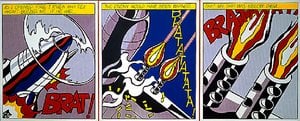
Roy Lichtenstein’s “Brattata,” completed in 1962, stands as a quintessential example of Pop Art's fascination with comic book aesthetics and its deliberate rejection of traditional artistic conventions. More than just a visual representation, it encapsulates the anxieties and aspirations surrounding American military preparedness during the Cold War era – specifically, the rigorous training undertaken by fighter pilots preparing for aerial combat.
The artwork’s genesis lies in DC Comics' “All-American Men of War” #89, published in January–February 1962. Lichtenstein meticulously adapted a panel from this publication, transforming it into a dynamic and emotionally charged composition that prioritizes clarity of form over realistic depiction. The central figure—a pilot wearing a black mask—fires arrows with forceful precision against a stark white background punctuated by bold black outlines.
Lichtenstein’s signature technique – the use of Ben-Day dots – dominates the visual landscape. These multicolored halftone dots create an illusion of texture and shading, mimicking the printing process employed in comic books. This deliberate stylistic choice wasn't merely decorative; it served to heighten the sense of immediacy and excitement associated with wartime action. Geometric shapes—circles, rectangles, and triangles—are strategically deployed to define the pilot’s features and arrows, reinforcing the artwork’s simplified perspective.
The artist skillfully captures the tension inherent in combat scenarios. The mask symbolizes anonymity or menace, while the mechanical devices subtly hint at a technologically driven environment – perhaps reflecting anxieties about Soviet military advancements during the period. Lichtenstein's meticulous attention to detail—particularly in rendering skin tones and shadows—adds a palpable sense of realism despite the stylized approach.
“Brattata” transcends its immediate visual narrative, delving into deeper symbolic layers. The artwork speaks to themes of courage, determination, and the psychological pressures faced by military personnel. Lichtenstein’s masterful use of color—primarily black, white, and red—creates a dramatic contrast that amplifies the emotional impact of the scene.
Furthermore, the composition mirrors the training exercises undertaken by WWII pilots – focusing on visual acuity and rapid reaction time. The artist's deliberate simplification of perspective underscores the importance of conveying essential information effectively. As Russ Heath accurately depicted, Lichtenstein meticulously reproduced the gun sight and cockpit control panel, mirroring the tools used by fighter pilots during combat.
“Brattata” cemented Lichtenstein’s position as a pioneer of Pop Art, demonstrating how commonplace imagery could be elevated to artistic expression. Its enduring appeal lies in its ability to capture both the excitement of wartime action and the broader anxieties surrounding Cold War geopolitics—a testament to Lichtenstein's astute observation of his time and his transformative approach to painting.
"Brattata" by Roy Lichtenstein can be downloaded from the artwork's Download page, as a high-resolution digital image download.
The art-historical classification of "Brattata" by Roy Lichtenstein is Pop Art, in the Modern period.
"Brattata" was created by Roy Lichtenstein in 1962.


1923 - 1997 , United States of America

Explore the industrial artistry of Pop Art. Delve into the sophisticated history of Ben-Day dots and silk screen techniques that transformed mass media into high art, perfect for discerning collectors seeking deep historical insight and aesthetic excellence.

Explore the profound impact of Pop Art on modern aesthetics. From Warhol’s icons to Lichtenstein's bold dots, discover how mass media redefined the masterpiece and continues to inspire sophisticated art collectors and contemporary interior design.

Explore the profound psychological depth of Roy Lichtenstein's color theory. An expert analysis for art collectors on how bold palettes and Ben-Day dots redefine modern aesthetics and luxury interior curation.

Dive into the vibrant world of Ben-Day dots. Explore how Roy Lichtenstein transformed mass media imagery into high art, redefining modern aesthetics through the iconic textures of Pop Art and its enduring impact on contemporary visual culture.

Explore the profound impact of the Pop Art Revolution on modern aesthetics. From Lichtenstein’s dots to Warhol’s icons, gain expert insights into how this vibrant movement redefined culture through consumerism and mass media. A definitive guide for art lovers and collectors.

 Preview
 Send
Send Share
Share
 Details
 Guide
Guide

 Download
 Similars
 X-Ray
X-Ray Diaporama
 Stats
Stats

 Read More









 Glass option is only available in size under 110 CM