

 Cubism
 55.0 x 102.0 cm
The artwork displayed on this page is protected by copyright law, which means we cannot legally create or sell an identical reproduction. This protection is enforced under international agreements such as the Berne Convention and by national laws, including those outlined by the U.S. Copyright Law - Title 17.
This method fully complies with copyright regulations because it does not involve copying or duplicating the protected artwork. Instead, it is a creative reinterpretation - a new painting that is influenced by the original but not identical to it.
Museum-quality giclée or canvas print with fast production and flexible finish options. ( Buy Hand Made Painting Switch to Digital Image)
Pick from our preset sizes that match the artwork's original proportions.

Type the width and the height you need, to fit your frame or your wall. A print can only be cut, never made bigger than the picture, so a size with a different shape loses a part of the image. We send you a digital mockup to approve before we print anything. The picture shown on this page does not show the real cut — only the mockup does.
Worldwide Delivery () in 2 weeks instead of standard 4/5 weeks. (27 October)
Looking from Snowdon
Reproduction Size

Born in Abertillery, South Wales, in 1942, Roger Cecil’s artistic journey was inextricably linked to the rugged beauty and industrial heritage of his birthplace. His early life, marked by a close relationship with his mother and a quiet, introspective nature, profoundly shaped his artistic sensibility. Unlike many artists who seek inspiration in grand landscapes or classical themes, Cecil found his muse within the gritty reality of the valleys he called home – the scarred earth, the towering slag heaps, and the weathered faces of the men who toiled within them. This intimate connection with a landscape often overlooked fueled a uniquely powerful and deeply personal body of work.
Cecil’s formal artistic training began at Newport College of Art in 1959, where he honed his skills under the guidance of influential instructors like John Wright and Thomas Rathmell. He quickly demonstrated an aptitude for draughtsmanship and a willingness to experiment with materials, traits that would become hallmarks of his distinctive style. However, a pivotal moment arrived when he was offered a place at the Royal College of Art in London. While initially excited by the prospect, Cecil soon found himself disillusioned with the academic environment and the prevailing artistic trends. Rejecting the pressures of conformity, he returned to Abertillery, choosing instead to pursue his own path, working as a manual laborer – mining and construction – alongside his art practice. This dual existence, seamlessly blending physical labor with creative exploration, proved crucial to the development of his unique visual language.
Cecil's artistic process was characterized by a deliberate rejection of traditional painting techniques and a fascination with the textures and materials available in his immediate surroundings. He eschewed pristine canvases and elaborate brushstrokes, instead embracing a raw, almost brutal approach. His works frequently incorporated everyday materials – sandpaper, primer, Polyfilla, grit, and even coal dust – transforming them into layers of texture and surface. This wasn’t simply about adding visual interest; it was a deliberate attempt to capture the essence of his subject matter—the scars and imperfections of the industrial landscape.
He employed techniques such as rubbing, scraping, burnishing, and scratching to reveal underlying layers and create dynamic surfaces. His palette was predominantly dark – ochres, browns, grays, and blacks – mirroring the muted tones of his surroundings. Yet, within these somber hues, he skillfully introduced flashes of color—often achieved through the use of red oxide or other industrial pigments—to draw attention to specific details and imbue his paintings with a sense of drama and intensity. As critic Sarah Bradford noted, “He is very matter-of-fact about procedure and materials. To him painting is a very practical thing. The making is important.”
Cecil’s paintings are often described as dreamlike landscapes infused with spiritual and psychological depth. While he resisted easy categorization, his work frequently explores themes of isolation, memory, and the relationship between humanity and the natural world. The recurring motif of the triangle—representing land or a piece of ground—and the cross—a symbol of remembrance—are prominent features in many of his compositions. These symbols, combined with fragmented forms and ambiguous narratives, invite viewers to engage in a deeply personal interpretation of the work.
His most celebrated painting, “Shaman Secret,” exemplifies this approach. The image is dominated by a dark, almost impenetrable landscape punctuated by stark geometric shapes—a solitary figure standing before a vast expanse of earth. The painting’s power lies not in its literal depiction but in its evocation of a profound sense of mystery and the unknown. It's been suggested that Cecil was influenced by shamanic traditions, drawing on his own experiences and intuition to create works that resonate with primal imagery and spiritual symbolism.
Despite initially shunning the art world, Roger Cecil’s work gradually gained recognition throughout the 1980s and 1990s. He exhibited at Business Art Galleries in Newport and Abergavenny, receiving critical acclaim for his unique vision and technical skill. In 1995, a retrospective exhibition at the Hill Court Gallery in Abertillery provided a comprehensive overview of his career to date. Cecil’s work continues to be studied and appreciated for its raw emotional power, its innovative use of materials, and its profound engagement with the landscape of South Wales.
Cecil's life was marked by both artistic achievement and personal struggles. He suffered from dementia in his later years, ultimately passing away in February 2015 at the age of 72. His legacy endures as a testament to the power of art to transform ordinary experiences into extraordinary expressions of vision and emotion—a reminder that beauty can be found even in the most unexpected places.

1942 - 2015

Explore the profound emotional depth of Lyrical Abstraction. Discover how masters like Raymond Parker used color and form to bridge Impressionism and Abstract Expressionism. Learn about this pivotal movement through our expert-led art history guide.

Discover the profound intersection of geometry and emotion in Cubist Expressionism. Explore art history through our expert analysis of modern masters and find museum-quality, hand-painted oil reproductions of iconic masterpieces for your collection.

Explore 10 defining Abstract Expressionism masterpieces by Pollock, Rothko & de Kooning. Discover the stories behind these iconic paintings and find museum-quality art reproductions to elevate your home decor on .

Journey through Wassily Kandinsky's 25 most iconic abstract paintings. Explore his revolutionary use of color, form & spiritual expressionism. Find museum-quality Kandinsky reproductions and elevate your home decor with WahooArt.com. Discover all masterpieces on WahooArt.com!
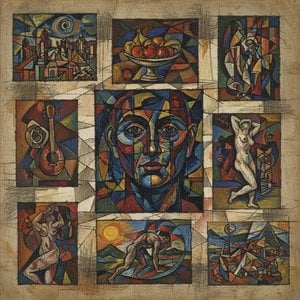
Explore 10 defining Cubist Expressionism masterpieces by Picasso, Braque & more. Discover the stories behind these bold, geometric paintings and bring museum-quality art to your home with WahooArt.com. Explore the full collection online.

 Preview
 Send
Send Share
Share
 Details
 Guide
Guide

 Download
 Similars
 X-Ray
X-Ray Diaporama
 Stats
Stats Read More






































 Glass option is only available in size under 110 CM


![Abstract Composition [triptych] — Vaclav Vytlacil, Abstract Expressionism](/media/artworks/images-thumb/08/3c/083c0675045645fd42d4e6c6d63f1ced.jpg)


