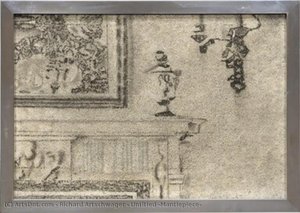
The Architect of Ambiguity: The Life and Legacy of Richard Artschwager
Richard Ernst Artschwager was an artist who refused to be pinned down, a master of the "categorical confusion" that defined his extraordinary career. Born in Washington, D.C., in 1923, his early life was shaped by a profound duality: the scientific rigor of his father, a Prussian botanist, and the creative spirit of his mother, an amateur artist. This tension between the empirical and the aesthetic would later become the heartbeat of his work. After moving to the arid landscapes of New and developing a keen eye for detail, Artschwager’s path was interrupted by the Second World War. His service in Europe, which included navigating the complex diplomatic aftermath of combat, instilled in him an intellectual curiosity and a fascination with how we interpret the world around us—a theme that would eventually permeate every sculpture and painting he created.
Following the war, Artschwager pursued studies in chemistry and mathematics at Cornell University before finding his true calling under the tutelage of the Purist painter Amédée Ozenfant. This academic foundation in science and abstraction provided him with a unique lens through which to view art. He did not merely see objects; he saw structures, surfaces, and the deceptive nature of perception. Before fully committing to the fine arts, he worked as an independent cabinetmaker, a period that proved instrumental to his later success. This trade gave him a tactile intimacy with industrial materials and a deep understanding of the "furniture" that populates our daily lives, allowing him to later transform the mundane into the monumental.
The Alchemy of the Everyday: Materials and Method
Artschwager’s brilliance lay in his ability to take the most unremarkable, utilitarian materials and imbue them with a sense of the uncanny. He was a pioneer in using substances that were previously considered beneath the dignity of high art, such as
Formica,
Celotex wood fiberboard, rubberized horse hair, and even sandpaper. By utilizing these "kitsch" veneers, he bridged the gap between the glossy, commercial language of Pop Art and the austere, geometric presence of Minimalism. His work often functioned as a series of stylistic hybrids; a sculpture might appear to be a simple piece of furniture, yet upon closer inspection, it revealed itself to be a complex exploration of texture and illusion.
His technical approach was characterized by a "deadpan wit," a subtle humor that invited the viewer to question their own visual certainties. In his famous "blps" series, he took the flat, linguistic symbols of punctuation marks and uprooted them from the page, rendering them as three-dimensional, often gaudy objects. This process of making the abstract physical—and the familiar alien—was his signature move. Whether it was a "multi-picture" that blurred the line between painting and sculpture or a wall object that mimicked the grain of walnut through a sheet of laminate, Artschwager excelled at creating a sense of pictorial illusionism that was both intellectually stimulating and visually arresting.
A Lasting Impression on Contemporary Art
The historical significance of Richard Artschwager cannot be overstated. He occupied a singular space in the American art scene for over five decades, acting as a bridge between several major movements. While his work is frequently associated with
Pop Art,
Minimalism, and
Conceptualism, he resisted being categorized by any single one of them. Instead, he used the tools of each to challenge the very boundaries of what an artwork could be. He forced the viewer to confront the structures of perception, highlighting the ways in which we inhabit space and how the objects within that space shape our reality.
His legacy is found in the way he transformed the gallery space itself, treating walls, floors, and ceilings not just as containers for art, but as active participants in the sculptural experience. Even in his final years, Artschwager continued to evolve, moving toward works that engaged with the political zeitgeist through a lens of popular culture. He left behind a body of work that remains as enigmatic and provocative today as it was during its creation—a testament to an artist who spent his life proving that there is profound mystery to be found in the most ordinary of things.
- Key Movements: Pop Art, Minimalism, Conceptualism
- Signature Materials: Formica, Celotex, Acrylic bristles, Sandpaper
- Core Themes: Perception, Language, The Mundane vs. The Monumental, Categorical Confusion



 Preview
 Buy Hand Made Painting
 Send
Send Share
Share
 Details

 Download
 Similars
 X-Ray
X-Ray Diaporama

 Read More






































 Glass option is only available in size under 110 CM