

 PaintingExpressionism
 Modern
 5.0 x 79.0 cm
 Musée des Cultures Taurines
Hand-painted oil on canvas in your size and frame, made to order by our artists. ( Switch to Print Switch to Digital Image)





























Pick from our preset sizes that match the artwork's original proportions.

You may enter your own dimensions to fit a specific frame or space. If your selected size does not match the original image's proportions, we will either crop the artwork or extend the painting with additional hand-painted elements. A digital mockup will be sent for your approval before production begins.
Please note that the on-screen preview does not reflect the actual cropping or extension. Only the mockup will accurately show the final composition.
While custom sizes are available, we recommend selecting a dimension from the predefined list to preserve the original proportions.
Worldwide Delivery () in 3/4 weeks instead of standard 5 weeks. (24 September). No compromise on quality.


Scène de raset
Reproduction Size
In the heart of the bullring, where life and death dance on the edge of a blade, René Georges Hermann-Paul captures a singular, breathless moment in Scène de raset. This evocative work transcends mere documentation of a spectacle; it is an immersive descent into the raw tension of the bullfight. The composition centers on the visceral confrontation between the matador and the charging bull, a struggle rendered with such kinetic energy that the viewer can almost hear the heavy breathing of the beast and the rustle of the cloth. Clad in traditional white attire accented by a striking red sash, the matador stands as a pillar of focused intensity. His posture is a masterclass in controlled readiness, poised between the grace of the dance and the lethal necessity of the strike. Opposite him, the bull emerges from the shadows, a powerful force of nature depicted with taut muscles and pointed horns that direct the eye straight toward the center of the conflict.
The painting’s atmosphere is heightened by a surreal, almost dreamlike backdrop. A sweeping blue arch or wave dominates the upper portion of the canvas, acting as a metaphorical barrier that separates the earthly struggle from the infinite. This abstract element lends the piece an expressionist quality, moving away from strict realism to embrace a more profound emotional truth. The deep, nocturnal blues provide a stark, dramatic contrast to the bright whites and blood-red accents of the matador’s costume, creating a visual rhythm that mirrors the heartbeat of the spectator. It is this interplay of light and shadow, of solid form and fluid abstraction, that elevates the work from a genre scene to a profound meditation on courage and fate.
To understand the soul of Scène de raset, one must look to the hands of its creator, René Georges Hermann-Paul. A master of line and emotion, Hermann-Paul’s journey through the French art world was marked by a unique ability to blend social satire with deep, atmospheric painting. While he first gained renown as a sharp-witted illustrator for iconic Parisian periodicals like Le Rire—where his caricatures poked fun at the foibles of the bourgeoisie—his later works moved toward the more primal and elemental. His connection to the landscapes of the Camargue and the intense traditions of Southern France allowed him to explore themes of power, nature, and human bravery with unparalleled authenticity.
The technique employed in this piece reflects a sophisticated use of bold brushstrokes and a saturated palette, reminiscent of the expressive movements that flourished during his era. There is no room for unnecessary detail here; instead, every stroke serves to emphasize the emotional weight of the scene. For the discerning collector or interior designer, this painting offers more than just aesthetic beauty; it provides a focal point of profound narrative depth. Whether placed in a contemporary gallery setting or a classic study, Scène de raset commands attention, inviting viewers to contemplate the eternal struggle between human will and the untamed forces of the world.

Born in Paris in 1864, René Georges Hermann-Paul emerged as a significant figure in the French art scene during a period of rapid social and artistic change. He passed away in Saintes-Maries-de-la-Mer in 1940. From an early age, he demonstrated a keen eye for observation and a talent for capturing the nuances of Parisian life.
Hermann-Paul initially gained recognition as a prolific illustrator. His work appeared in numerous newspapers and periodicals such as La Faridondaine, Le Courrier Français, and Le Rire. He quickly became known for his sharp wit and satirical depictions of French society. His early illustrations often targeted the bourgeoisie, exposing their foibles and hypocrisies with simple yet effective caricatures.
As Hermann-Paul transitioned from illustration to fine art, his style evolved. He experimented with various mediums including Ripolin enamel paint, watercolors, woodcuts, lithographs, drypoint engraving, oils, and ink. His artistic development was influenced by the prevailing movements of the time, including Art Nouveau and Intimism.
Around the eve of World War I, Hermann-Paul made a notable impression with his use of Ripolin enamel paint – a relatively new medium at the time. As noted by The Burlington Magazine for Connoisseurs, his exhibition pieces were remarkable for this innovative approach, combining large splashes of color with fine black lines.
The outbreak of World War I profoundly impacted Hermann-Paul’s work. He documented both the tragedy and the absurdities of war through his art. After the war, he underwent further stylistic changes, eventually focusing on depictions of the Camargue region in southern France.
Hermann-Paul’s major achievements lie in his ability to blend social commentary with artistic innovation. He was a staunch defender of Captain Alfred Dreyfus, using his art as a platform for political activism. His work provides valuable insights into French society during a turbulent period.
Recent efforts to catalog Hermann-Paul’s work have revealed an artist of considerable scope and depth. While not as widely recognized as some of his contemporaries, he remains a significant figure in French art history, offering a unique perspective on the social and political landscape of his time.

1864 - 1940 , France

Delve into the visceral world of German Expressionism. Explore the history, key artists like Kirchner and Kandinsky, and the movement's profound emotional impact through an expert art-history lens. Discover how bold colors and distortion redefined modern aesthetics.

Discover the profound power of Expressionist art. From the raw intensity of Edvard Munch to the visceral textures of Neo-Expressionism, explore how subjective emotion and distorted reality define this movement. An expert guide for discerning collectors seeking depth and soul in fine art.

Explore the profound emotional depth of Expressionist painting. From the bold colors of Emil Nolde to the distorted forms of Kirchner, discover how this movement redefined art through raw feeling and visceral texture in our expert guide to art history.
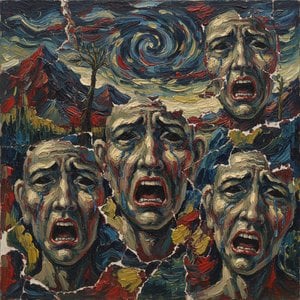
Explore the profound psychological depth of Expressionist art. From Munch to Van Gogh, discover how distorted forms and bold colors convey raw human emotion through our expert guide on this transformative movement.

Explore the profound psychological depth of Expressionist portraiture. From Munch to Schiele, discover how distorted forms and visceral brushstrokes unmask raw human emotion in this definitive guide for art enthusiasts and collectors.

 Preview
 Send
Send Share
Share
 Details
 Guide
Guide

 Download
 Similars
 X-Ray
X-Ray Diaporama
 Stats
Stats Read More







 Glass option is only available in size under 110 CM


